 Add to Chrome
 Add to Firefox
 Add to Edge
CUROCKET: Optimizing ROCKET for GPU
Jan 23, 2026
ROCKET (RandOm Convolutional KErnel Transform) is a feature extraction algorithm created for Time Series Classification (TSC), published in 2019. It applies convolution with randomly generated kernels on a time series, producing features that can be used to train a linear classifier or regressor like Ridge. At the time of publication, ROCKET was on par with the best state-of-the-art algorithms for TSC in terms of accuracy while being significantly less computationally expensive, making ROCKET a compelling algorithm for TSC. This also led to several subsequent versions, further improving accuracy and computational efficiency. The currently available ROCKET implementations are mostly bound to execution on CPU. However, convolution is a task that can be highly parallelized and is therefore suited to be executed on GPU, which speeds up the computation significantly. A key difficulty arises from the inhomogeneous kernels ROCKET uses, making standard methods for applying convolution on GPU inefficient. In this work, we propose an algorithm that is able to efficiently perform ROCKET on GPU and achieves up to 11 times higher computational efficiency per watt than ROCKET on CPU. The code for CUROCKET is available in this repository https://github.com/oleeven/CUROCKET on github.

Industrial Language-Image Dataset (ILID): Adapting Vision Foundation Models for Industrial Settings
Jun 14, 2024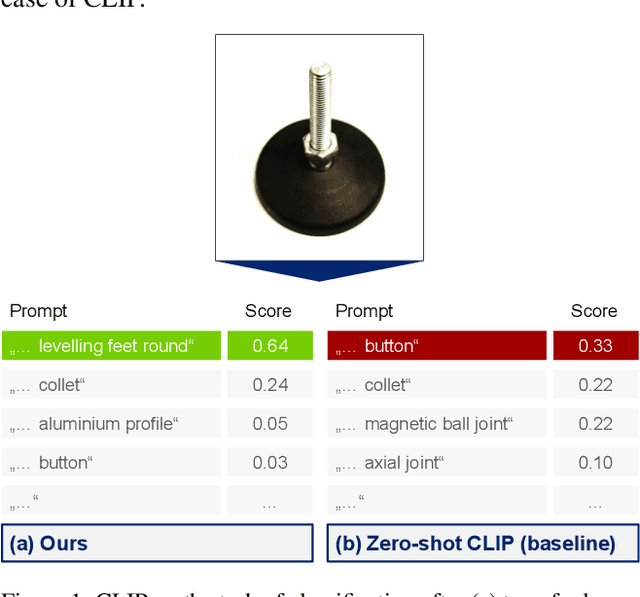

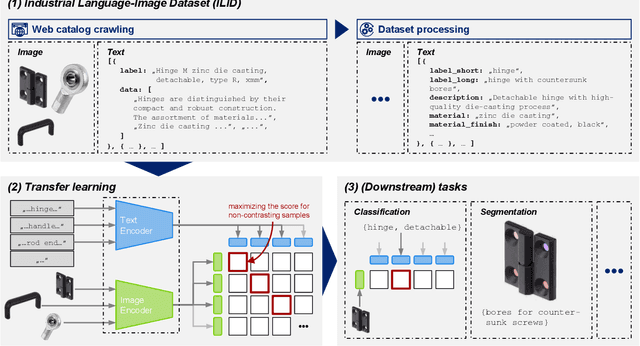
In recent years, the upstream of Large Language Models (LLM) has also encouraged the computer vision community to work on substantial multimodal datasets and train models on a scale in a self-/semi-supervised manner, resulting in Vision Foundation Models (VFM), as, e.g., Contrastive Language-Image Pre-training (CLIP). The models generalize well and perform outstandingly on everyday objects or scenes, even on downstream tasks, tasks the model has not been trained on, while the application in specialized domains, as in an industrial context, is still an open research question. Here, fine-tuning the models or transfer learning on domain-specific data is unavoidable when objecting to adequate performance. In this work, we, on the one hand, introduce a pipeline to generate the Industrial Language-Image Dataset (ILID) based on web-crawled data; on the other hand, we demonstrate effective self-supervised transfer learning and discussing downstream tasks after training on the cheaply acquired ILID, which does not necessitate human labeling or intervention. With the proposed approach, we contribute by transferring approaches from state-of-the-art research around foundation models, transfer learning strategies, and applications to the industrial domain.
Industrial Segment Anything -- a Case Study in Aircraft Manufacturing, Intralogistics, Maintenance, Repair, and Overhaul
Jul 24, 2023Deploying deep learning-based applications in specialized domains like the aircraft production industry typically suffers from the training data availability problem. Only a few datasets represent non-everyday objects, situations, and tasks. Recent advantages in research around Vision Foundation Models (VFM) opened a new area of tasks and models with high generalization capabilities in non-semantic and semantic predictions. As recently demonstrated by the Segment Anything Project, exploiting VFM's zero-shot capabilities is a promising direction in tackling the boundaries spanned by data, context, and sensor variety. Although, investigating its application within specific domains is subject to ongoing research. This paper contributes here by surveying applications of the SAM in aircraft production-specific use cases. We include manufacturing, intralogistics, as well as maintenance, repair, and overhaul processes, also representing a variety of other neighboring industrial domains. Besides presenting the various use cases, we further discuss the injection of domain knowledge.