 Add to Chrome
 Add to Firefox
 Add to Edge
Active Inference-Driven World Modeling for Adaptive UAV Swarm Trajectory Design
Jan 19, 2026
This paper proposes an Active Inference-based framework for autonomous trajectory design in UAV swarms. The method integrates probabilistic reasoning and self-learning to enable distributed mission allocation, route ordering, and motion planning. Expert trajectories generated using a Genetic Algorithm with Repulsion Forces (GA-RF) are employed to train a hierarchical World Model capturing swarm behavior across mission, route, and motion levels. During online operation, UAVs infer actions by minimizing divergence between current beliefs and model-predicted states, enabling adaptive responses to dynamic environments. Simulation results show faster convergence, higher stability, and safer navigation than Q-Learning, demonstrating the scalability and cognitive grounding of the proposed framework for intelligent UAV swarm control.

AINS: Affordable Indoor Navigation Solution via Line Color Identification Using Mono-Camera for Autonomous Vehicles
Feb 07, 2024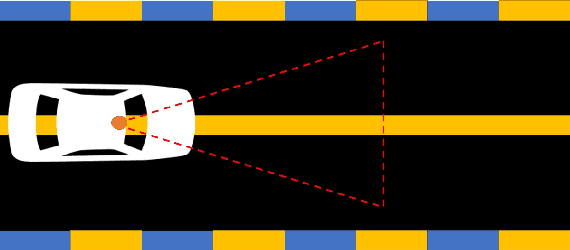
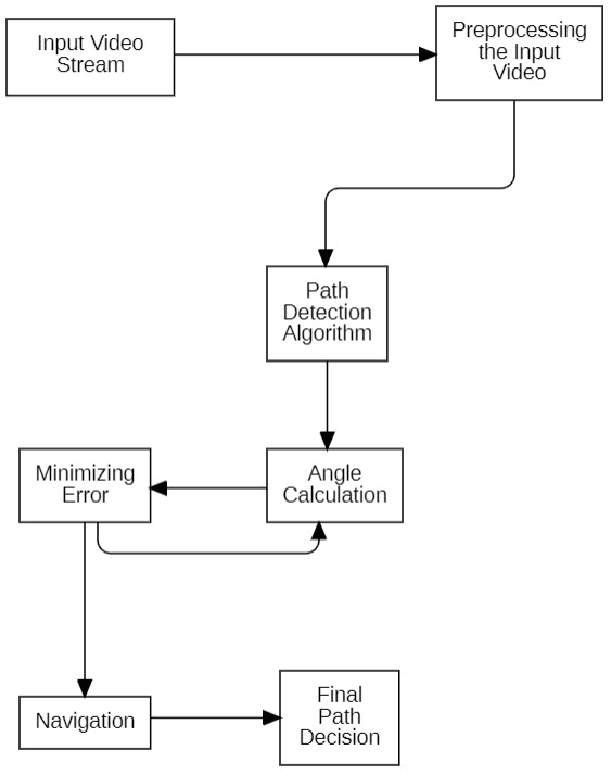
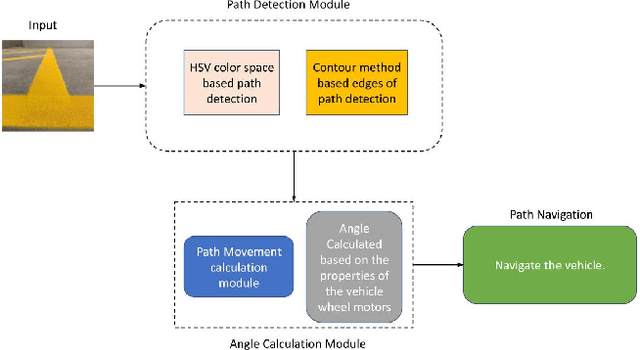
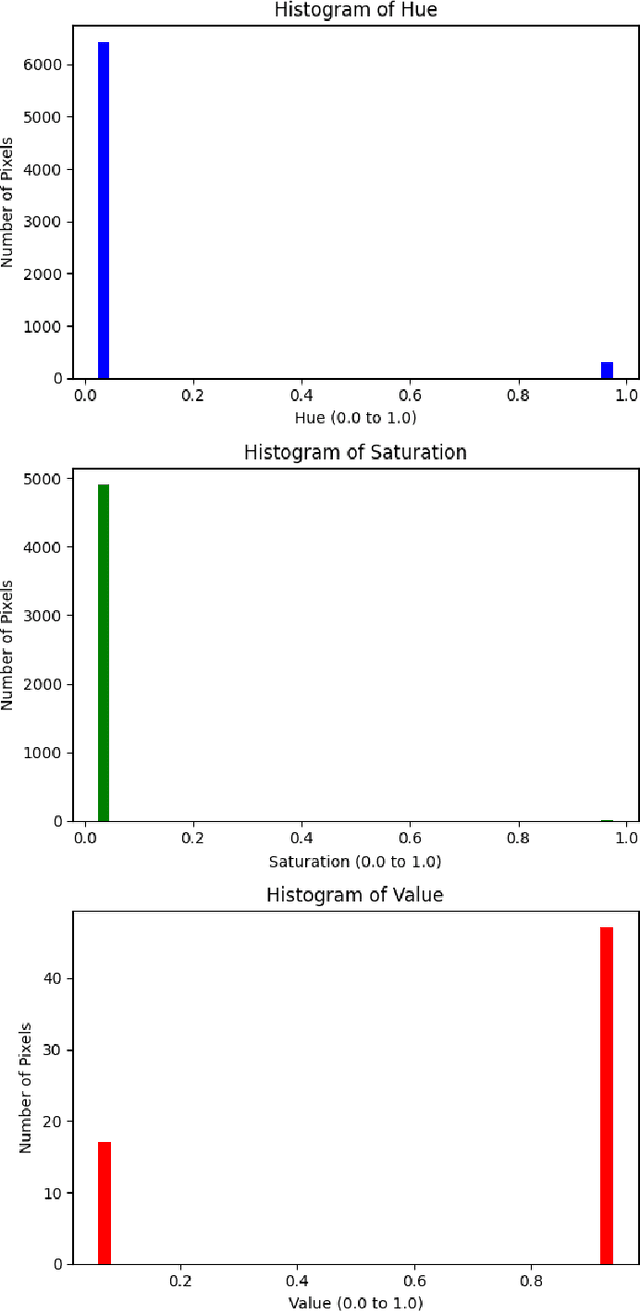
Recently, researchers have been exploring various ways to improve the effectiveness and efficiency of autonomous vehicles by researching new methods, especially for indoor scenarios. Autonomous Vehicles in indoor navigation systems possess many challenges especially the limited accuracy of GPS in indoor scenarios. Several, robust methods have been explored for autonomous vehicles in indoor scenarios to solve this problem, but the ineffectiveness of the proposed methods is the high deployment cost. To address the above-mentioned problems we have presented A low-cost indoor navigation method for autonomous vehicles called Affordable Indoor Navigation Solution (AINS) which is based on based on Monocular Camera. Our proposed solution is mainly based on a mono camera without relying on various huge or power-inefficient sensors to find the path, such as range finders and other navigation sensors. Our proposed method shows that we can deploy autonomous vehicles indoor navigation systems while taking into consideration the cost. We can observe that the results shown by our solution are better than existing solutions and we can reduce the estimated error and time consumption.