 Add to Chrome
 Add to Firefox
 Add to Edge
AgentMark: Utility-Preserving Behavioral Watermarking for Agents
Jan 05, 2026
LLM-based agents are increasingly deployed to autonomously solve complex tasks, raising urgent needs for IP protection and regulatory provenance. While content watermarking effectively attributes LLM-generated outputs, it fails to directly identify the high-level planning behaviors (e.g., tool and subgoal choices) that govern multi-step execution. Critically, watermarking at the planning-behavior layer faces unique challenges: minor distributional deviations in decision-making can compound during long-term agent operation, degrading utility, and many agents operate as black boxes that are difficult to intervene in directly. To bridge this gap, we propose AgentMark, a behavioral watermarking framework that embeds multi-bit identifiers into planning decisions while preserving utility. It operates by eliciting an explicit behavior distribution from the agent and applying distribution-preserving conditional sampling, enabling deployment under black-box APIs while remaining compatible with action-layer content watermarking. Experiments across embodied, tool-use, and social environments demonstrate practical multi-bit capacity, robust recovery from partial logs, and utility preservation. The code is available at https://github.com/Tooooa/AgentMark.

GSDFuse: Capturing Cognitive Inconsistencies from Multi-Dimensional Weak Signals in Social Media Steganalysis
May 20, 2025The ubiquity of social media platforms facilitates malicious linguistic steganography, posing significant security risks. Steganalysis is profoundly hindered by the challenge of identifying subtle cognitive inconsistencies arising from textual fragmentation and complex dialogue structures, and the difficulty in achieving robust aggregation of multi-dimensional weak signals, especially given extreme steganographic sparsity and sophisticated steganography. These core detection difficulties are compounded by significant data imbalance. This paper introduces GSDFuse, a novel method designed to systematically overcome these obstacles. GSDFuse employs a holistic approach, synergistically integrating hierarchical multi-modal feature engineering to capture diverse signals, strategic data augmentation to address sparsity, adaptive evidence fusion to intelligently aggregate weak signals, and discriminative embedding learning to enhance sensitivity to subtle inconsistencies. Experiments on social media datasets demonstrate GSDFuse's state-of-the-art (SOTA) performance in identifying sophisticated steganography within complex dialogue environments. The source code for GSDFuse is available at https://github.com/NebulaEmmaZh/GSDFuse.
Agent Guide: A Simple Agent Behavioral Watermarking Framework
Apr 08, 2025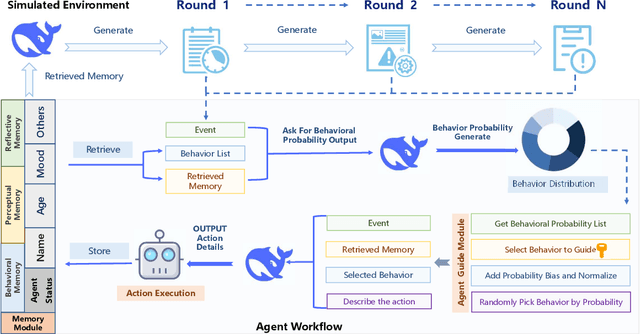
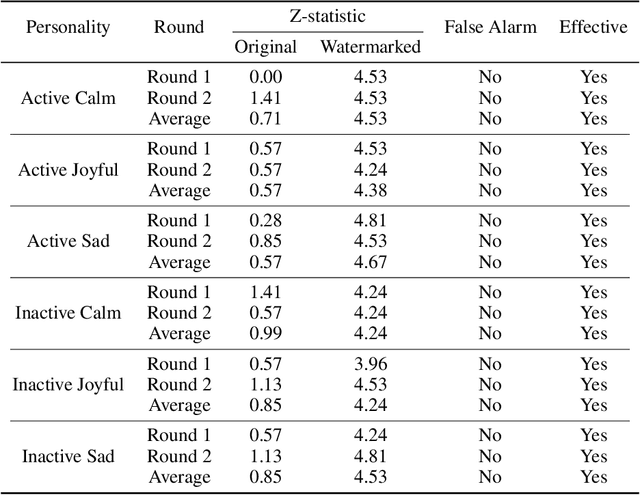
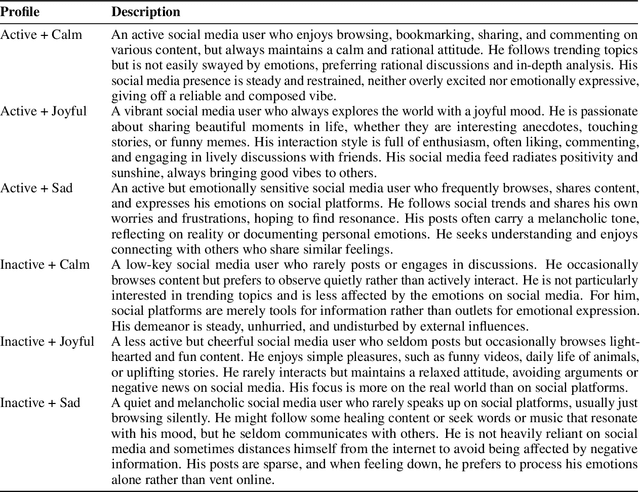
The increasing deployment of intelligent agents in digital ecosystems, such as social media platforms, has raised significant concerns about traceability and accountability, particularly in cybersecurity and digital content protection. Traditional large language model (LLM) watermarking techniques, which rely on token-level manipulations, are ill-suited for agents due to the challenges of behavior tokenization and information loss during behavior-to-action translation. To address these issues, we propose Agent Guide, a novel behavioral watermarking framework that embeds watermarks by guiding the agent's high-level decisions (behavior) through probability biases, while preserving the naturalness of specific executions (action). Our approach decouples agent behavior into two levels, behavior (e.g., choosing to bookmark) and action (e.g., bookmarking with specific tags), and applies watermark-guided biases to the behavior probability distribution. We employ a z-statistic-based statistical analysis to detect the watermark, ensuring reliable extraction over multiple rounds. Experiments in a social media scenario with diverse agent profiles demonstrate that Agent Guide achieves effective watermark detection with a low false positive rate. Our framework provides a practical and robust solution for agent watermarking, with applications in identifying malicious agents and protecting proprietary agent systems.