 Add to Chrome
 Add to Firefox
 Add to Edge
Enhancing the quality of gauge images captured in smoke and haze scenes through deep learning
Jan 15, 2026
Images captured in hazy and smoky environments suffer from reduced visibility, posing a challenge when monitoring infrastructures and hindering emergency services during critical situations. The proposed work investigates the use of the deep learning models to enhance the automatic, machine-based readability of gauge in smoky environments, with accurate gauge data interpretation serving as a valuable tool for first responders. The study utilizes two deep learning architectures, FFA-Net and AECR-Net, to improve the visibility of gauge images, corrupted with light up to dense haze and smoke. Since benchmark datasets of analog gauge images are unavailable, a new synthetic dataset, containing over 14,000 images, was generated using the Unreal Engine. The models were trained with an 80\% train, 10\% validation, and 10\% test split for the haze and smoke dataset, respectively. For the synthetic haze dataset, the SSIM and PSNR metrics are about 0.98 and 43\,dB, respectively, comparing well to state-of-the art results. Additionally, more robust results are retrieved from the AECR-Net, when compared to the FFA-Net. Although the results from the synthetic smoke dataset are poorer, the trained models achieve interesting results. In general, imaging in the presence of smoke are more difficult to enhance given the inhomogeneity and high density. Secondly, FFA-Net and AECR-Net are implemented to dehaze and not to desmoke images. This work shows that use of deep learning architectures can improve the quality of analog gauge images captured in smoke and haze scenes immensely. Finally, the enhanced output images can be successfully post-processed for automatic autonomous reading of gauges
* 17 pages, 10 figures, 6 tables, SPIE Applications of Machine Learning 2023, San Diego, US

SynDroneVision: A Synthetic Dataset for Image-Based Drone Detection
Nov 08, 2024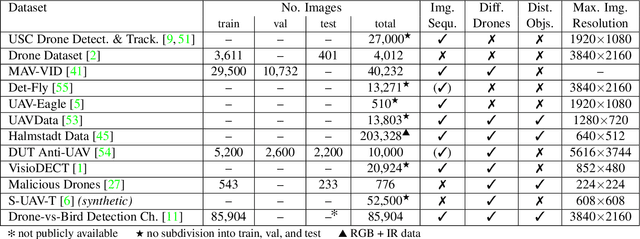
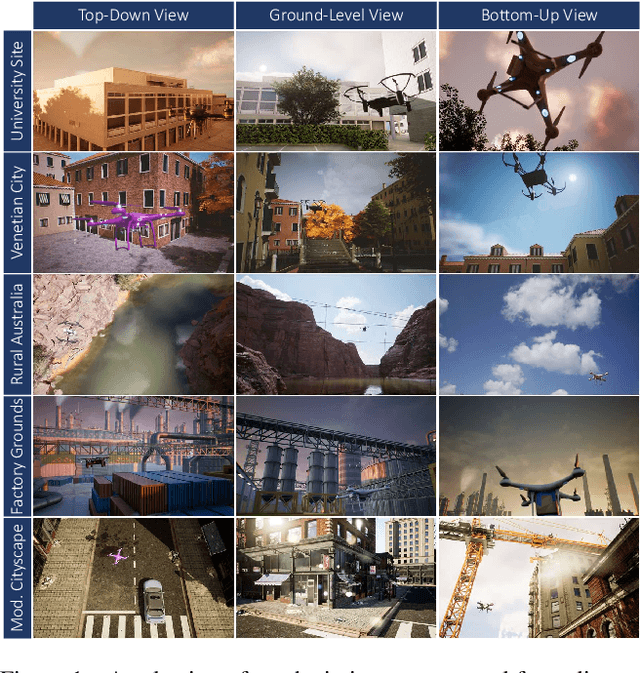
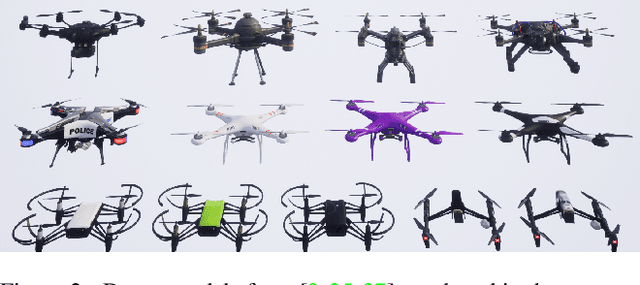
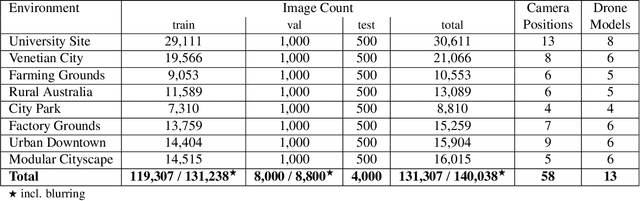
Developing robust drone detection systems is often constrained by the limited availability of large-scale annotated training data and the high costs associated with real-world data collection. However, leveraging synthetic data generated via game engine-based simulations provides a promising and cost-effective solution to overcome this issue. Therefore, we present SynDroneVision, a synthetic dataset specifically designed for RGB-based drone detection in surveillance applications. Featuring diverse backgrounds, lighting conditions, and drone models, SynDroneVision offers a comprehensive training foundation for deep learning algorithms. To evaluate the dataset's effectiveness, we perform a comparative analysis across a selection of recent YOLO detection models. Our findings demonstrate that SynDroneVision is a valuable resource for real-world data enrichment, achieving notable enhancements in model performance and robustness, while significantly reducing the time and costs of real-world data acquisition. SynDroneVision will be publicly released upon paper acceptance.