 Add to Chrome
 Add to Firefox
 Add to Edge
Multi-Agent Monte Carlo Tree Search for Makespan-Efficient Object Rearrangement in Cluttered Spaces
Feb 02, 2026
Object rearrangement planning in complex, cluttered environments is a common challenge in warehouses, households, and rescue sites. Prior studies largely address monotone instances, whereas real-world tasks are often non-monotone-objects block one another and must be temporarily relocated to intermediate positions before reaching their final goals. In such settings, effective multi-agent collaboration can substantially reduce the time required to complete tasks. This paper introduces Centralized, Asynchronous, Multi-agent Monte Carlo Tree Search (CAM-MCTS), a novel framework for general-purpose makespan-efficient object rearrangement planning in challenging environments. CAM-MCTS combines centralized task assignment-where agents remain aware of each other's intended actions to facilitate globally optimized planning-with an asynchronous task execution strategy that enables agents to take on new tasks at appropriate time steps, rather than waiting for others, guided by a one-step look-ahead cost estimate. This design minimizes idle time, prevents unnecessary synchronization delays, and enhances overall system efficiency. We evaluate CAM-MCTS across a diverse set of monotone and non-monotone tasks in cluttered environments, demonstrating consistent reductions in makespan compared to strong baselines. Finally, we validate our approach on a real-world multi-agent system under different configurations, further confirming its effectiveness and robustness.

Integrating Active Sensing and Rearrangement Planning for Efficient Object Retrieval from Unknown, Confined, Cluttered Environments
Nov 18, 2024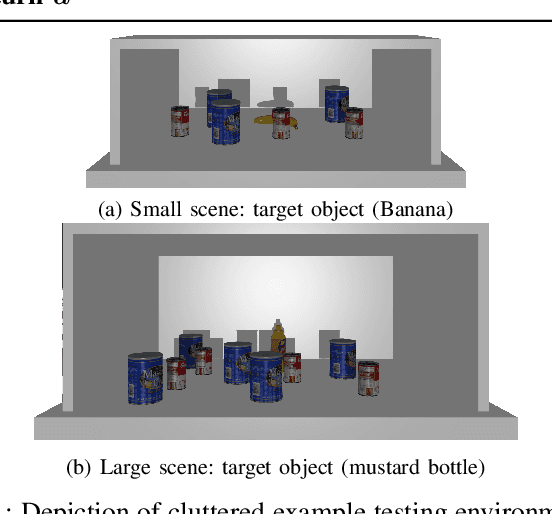
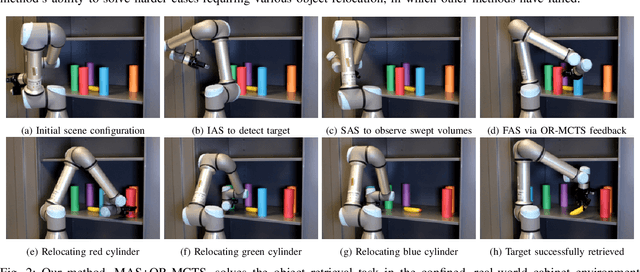
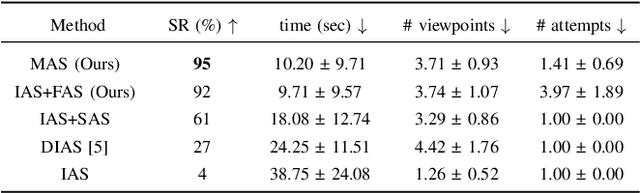

Retrieving target objects from unknown, confined spaces remains a challenging task that requires integrated, task-driven active sensing and rearrangement planning. Previous approaches have independently addressed active sensing and rearrangement planning, limiting their practicality in real-world scenarios. This paper presents a new, integrated heuristic-based active sensing and Monte-Carlo Tree Search (MCTS)-based retrieval planning approach. These components provide feedback to one another to actively sense critical, unobserved areas suitable for the retrieval planner to plan a sequence for relocating path-blocking obstacles and a collision-free trajectory for retrieving the target object. We demonstrate the effectiveness of our approach using a robot arm equipped with an in-hand camera in both simulated and real-world confined, cluttered scenarios. Our framework is compared against various state-of-the-art methods. The results indicate that our proposed approach outperforms baseline methods by a significant margin in terms of the success rate, the object rearrangement planning time consumption and the number of planning trials before successfully retrieving the target. Videos can be found at https://youtu.be/tea7I-3RtV0.