 Add to Chrome
 Add to Firefox
 Add to Edge
EWSJF: An Adaptive Scheduler with Hybrid Partitioning for Mixed-Workload LLM Inference
Jan 29, 2026
Serving Large Language Models (LLMs) under mixed workloads--short, latency-sensitive interactive queries alongside long, throughput-oriented batch requests--poses a fundamental scheduling challenge. Standard First-Come, First-Served (FCFS) policies suffer from severe head-of-line blocking, leading to high tail latency and underutilized hardware. We introduce EWSJF (Effective Workload-based Shortest Job First), an adaptive request-level scheduler that learns workload structure in real time to jointly improve fairness and throughput. EWSJF operates upstream of execution-level schedulers and integrates four components: (1) Refine-and-Prune, an unsupervised partitioning algorithm that discovers performance-homogeneous request groups; (2) Dynamic Queue Routing for assigning requests to these groups; (3) Density-Weighted Scoring, a context-aware prioritization function balancing urgency and fairness; and (4) Bayesian Meta-Optimization, which continuously tunes scoring and partitioning parameters based on live performance feedback. Implemented in vLLM, EWSJF improves end-to-end throughput by over 30% and reduces average Time-To-First-Token for short requests by up to 4x compared to FCFS. These results demonstrate that adaptive, learning-based request scheduling is a critical missing layer for efficient and responsive LLM serving. Implementation available at https://anonymous.4open.science/r/vllm_0110-32D8.

Joint Encoding of KV-Cache Blocks for Scalable LLM Serving
Jan 06, 2026Modern large language models (LLMs) drive interactive AI systems but are bottlenecked by the memory-heavy growth of key-value (KV) caches, which limits real-time throughput under concurrent loads. Existing KV-cache compression methods rely on rigid heuristics, disrupt tensor layouts, or require specialized compute, hindering scalability and deployment. We propose joint encoding of KV-cache blocks, which fuses similar blocks across requests and input chunks into shared representations while preserving standard cache structure. This alleviates the KV-cache memory bottleneck, supporting high-concurrency serving without specialized hardware. Theoretically, we analyze the rate-distortion tradeoff of fused cache blocks under a Poisson process model. Empirically, our method achieves up to 4.38 $\times$ KV-cache compression with negligible accuracy loss across diverse LLMs and benchmarks, outperforming recent structured and adaptive compression baselines. In real LLM serving, joint encoding improves the token throughput by $\sim$40\% on a single-machine vLLM benchmark, demonstrating substantial gains in inference throughput. Code is available at https://github.com/sef1/kv_fast_fusion kv_joint_encoding.
Linear Log-Normal Attention with Unbiased Concentration
Nov 22, 2023Transformer models have achieved remarkable results in a wide range of applications. However, their scalability is hampered by the quadratic time and memory complexity of the self-attention mechanism concerning the sequence length. This limitation poses a substantial obstacle when dealing with long documents or high-resolution images. In this work, we study the self-attention mechanism by analyzing the distribution of the attention matrix and its concentration ability. Furthermore, we propose instruments to measure these quantities and introduce a novel self-attention mechanism, Linear Log-Normal Attention, designed to emulate the distribution and concentration behavior of the original self-attention. Our experimental results on popular natural language benchmarks reveal that our proposed Linear Log-Normal Attention outperforms other linearized attention alternatives, offering a promising avenue for enhancing the scalability of transformer models. Our code is available in supplementary materials.
Rotation Invariant Quantization for Model Compression
Mar 03, 2023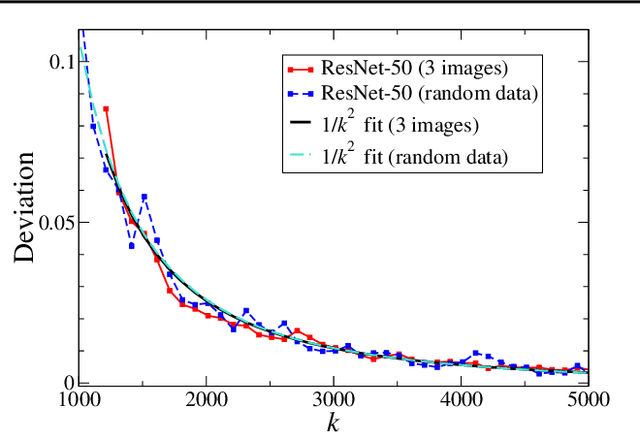


Post-training Neural Network (NN) model compression is an attractive approach for deploying large, memory-consuming models on devices with limited memory resources. In this study, we investigate the rate-distortion tradeoff for NN model compression. First, we suggest a Rotation-Invariant Quantization (RIQ) technique that utilizes a single parameter to quantize the entire NN model, yielding a different rate at each layer, i.e., mixed-precision quantization. Then, we prove that our rotation-invariant approach is optimal in terms of compression. We rigorously evaluate RIQ and demonstrate its capabilities on various models and tasks. For example, RIQ facilitates $\times 19.4$ and $\times 52.9$ compression ratios on pre-trained VGG dense and pruned models, respectively, with $<0.4\%$ accuracy degradation. Code: \url{https://github.com/ehaleva/RIQ}.