 Add to Chrome
 Add to Firefox
 Add to Edge
Graph Neural Network Reveals the Local Cortical Morphology of Brain Aging in Normal Cognition and Alzheimers Disease
Jan 16, 2026
Estimating brain age (BA) from T1-weighted magnetic resonance images (MRIs) provides a useful approach to map the anatomic features of brain senescence. Whereas global BA (GBA) summarizes overall brain health, local BA (LBA) can reveal spatially localized patterns of aging. Although previous studies have examined anatomical contributors to GBA, no framework has been established to compute LBA using cortical morphology. To address this gap, we introduce a novel graph neural network (GNN) that uses morphometric features (cortical thickness, curvature, surface area, gray/white matter intensity ratio and sulcal depth) to estimate LBA across the cortical surface at high spatial resolution (mean inter-vertex distance = 1.37 mm). Trained on cortical surface meshes extracted from the MRIs of cognitively normal adults (N = 14,250), our GNN identifies prefrontal and parietal association cortices as early sites of morphometric aging, in concordance with biological theories of brain aging. Feature comparison using integrated gradients reveals that morphological aging is driven primarily by changes in surface area (gyral crowns and highly folded regions) and cortical thickness (occipital lobes), with additional contributions from gray/white matter intensity ratio (frontal lobes and sulcal troughs) and curvature (sulcal troughs). In Alzheimers disease (AD), as expected, the model identifies widespread, excessive morphological aging in parahippocampal gyri and related temporal structures. Significant associations are found between regional LBA gaps and neuropsychological measures descriptive of AD-related cognitive impairment, suggesting an intimate relationship between morphological cortical aging and cognitive decline. These results highlight the ability of GNN-derived gero-morphometry to provide insights into local brain aging.

Enhancing Brain Age Estimation with a Multimodal 3D CNN Approach Combining Structural MRI and AI-Synthesized Cerebral Blood Volume Data
Dec 01, 2024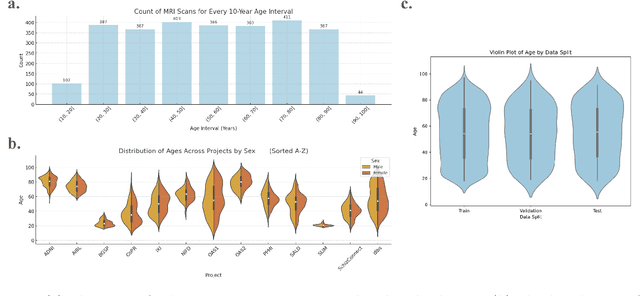
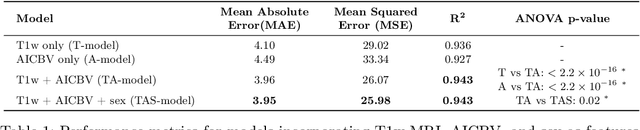
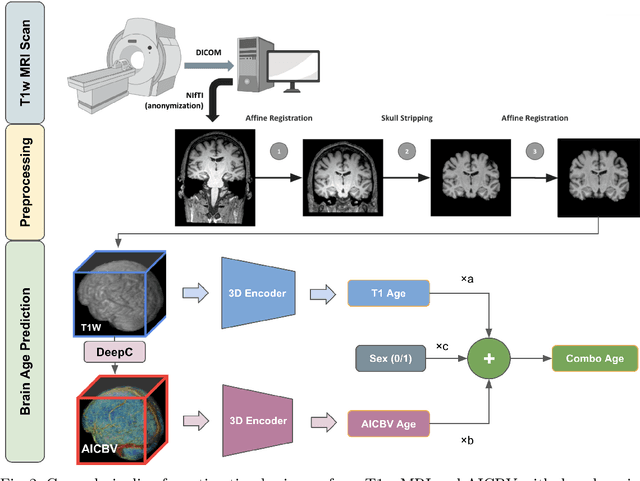
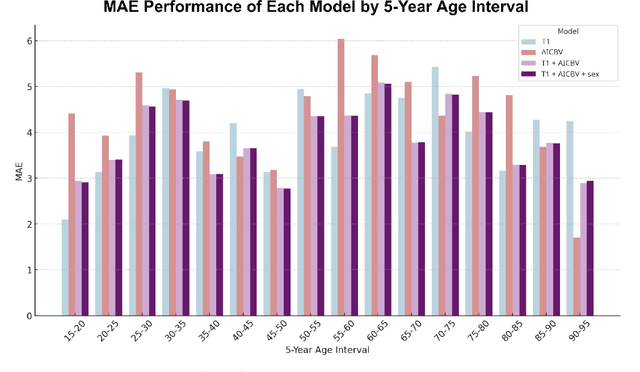
The growing global aging population necessitates enhanced methods for assessing brain aging and related neurodegenerative changes. Brain Age Gap Estimation (BrainAGE) offers a neuroimaging biomarker for understanding these changes by predicting brain age from MRI scans. Current approaches primarily use T1-weighted magnetic resonance imaging (T1w MRI) data, capturing only structural brain information. To address the lack of functional data, we integrated AI-generated Cerebral Blood Volume (AICBV) with T1w MRI, combining both structural and functional metrics. We developed a deep learning model using a VGG-based architecture to predict brain age. Our model achieved a mean absolute error (MAE) of 3.95 years and a correlation of \(R^2 = 0.94\) on the test set (\(n = 288\)), outperforming existing models trained on similar data. We have further created gradient-based class activation maps (Grad-CAM) to visualize the regions of the brain that most influenced the model's predictions, providing interpretable insights into the structural and functional contributors to brain aging.