 Add to Chrome
 Add to Firefox
 Add to Edge
Efficient Softmax Reformulation for Homomorphic Encryption via Moment Generating Function
Feb 02, 2026
Homomorphic encryption (HE) is a prominent framework for privacy-preserving machine learning, enabling inference directly on encrypted data. However, evaluating softmax, a core component of transformer architectures, remains particularly challenging in HE due to its multivariate structure, the large dynamic range induced by exponential functions, and the need for accurate division during normalization. In this paper, we propose MGF-softmax, a novel softmax reformulation based on the moment generating function (MGF) that replaces the softmax denominator with its moment-based counterpart. This reformulation substantially reduces multiplicative depth while preserving key properties of softmax and asymptotically converging to the exact softmax as the number of input tokens increases. Extensive experiments on Vision Transformers and large language models show that MGF-softmax provides an efficient and accurate approximation of softmax in encrypted inference. In particular, it achieves inference accuracy close to that of high-depth exact methods, while requiring substantially lower computational cost through reduced multiplicative depth.

Communication-Efficient and Drift-Robust Federated Learning via Elastic Net
Oct 06, 2022
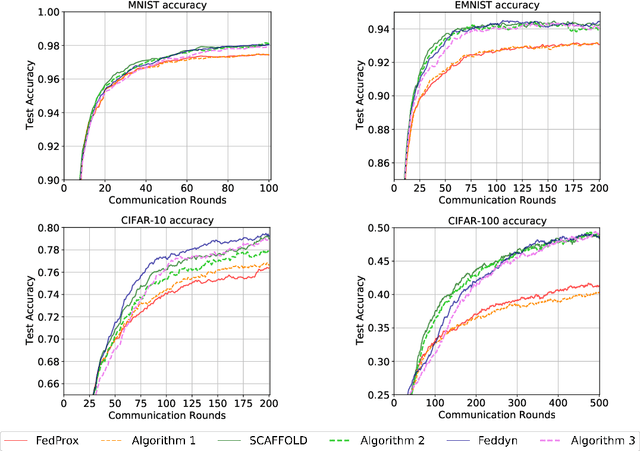
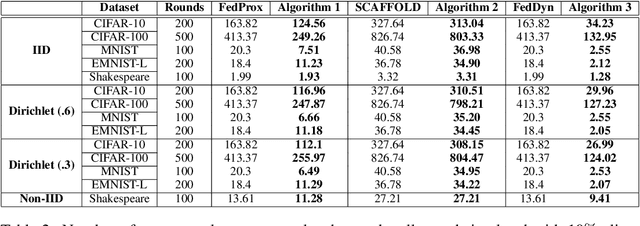
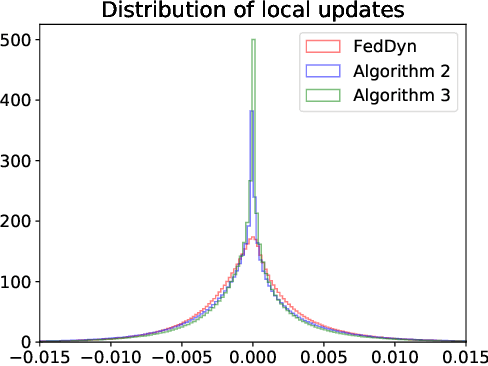
Federated learning (FL) is a distributed method to train a global model over a set of local clients while keeping data localized. It reduces the risks of privacy and security but faces important challenges including expensive communication costs and client drift issues. To address these issues, we propose FedElasticNet, a communication-efficient and drift-robust FL framework leveraging the elastic net. It repurposes two types of the elastic net regularizers (i.e., $\ell_1$ and $\ell_2$ penalties on the local model updates): (1) the $\ell_1$-norm regularizer sparsifies the local updates to reduce the communication costs and (2) the $\ell_2$-norm regularizer resolves the client drift problem by limiting the impact of drifting local updates due to data heterogeneity. FedElasticNet is a general framework for FL; hence, without additional costs, it can be integrated into prior FL techniques, e.g., FedAvg, FedProx, SCAFFOLD, and FedDyn. We show that our framework effectively resolves the communication cost and client drift problems simultaneously.