 Add to Chrome
 Add to Firefox
 Add to Edge
Improving Large Molecular Language Model via Relation-aware Multimodal Collaboration
Jan 18, 2026
Large language models (LLMs) have demonstrated their instruction-following capabilities and achieved powerful performance on various tasks. Inspired by their success, recent works in the molecular domain have led to the development of large molecular language models (LMLMs) that integrate 1D molecular strings or 2D molecular graphs into the language models. However, existing LMLMs often suffer from hallucination and limited robustness, largely due to inadequate integration of diverse molecular modalities such as 1D sequences, 2D molecular graphs, and 3D conformations. To address these limitations, we propose CoLLaMo, a large language model-based molecular assistant equipped with a multi-level molecular modality-collaborative projector. The relation-aware modality-collaborative attention mechanism in the projector facilitates fine-grained and relation-guided information exchange between atoms by incorporating 2D structural and 3D spatial relations. Furthermore, we present a molecule-centric new automatic measurement, including a hallucination assessment metric and GPT-based caption quality evaluation to address the limitations of token-based generic evaluation metrics (i.e., BLEU) widely used in assessing molecular comprehension of LMLMs. Our extensive experiments demonstrate that our CoLLaMo enhances the molecular modality generalization capabilities of LMLMs, achieving the best performance on multiple tasks, including molecule captioning, computed property QA, descriptive property QA, motif counting, and IUPAC name prediction.

DeepVideo-R1: Video Reinforcement Fine-Tuning via Difficulty-aware Regressive GRPO
Jun 09, 2025Recent works have demonstrated the effectiveness of reinforcement learning (RL)-based post-training in enhancing the reasoning capabilities of large language models (LLMs). In particular, Group Relative Policy Optimization (GRPO) has shown impressive success by employing a PPO-style reinforcement algorithm with group-based normalized rewards. However, the application of GRPO to Video Large Language Models (Video LLMs) has been less studied. In this paper, we explore GRPO for video LLMs and identify two primary issues that impede its effective learning: (1) reliance on safeguards, and (2) the vanishing advantage problem. To mitigate these challenges, we propose DeepVideo-R1, a video large language model trained with our proposed Reg-GRPO (Regressive GRPO) and difficulty-aware data augmentation strategy. Reg-GRPO reformulates the GRPO objective as a regression task, directly predicting the advantage in GRPO. This design eliminates the need for safeguards like clipping and min functions, thereby facilitating more direct policy guidance by aligning the model with the advantage values. We also design the difficulty-aware data augmentation strategy that dynamically augments training samples at solvable difficulty levels, fostering diverse and informative reward signals. Our comprehensive experiments show that DeepVideo-R1 significantly improves video reasoning performance across multiple video reasoning benchmarks.
VidChain: Chain-of-Tasks with Metric-based Direct Preference Optimization for Dense Video Captioning
Jan 12, 2025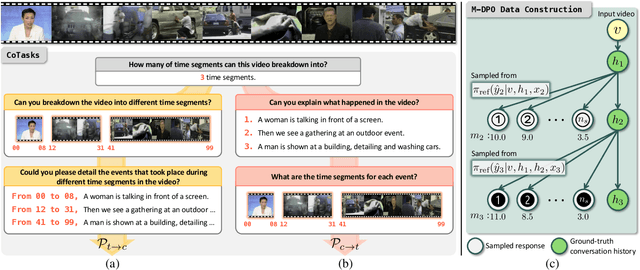
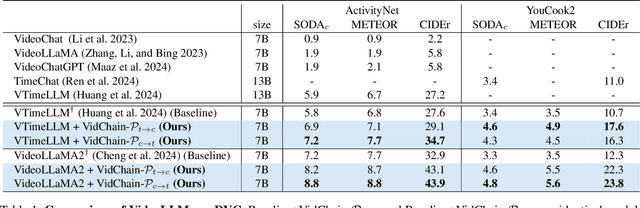
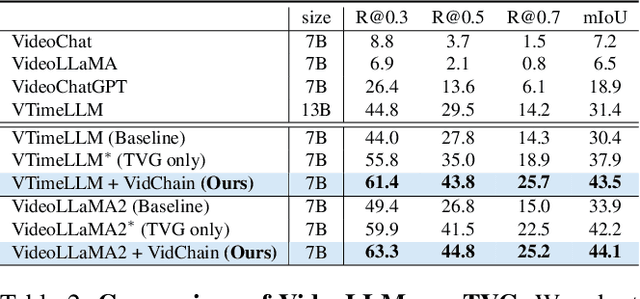
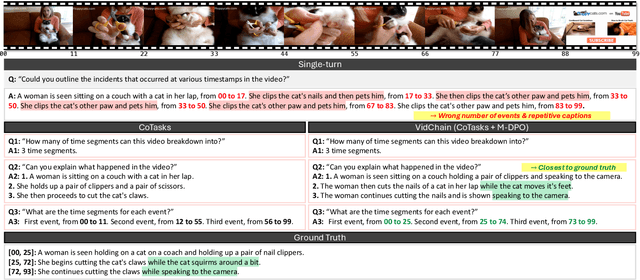
Despite the advancements of Video Large Language Models (VideoLLMs) in various tasks, they struggle with fine-grained temporal understanding, such as Dense Video Captioning (DVC). DVC is a complicated task of describing all events within a video while also temporally localizing them, which integrates multiple fine-grained tasks, including video segmentation, video captioning, and temporal video grounding. Previous VideoLLMs attempt to solve DVC in a single step, failing to utilize their reasoning capability. Moreover, previous training objectives for VideoLLMs do not fully reflect the evaluation metrics, therefore not providing supervision directly aligned to target tasks. To address such a problem, we propose a novel framework named VidChain comprised of Chain-of-Tasks (CoTasks) and Metric-based Direct Preference Optimization (M-DPO). CoTasks decompose a complex task into a sequence of sub-tasks, allowing VideoLLMs to leverage their reasoning capabilities more effectively. M-DPO aligns a VideoLLM with evaluation metrics, providing fine-grained supervision to each task that is well-aligned with metrics. Applied to two different VideoLLMs, VidChain consistently improves their fine-grained video understanding, thereby outperforming previous VideoLLMs on two different DVC benchmarks and also on the temporal video grounding task. Code is available at \url{https://github.com/mlvlab/VidChain}.