 Add to Chrome
 Add to Firefox
 Add to Edge
A Dual-Mode Faust-to-CLAP Compilation System
Jun 11, 2026
We describe faust2clap, a framework establishing the first officially maintained compilation pathway from Faust DSP specifications to the CLAP format. The system operates in two different modes. A static mode employs ahead-of-time compilation to yield native binaries of optimal efficiency, while a dynamic mode uses runtime interpretation to permit DSP code modification without interrupting the host application. This latter capability addresses a persistent friction in audio software development, namely the cumulative overhead of the edit, compile, and reload cycle. We detail the algorithmic machinery underlying both modes, focusing specifically on the problem of parameter identity. To preserve both parameter values and their bindings to host automation across structural DSP mutations, we introduce an address-based identity matching algorithm and a stable slot allocation scheme. The implementation, comprising approximately 2,400 lines of C++ architecture and Python tooling code, has been integrated into the main Faust distribution.

Sample Rate Independent Recurrent Neural Networks for Audio Effects Processing
Jun 10, 2024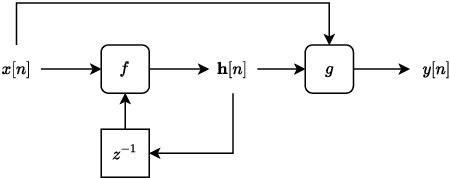

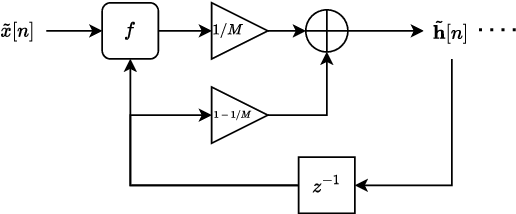
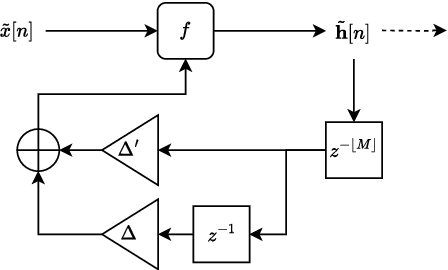
In recent years, machine learning approaches to modelling guitar amplifiers and effects pedals have been widely investigated and have become standard practice in some consumer products. In particular, recurrent neural networks (RNNs) are a popular choice for modelling non-linear devices such as vacuum tube amplifiers and distortion circuitry. One limitation of such models is that they are trained on audio at a specific sample rate and therefore give unreliable results when operating at another rate. Here, we investigate several methods of modifying RNN structures to make them approximately sample rate independent, with a focus on oversampling. In the case of integer oversampling, we demonstrate that a previously proposed delay-based approach provides high fidelity sample rate conversion whilst additionally reducing aliasing. For non-integer sample rate adjustment, we propose two novel methods and show that one of these, based on cubic Lagrange interpolation of a delay-line, provides a significant improvement over existing methods. To our knowledge, this work provides the first in-depth study into this problem.
chowdsp_wdf: An Advanced C++ Library for Wave Digital Circuit Modelling
Oct 22, 2022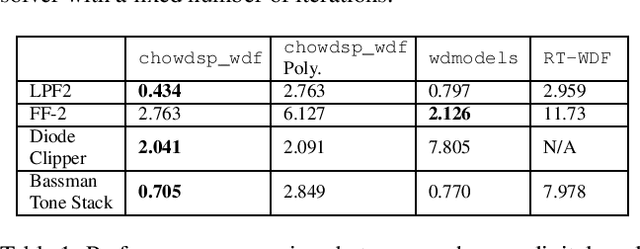
chowdsp_wdf is a C++ library for implementing real-time wave digital models of analog circuits. chowdsp_wdf differs from existing wave digital modelling libraries by providing a template meta-programming interface for modelling circuits with a fixed topology, and providing support for explicit SIMD acceleration. The motivation and design of the library are described, as well as real-world use-cases, and performance comparisons with other wave digital modelling libraries.
RTNeural: Fast Neural Inferencing for Real-Time Systems
Jun 06, 2021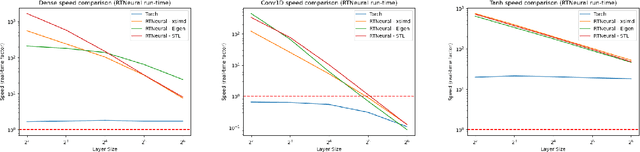
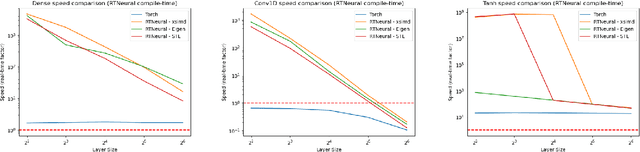
RTNeural is a neural inferencing library written in C++. RTNeural is designed to be used in systems with hard real-time constraints, with additional emphasis on speed, flexibility, size, and convenience. The motivation and design of the library are described, as well as real-world use-cases, and performance comparisons with other neural inferencing libraries.