 Add to Chrome
 Add to Firefox
 Add to Edge
SNIP: An Adaptive Mixed Precision Framework for Subbyte Large Language Model Training
Feb 01, 2026
Training large language models (LLMs) efficiently while preserving model quality poses significant challenges, particularly with subbyte precision supported by state-of-the-art GPUs. Current mixed-precision training approaches either apply uniform precision to all GEMM operations or rely on heuristic-based methods that fail to generalize during training, leading to suboptimal convergence and instability. To address these challenges, this paper introduces SNIP, a fine-grained adaptive mixed-precision training framework for LLM pretraining that supports subbyte precision. SNIP periodically collects statistics on activations, gradients, and optimizer states to assess the precision loss impact on model quality. We define two key metrics: loss divergence in the forward pass, caused by quantization-induced increases in training loss, and weight divergence in the backward pass, which measures error propagation through gradients affecting model updates. These metrics guide an Integer Linear Programming (ILP) problem that systematically optimizes layerwise precision to minimize overall quality loss while meeting efficiency targets. Experiments on 1B, 3B, 7B and 70B Llama-like models demonstrate that SNIP consistently outperforms existing baselines, reducing FLOPs by up to 80% while preserving model quality across different model sizes and training phases with minimal computational overhead.

Understanding and Alleviating Memory Consumption in RLHF for LLMs
Oct 21, 2024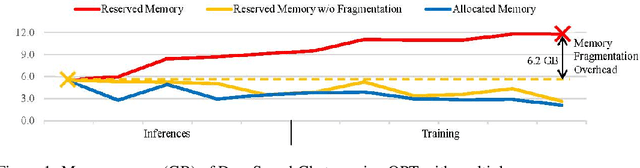
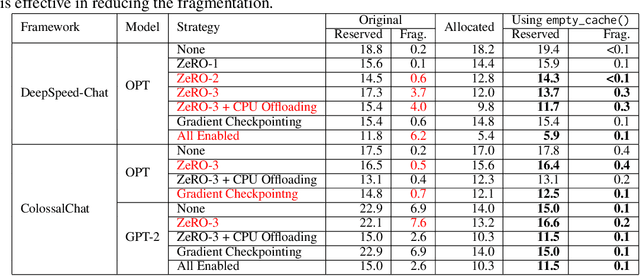
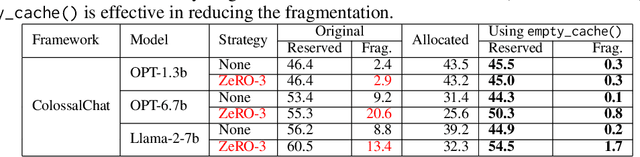
Fine-tuning with Reinforcement Learning with Human Feedback (RLHF) is essential for aligning large language models (LLMs). However, RLHF often encounters significant memory challenges. This study is the first to examine memory usage in the RLHF context, exploring various memory management strategies and unveiling the reasons behind excessive memory consumption. Additionally, we introduce a simple yet effective approach that substantially reduces the memory required for RLHF fine-tuning.
ProTrain: Efficient LLM Training via Memory-Aware Techniques
Jun 12, 2024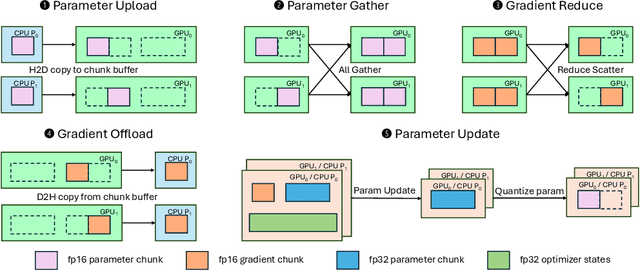
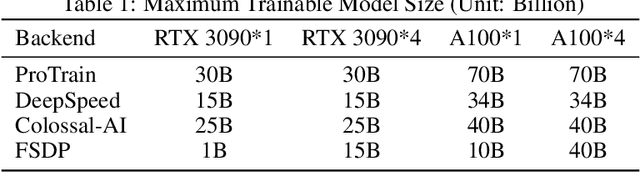
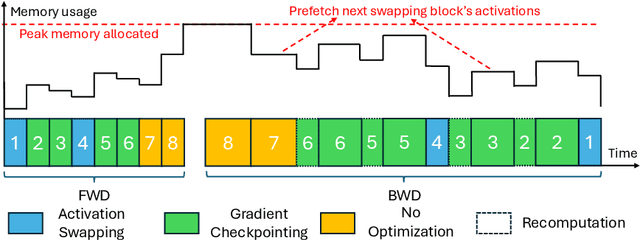
It is extremely memory-hungry to train Large Language Models (LLM). To solve this problem, existing work exploits the combination of CPU and GPU for the training process, such as ZeRO-Offload. Such a technique largely democratizes billion-scale model training, making it possible to train with few consumer graphics cards. However, based on our observation, existing frameworks often provide coarse-grained memory management and require experienced experts in configuration tuning, leading to suboptimal hardware utilization and performance. This paper proposes ProTrain, a novel training system that intelligently balances memory usage and performance by coordinating memory, computation, and IO. ProTrain achieves adaptive memory management through Chunk-Based Model State Management and Block-Wise Activation Management, guided by a Memory-Aware Runtime Profiler without user intervention. ProTrain does not change the training algorithm and thus does not compromise accuracy. Experiments show that ProTrain improves training throughput by 1.43$\times$ to 2.71$\times$ compared to the SOTA training systems.