 Add to Chrome
 Add to Firefox
 Add to Edge
Evaluation of Winning Solutions of 2025 Low Power Computer Vision Challenge
Apr 22, 2026
The IEEE Low-Power Computer Vision Challenge (LPCVC) aims to promote the development of efficient vision models for edge devices, balancing accuracy with constraints such as latency, memory capacity, and energy use. The 2025 challenge featured three tracks: (1) Image classification under various lighting conditions and styles, (2) Open-Vocabulary Segmentation with Text Prompt, and (3) Monocular Depth Estimation. This paper presents the design of LPCVC 2025, including its competition structure and evaluation framework, which integrates the Qualcomm AI Hub for consistent and reproducible benchmarking. The paper also introduces the top-performing solutions from each track and outlines key trends and observations. The paper concludes with suggestions for future computer vision competitions.

Interactive Multi-Head Self-Attention with Linear Complexity
Feb 27, 2024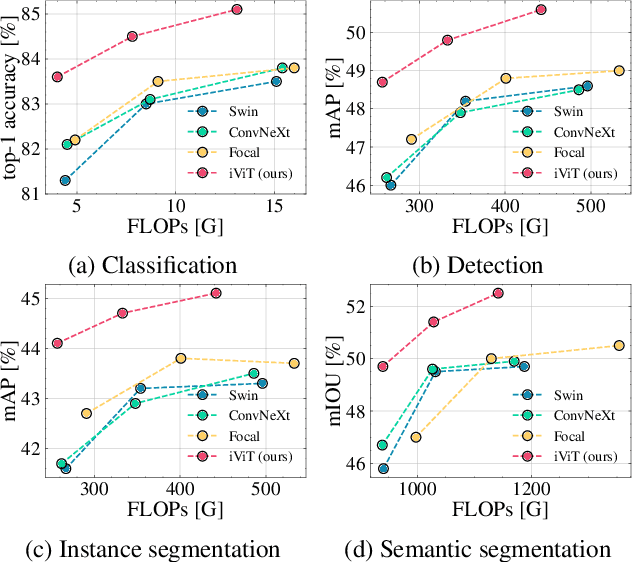
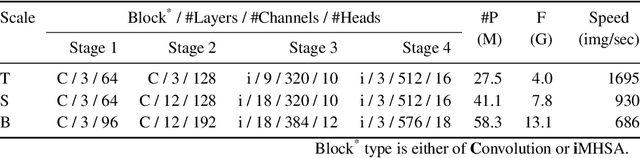
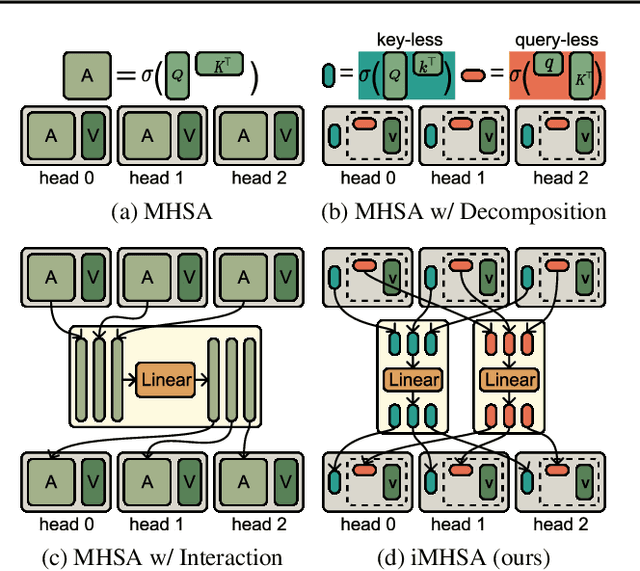
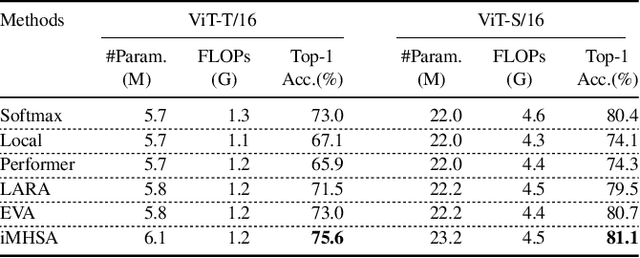
We propose an efficient interactive method for multi-head self-attention via decomposition. For existing methods using multi-head self-attention, the attention operation of each head is computed independently. However, we show that the interactions between cross-heads of the attention matrix enhance the information flow of the attention operation. Considering that the attention matrix of each head can be seen as a feature of networks, it is beneficial to establish connectivity between them to capture interactions better. However, a straightforward approach to capture the interactions between the cross-heads is computationally prohibitive as the complexity grows substantially with the high dimension of an attention matrix. In this work, we propose an effective method to decompose the attention operation into query- and key-less components. This will result in a more manageable size for the attention matrix, specifically for the cross-head interactions. Expensive experimental results show that the proposed cross-head interaction approach performs favorably against existing efficient attention methods and state-of-the-art backbone models.