 Add to Chrome
 Add to Firefox
 Add to Edge
ELF: Embedded Language Flows
May 11, 2026
Diffusion and flow-based models have become the de facto approaches for generating continuous data, e.g., in domains such as images and videos. Their success has attracted growing interest in applying them to language modeling. Unlike their image-domain counterparts, today's leading diffusion language models (DLMs) primarily operate over discrete tokens. In this paper, we show that continuous DLMs can be made effective with minimal adaptation to the discrete domain. We propose Embedded Language Flows (ELF), a class of diffusion models in continuous embedding space based on continuous-time Flow Matching. Unlike existing DLMs, ELF predominantly stays within the continuous embedding space until the final time step, where it maps to discrete tokens using a shared-weight network. This formulation makes it straightforward to adapt established techniques from image-domain diffusion models, e.g., classifier-free guidance (CFG). Experiments show that ELF substantially outperforms leading discrete and continuous DLMs, achieving better generation quality with fewer sampling steps. These results suggest that ELF offers a promising path toward effective continuous DLMs.

One-step Latent-free Image Generation with Pixel Mean Flows
Jan 29, 2026Modern diffusion/flow-based models for image generation typically exhibit two core characteristics: (i) using multi-step sampling, and (ii) operating in a latent space. Recent advances have made encouraging progress on each aspect individually, paving the way toward one-step diffusion/flow without latents. In this work, we take a further step towards this goal and propose "pixel MeanFlow" (pMF). Our core guideline is to formulate the network output space and the loss space separately. The network target is designed to be on a presumed low-dimensional image manifold (i.e., x-prediction), while the loss is defined via MeanFlow in the velocity space. We introduce a simple transformation between the image manifold and the average velocity field. In experiments, pMF achieves strong results for one-step latent-free generation on ImageNet at 256x256 resolution (2.22 FID) and 512x512 resolution (2.48 FID), filling a key missing piece in this regime. We hope that our study will further advance the boundaries of diffusion/flow-based generative models.
Bidirectional Normalizing Flow: From Data to Noise and Back
Dec 11, 2025Normalizing Flows (NFs) have been established as a principled framework for generative modeling. Standard NFs consist of a forward process and a reverse process: the forward process maps data to noise, while the reverse process generates samples by inverting it. Typical NF forward transformations are constrained by explicit invertibility, ensuring that the reverse process can serve as their exact analytic inverse. Recent developments in TARFlow and its variants have revitalized NF methods by combining Transformers and autoregressive flows, but have also exposed causal decoding as a major bottleneck. In this work, we introduce Bidirectional Normalizing Flow ($\textbf{BiFlow}$), a framework that removes the need for an exact analytic inverse. BiFlow learns a reverse model that approximates the underlying noise-to-data inverse mapping, enabling more flexible loss functions and architectures. Experiments on ImageNet demonstrate that BiFlow, compared to its causal decoding counterpart, improves generation quality while accelerating sampling by up to two orders of magnitude. BiFlow yields state-of-the-art results among NF-based methods and competitive performance among single-evaluation ("1-NFE") methods. Following recent encouraging progress on NFs, we hope our work will draw further attention to this classical paradigm.
Is Noise Conditioning Necessary for Denoising Generative Models?
Feb 18, 2025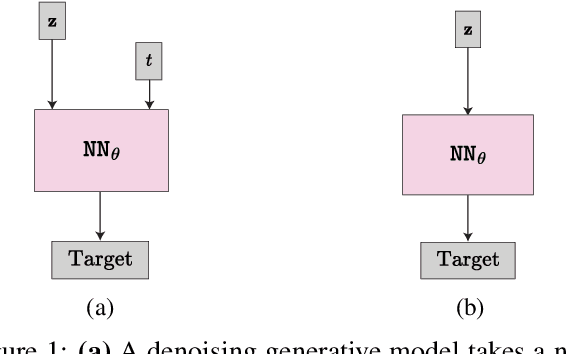
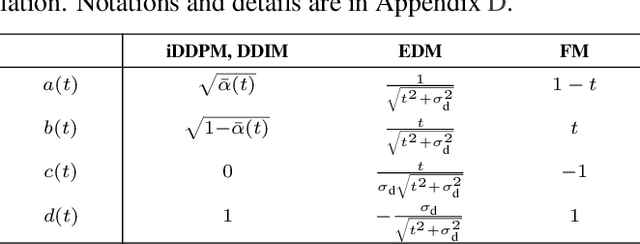
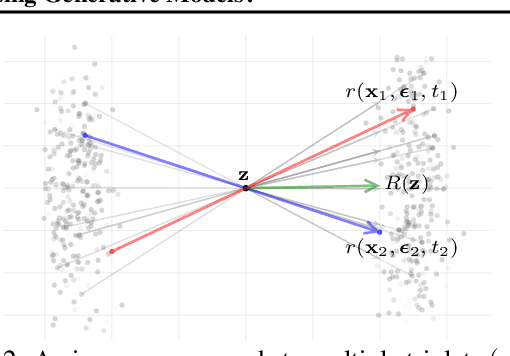
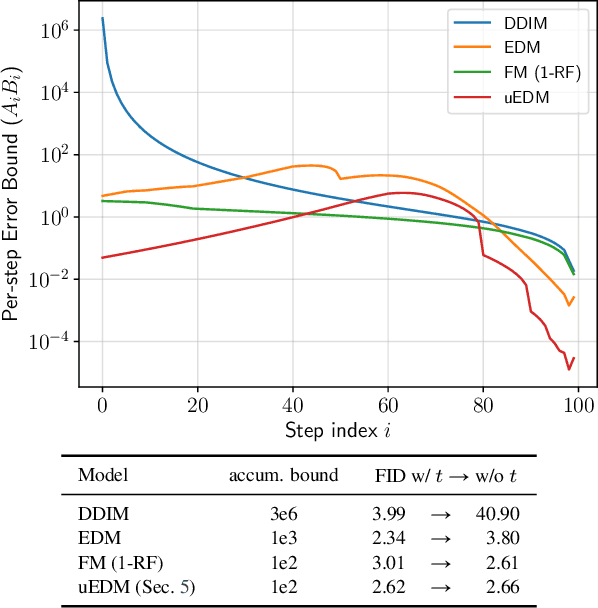
It is widely believed that noise conditioning is indispensable for denoising diffusion models to work successfully. This work challenges this belief. Motivated by research on blind image denoising, we investigate a variety of denoising-based generative models in the absence of noise conditioning. To our surprise, most models exhibit graceful degradation, and in some cases, they even perform better without noise conditioning. We provide a theoretical analysis of the error caused by removing noise conditioning and demonstrate that our analysis aligns with empirical observations. We further introduce a noise-unconditional model that achieves a competitive FID of 2.23 on CIFAR-10, significantly narrowing the gap to leading noise-conditional models. We hope our findings will inspire the community to revisit the foundations and formulations of denoising generative models.