 Add to Chrome
 Add to Firefox
 Add to Edge
A large-scale nanocrystal database with aligned synthesis and properties enabling generative inverse design
Jan 04, 2026
The synthesis of nanocrystals has been highly dependent on trial-and-error, due to the complex correlation between synthesis parameters and physicochemical properties. Although deep learning offers a potential methodology to achieve generative inverse design, it is still hindered by the scarcity of high-quality datasets that align nanocrystal synthesis routes with their properties. Here, we present the construction of a large-scale, aligned Nanocrystal Synthesis-Property (NSP) database and demonstrate its capability for generative inverse design. To extract structured synthesis routes and their corresponding product properties from literature, we develop NanoExtractor, a large language model (LLM) enhanced by well-designed augmentation strategies. NanoExtractor is validated against human experts, achieving a weighted average score of 88% on the test set, significantly outperforming chemistry-specialized (3%) and general-purpose LLMs (38%). The resulting NSP database contains nearly 160,000 aligned entries and serves as training data for our NanoDesigner, an LLM for inverse synthesis design. The generative capability of NanoDesigner is validated through the successful design of viable synthesis routes for both well-established PbSe nanocrystals and rarely reported MgF2 nanocrystals. Notably, the model recommends a counter-intuitive, non-stoichiometric precursor ratio (1:1) for MgF2 nanocrystals, which is experimentally confirmed as critical for suppressing byproducts. Our work bridges the gap between unstructured literature and data-driven synthesis, and also establishes a powerful human-AI collaborative paradigm for accelerating nanocrystal discovery.

Deep Learning Models for Colloidal Nanocrystal Synthesis
Dec 14, 2024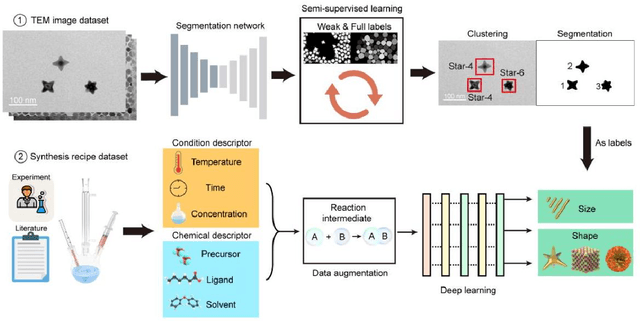
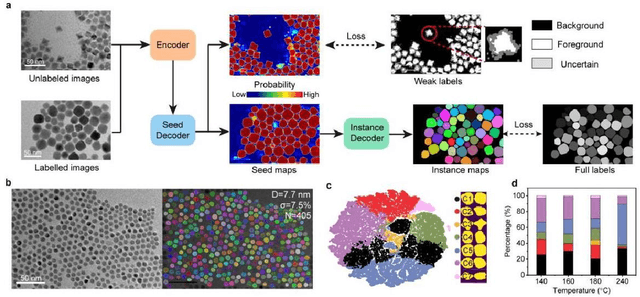
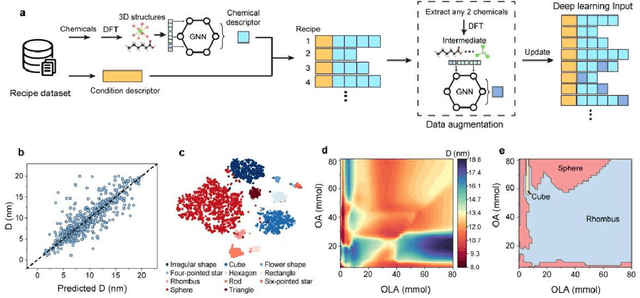
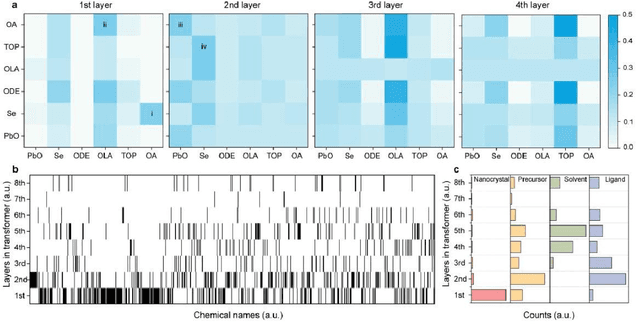
Colloidal synthesis of nanocrystals usually includes complex chemical reactions and multi-step crystallization processes. Despite the great success in the past 30 years, it remains challenging to clarify the correlations between synthetic parameters of chemical reaction and physical properties of nanocrystals. Here, we developed a deep learning-based nanocrystal synthesis model that correlates synthetic parameters with the final size and shape of target nanocrystals, using a dataset of 3500 recipes covering 348 distinct nanocrystal compositions. The size and shape labels were obtained from transmission electron microscope images using a segmentation model trained with a semi-supervised algorithm on a dataset comprising 1.2 million nanocrystals. By applying the reaction intermediate-based data augmentation method and elaborated descriptors, the synthesis model was able to predict nanocrystal's size with a mean absolute error of 1.39 nm, while reaching an 89% average accuracy for shape classification. The synthesis model shows knowledge transfer capabilities across different nanocrystals with inputs of new recipes. With that, the influence of chemicals on the final size of nanocrystals was further evaluated, revealing the importance order of nanocrystal composition, precursor or ligand, and solvent. Overall, the deep learning-based nanocrystal synthesis model offers a powerful tool to expedite the development of high-quality nanocrystals.