 Add to Chrome
 Add to Firefox
 Add to Edge
Global Optimization of Atomic Clusters via Physically-Constrained Tensor Train Decomposition
Jan 26, 2026
The global optimization of atomic clusters represents a fundamental challenge in computational chemistry and materials science due to the exponential growth of local minima with system size (i.e., the curse of dimensionality). We introduce a novel framework that overcomes this limitation by exploiting the low-rank structure of potential energy surfaces through Tensor Train (TT) decomposition. Our approach combines two complementary TT-based strategies: the algebraic TTOpt method, which utilizes maximum volume sampling, and the probabilistic PROTES method, which employs generative sampling. A key innovation is the development of physically-constrained encoding schemes that incorporate molecular constraints directly into the discretization process. We demonstrate the efficacy of our method by identifying global minima of Lennard-Jones clusters containing up to 45 atoms. Furthermore, we establish its practical applicability to real-world systems by optimizing 20-atom carbon clusters using a machine-learned Moment Tensor Potential, achieving geometries consistent with quantum-accurate simulations. This work establishes TT-decomposition as a powerful tool for molecular structure prediction and provides a general framework adaptable to a wide range of high-dimensional optimization problems in computational material science.

Smart Flow Matching: On The Theory of Flow Matching Algorithms with Applications
Feb 05, 2024The paper presents the exact formula for the vector field that minimizes the loss for the standard flow. This formula depends analytically on a given distribution \rho_0 and an unknown one \rho_1. Based on the presented formula, a new loss and algorithm for training a vector field model in the style of Conditional Flow Matching are provided. Our loss, in comparison to the standard Conditional Flow Matching approach, exhibits smaller variance when evaluated through Monte Carlo sampling methods. Numerical experiments on synthetic models and models on tabular data of large dimensions demonstrate better learning results with the use of the presented algorithm.
Black-Box Approximation and Optimization with Hierarchical Tucker Decomposition
Feb 05, 2024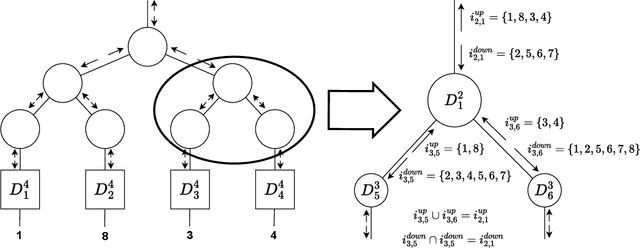
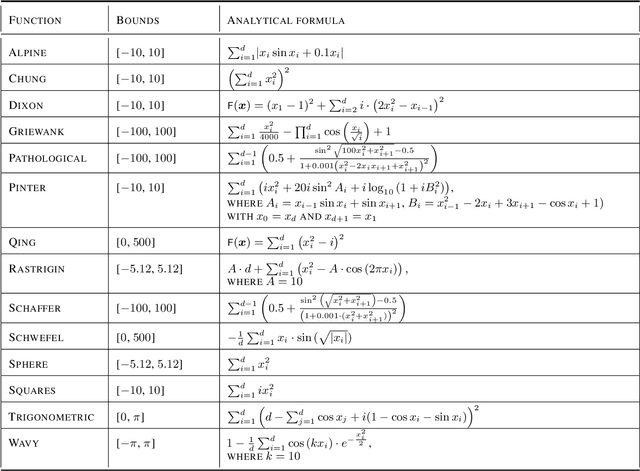
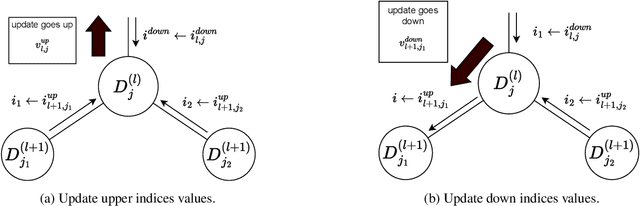
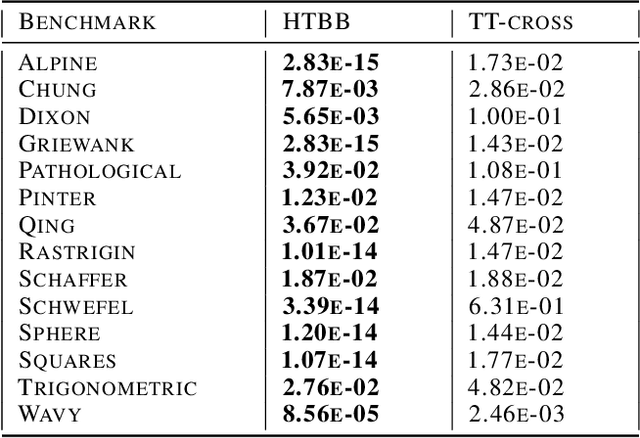
We develop a new method HTBB for the multidimensional black-box approximation and gradient-free optimization, which is based on the low-rank hierarchical Tucker decomposition with the use of the MaxVol indices selection procedure. Numerical experiments for 14 complex model problems demonstrate the robustness of the proposed method for dimensions up to 1000, while it shows significantly more accurate results than classical gradient-free optimization methods, as well as approximation and optimization methods based on the popular tensor train decomposition, which represents a simpler case of a tensor network.