 Add to Chrome
 Add to Firefox
 Add to Edge
Federated Latent Space Alignment for Multi-user Semantic Communications
Feb 19, 2026
Semantic communication aims to convey meaning for effective task execution, but differing latent representations in AI-native devices can cause semantic mismatches that hinder mutual understanding. This paper introduces a novel approach to mitigating latent space misalignment in multi-agent AI- native semantic communications. In a downlink scenario, we consider an access point (AP) communicating with multiple users to accomplish a specific AI-driven task. Our method implements a protocol that shares a semantic pre-equalizer at the AP and local semantic equalizers at user devices, fostering mutual understanding and task-oriented communication while considering power and complexity constraints. To achieve this, we employ a federated optimization for the decentralized training of the semantic equalizers at the AP and user sides. Numerical results validate the proposed approach in goal-oriented semantic communication, revealing key trade-offs among accuracy, com- munication overhead, complexity, and the semantic proximity of AI-native communication devices.

Semantic and Goal-oriented Wireless Network Coverage: The Area of Effectiveness
Feb 25, 2025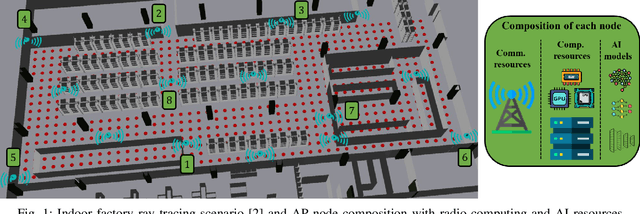
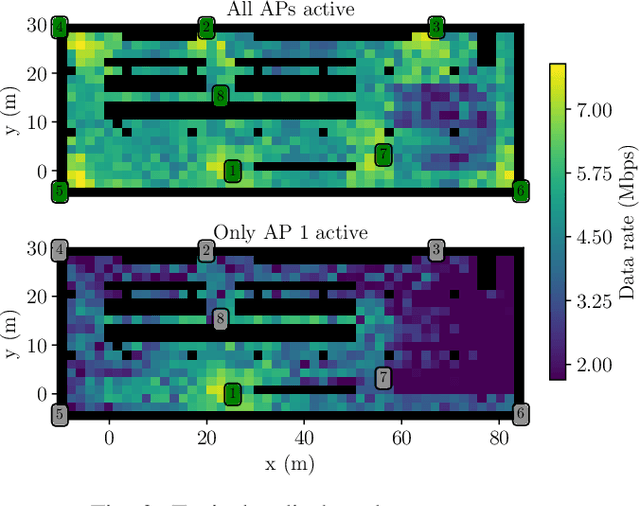
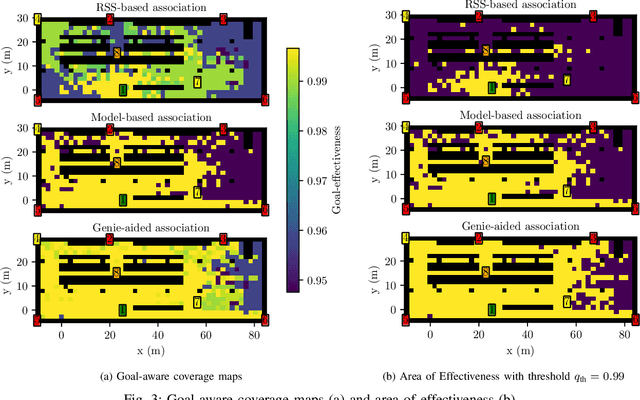
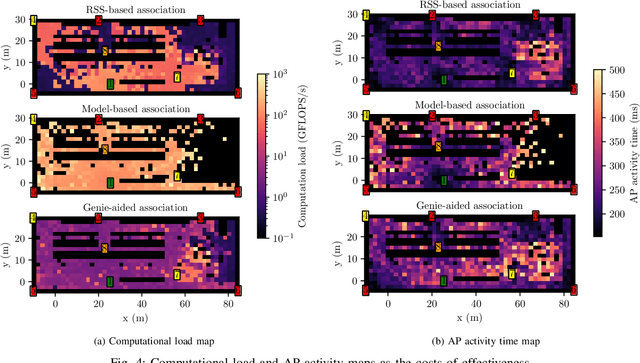
Assessing wireless coverage is a fundamental task for public network operators and private deployments, whose goal is to guarantee quality of service across the network while minimizing material waste and energy consumption. These maps are usually built through ray tracing techniques and/or channel measurements that can be consequently translated into network Key Performance Indicators (KPIs), such as capacity or throughput. However, next generation networks (e.g., 6G) typically involve beyond communication resources, towards services that require data transmission, but also processing (local and remote) to perform complex decision making in real time, with the best balance between performance, energy consumption, material waste, and privacy. In this paper, we introduce the novel concept of areas of effectiveness, which goes beyond the legacy notion of coverage, towards one that takes into account capability of the network of offering edge Artificial Intelligence (AI)-related computation. We will show that radio coverage is a poor indicator of real system performance, depending on the application and the computing capabilities of network and devices. This opens new challenges in network planning, but also resource orchestration during operation to achieve the specific goal of communication.