 Add to Chrome
 Add to Firefox
 Add to Edge
Estimation of Ground Reaction Forces from Kinematic Data during Locomotion
Feb 03, 2026
Ground reaction forces (GRFs) provide fundamental insight into human gait mechanics and are widely used to assess joint loading, limb symmetry, balance control, and motor function. Despite their clinical relevance, the use of GRF remains underutilised in clinical workflows due to the practical limitations of force plate systems. In this work, we present a force-plate-free approach for estimating GRFs using only marker-based motion capture data. This kinematics only method to estimate and decompose GRF makes it well suited for widespread clinical depolyment. By using kinematics from sixteen body segments, we estimate the centre of mass (CoM) and compute GRFs, which are subsequently decomposed into individual components through a minimization-based approach. Through this framework, we can identify gait stance phases and provide access to clinically meaningful kinetic measures without a dedicated force plate system. Experimental results demonstrate the viability of CoM and GRF estimation based solely on kinematic data, supporting force-plate-free gait analysis.

Sensorized gripper for human demonstrations
Mar 19, 2025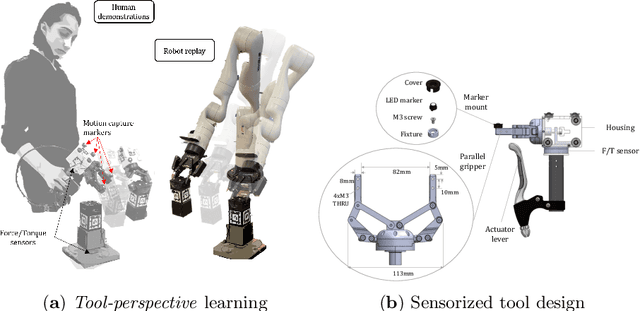
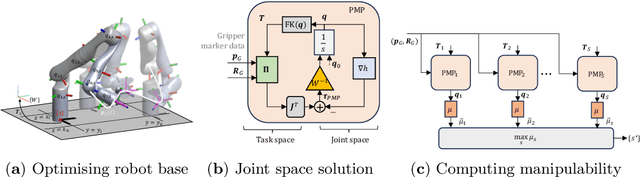
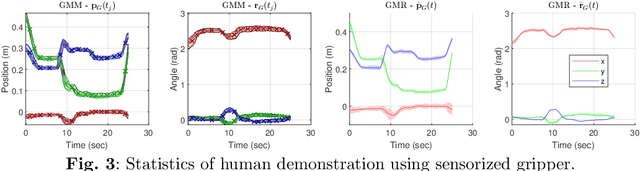
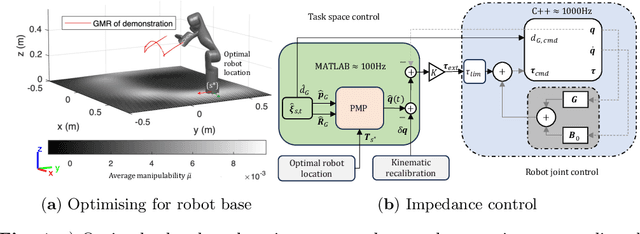
Ease of programming is a key factor in making robots ubiquitous in unstructured environments. In this work, we present a sensorized gripper built with off-the-shelf parts, used to record human demonstrations of a box in box assembly task. With very few trials of short interval timings each, we show that a robot can repeat the task successfully. We adopt a Cartesian approach to robot motion generation by computing the joint space solution while concurrently solving for the optimal robot position, to maximise manipulability. The statistics of the human demonstration are extracted using Gaussian Mixture Models (GMM) and the robot is commanded using impedance control.