 Add to Chrome
 Add to Firefox
 Add to Edge
LESV: Language Embedded Sparse Voxel Fusion for Open-Vocabulary 3D Scene Understanding
Apr 01, 2026
Recent advancements in open-vocabulary 3D scene understanding heavily rely on 3D Gaussian Splatting (3DGS) to register vision-language features into 3D space. However, we identify two critical limitations in these approaches: the spatial ambiguity arising from unstructured, overlapping Gaussians which necessitates probabilistic feature registration, and the multi-level semantic ambiguity caused by pooling features over object-level masks, which dilutes fine-grained details. To address these challenges, we present a novel framework that leverages Sparse Voxel Rasterization (SVRaster) as a structured, disjoint geometry representation. By regularizing SVRaster with monocular depth and normal priors, we establish a stable geometric foundation. This enables a deterministic, confidence-aware feature registration process and suppresses the semantic bleeding artifact common in 3DGS. Furthermore, we resolve multi-level ambiguity by exploiting the emerging dense alignment properties of foundation model AM-RADIO, avoiding the computational overhead of hierarchical training methods. Our approach achieves state-of-the-art performance on Open Vocabulary 3D Object Retrieval and Point Cloud Understanding benchmarks, particularly excelling on fine-grained queries where registration methods typically fail.

CoStruction: Conjoint radiance field optimization for urban scene reconStruction with limited image overlap
Jan 07, 2025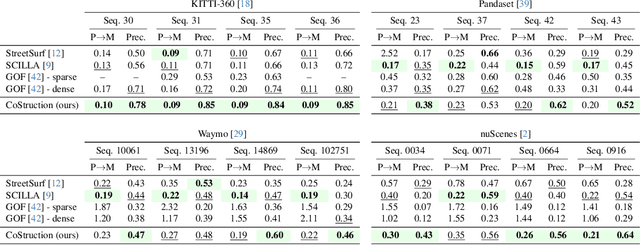
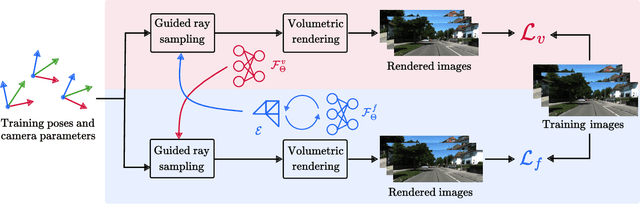
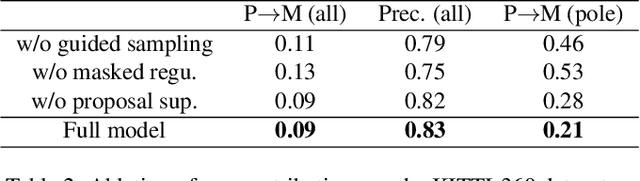
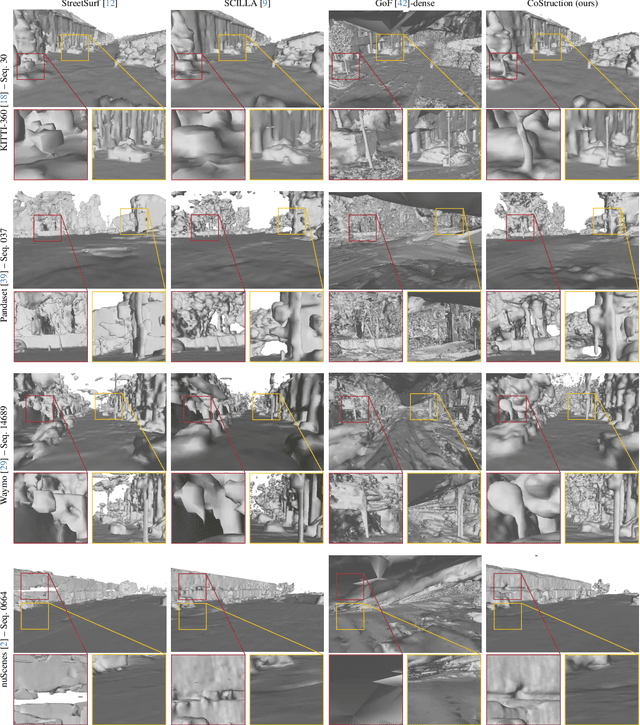
Reconstructing the surrounding surface geometry from recorded driving sequences poses a significant challenge due to the limited image overlap and complex topology of urban environments. SoTA neural implicit surface reconstruction methods often struggle in such setting, either failing due to small vision overlap or exhibiting suboptimal performance in accurately reconstructing both the surface and fine structures. To address these limitations, we introduce CoStruction, a novel hybrid implicit surface reconstruction method tailored for large driving sequences with limited camera overlap. CoStruction leverages cross-representation uncertainty estimation to filter out ambiguous geometry caused by limited observations. Our method performs joint optimization of both radiance fields in addition to guided sampling achieving accurate reconstruction of large areas along with fine structures in complex urban scenarios. Extensive evaluation on major driving datasets demonstrates the superiority of our approach in reconstructing large driving sequences with limited image overlap, outperforming concurrent SoTA methods.
PlaNeRF: SVD Unsupervised 3D Plane Regularization for NeRF Large-Scale Scene Reconstruction
Jun 06, 2023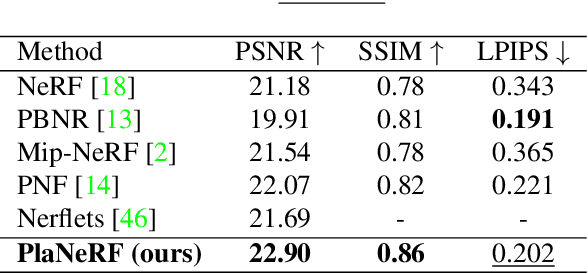


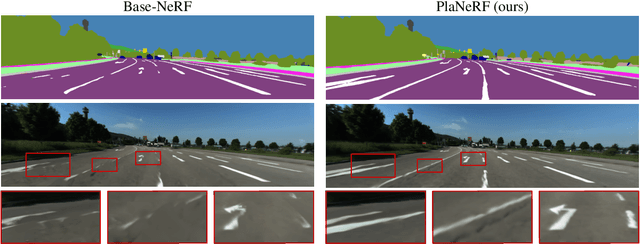
Neural Radiance Fields (NeRF) enable 3D scene reconstruction from 2D images and camera poses for Novel View Synthesis (NVS). Although NeRF can produce photorealistic results, it often suffers from overfitting to training views, leading to poor geometry reconstruction, especially in low-texture areas. This limitation restricts many important applications which require accurate geometry, such as extrapolated NVS, HD mapping and scene editing. To address this limitation, we propose a new method to improve NeRF's 3D structure using only RGB images and semantic maps. Our approach introduces a novel plane regularization based on Singular Value Decomposition (SVD), that does not rely on any geometric prior. In addition, we leverage the Structural Similarity Index Measure (SSIM) in our loss design to properly initialize the volumetric representation of NeRF. Quantitative and qualitative results show that our method outperforms popular regularization approaches in accurate geometry reconstruction for large-scale outdoor scenes and achieves SoTA rendering quality on the KITTI-360 NVS benchmark.