 Add to Chrome
 Add to Firefox
 Add to Edge
Unpacking Interpretability: Human-Centered Criteria for Optimal Combinatorial Solutions
Mar 09, 2026
Algorithmic support systems often return optimal solutions that are hard to understand. Effective human-algorithm collaboration, however, requires interpretability. When machine solutions are equally optimal, humans must select one, but a precise account of what makes one solution more interpretable than another remains missing. To identify structural properties of interpretable machine solutions, we present an experimental paradigm in which participants chose which of two equally optimal solutions for packing items into bins was easier to understand. We show that preferences reliably track three quantifiable properties of solution structure: alignment with a greedy heuristic, simple within-bin composition, and ordered visual representation. The strongest associations were observed for ordered representations and heuristic alignment, with compositional simplicity also showing a consistent association. Reaction-time evidence was mixed, with faster responses observed primarily when heuristic differences were larger, and aggregate webcam-based gaze did not show reliable effects of complexity. These results provide a concrete, feature-based account of interpretability in optimal packing solutions, linking solution structure to human preference. By identifying actionable properties (simple compositions, ordered representation, and heuristic alignment), our findings enable interpretability-aware optimization and presentation of machine solutions, and outline a path to quantify trade-offs between optimality and interpretability in real-world allocation and design tasks.

Types of Relations: Defining Analogies with Category Theory
May 26, 2025In order to behave intelligently both humans and machines have to represent their knowledge adequately for how it is used. Humans often use analogies to transfer their knowledge to new domains, or help others with this transfer via explanations. Hence, an important question is: What representation can be used to construct, find, and evaluate analogies? In this paper, we study features of a domain that are important for constructing analogies. We do so by formalizing knowledge domains as categories. We use the well-known example of the analogy between the solar system and the hydrogen atom to demonstrate how to construct domain categories. We also show how functors, pullbacks, and pushouts can be used to define an analogy, describe its core and a corresponding blend of the underlying domains.
Solving Bongard Problems with a Visual Language and Pragmatic Reasoning
Apr 12, 2018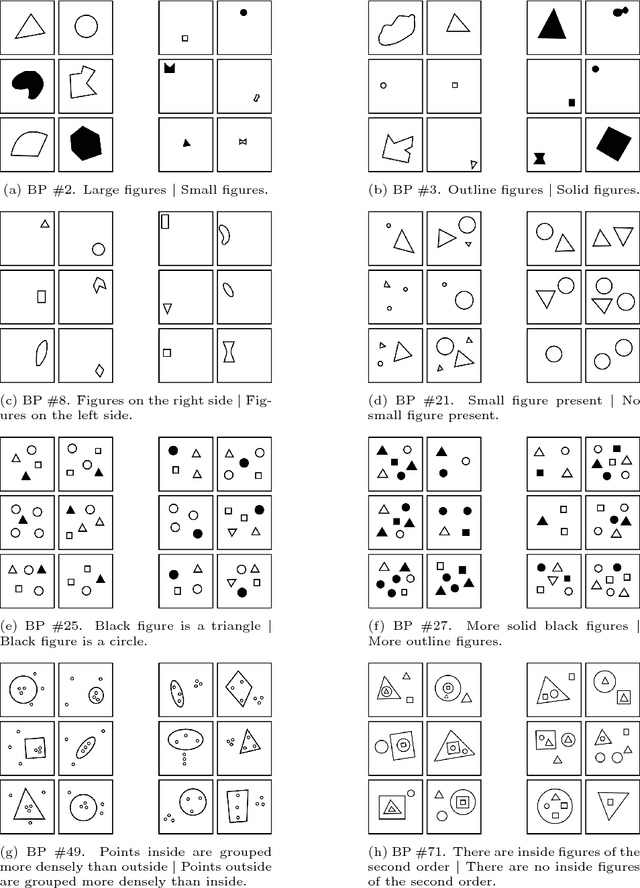
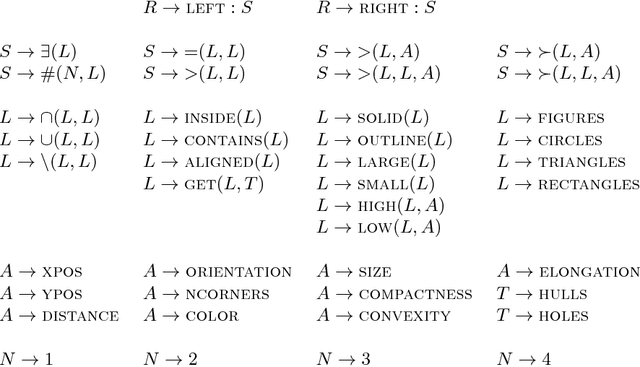
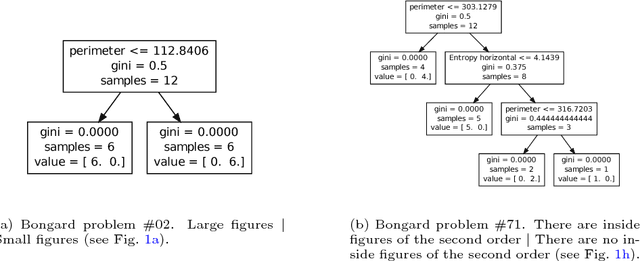
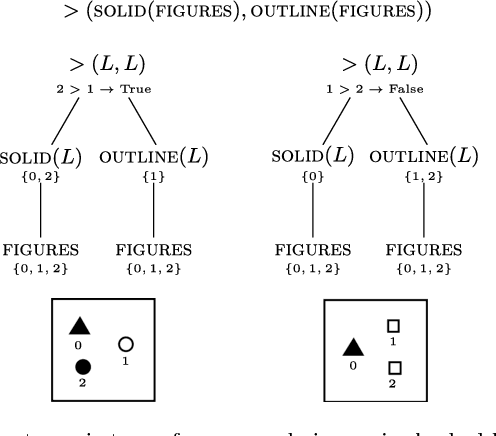
More than 50 years ago Bongard introduced 100 visual concept learning problems as a testbed for intelligent vision systems. These problems are now known as Bongard problems. Although they are well known in the cognitive science and AI communities only moderate progress has been made towards building systems that can solve a substantial subset of them. In the system presented here, visual features are extracted through image processing and then translated into a symbolic visual vocabulary. We introduce a formal language that allows representing complex visual concepts based on this vocabulary. Using this language and Bayesian inference, complex visual concepts can be induced from the examples that are provided in each Bongard problem. Contrary to other concept learning problems the examples from which concepts are induced are not random in Bongard problems, instead they are carefully chosen to communicate the concept, hence requiring pragmatic reasoning. Taking pragmatic reasoning into account we find good agreement between the concepts with high posterior probability and the solutions formulated by Bongard himself. While this approach is far from solving all Bongard problems, it solves the biggest fraction yet.