 Add to Chrome
 Add to Firefox
 Add to Edge
Omni-Judge: Can Omni-LLMs Serve as Human-Aligned Judges for Text-Conditioned Audio-Video Generation?
Feb 02, 2026
State-of-the-art text-to-video generation models such as Sora 2 and Veo 3 can now produce high-fidelity videos with synchronized audio directly from a textual prompt, marking a new milestone in multi-modal generation. However, evaluating such tri-modal outputs remains an unsolved challenge. Human evaluation is reliable but costly and difficult to scale, while traditional automatic metrics, such as FVD, CLAP, and ViCLIP, focus on isolated modality pairs, struggle with complex prompts, and provide limited interpretability. Omni-modal large language models (omni-LLMs) present a promising alternative: they naturally process audio, video, and text, support rich reasoning, and offer interpretable chain-of-thought feedback. Driven by this, we introduce Omni-Judge, a study assessing whether omni-LLMs can serve as human-aligned judges for text-conditioned audio-video generation. Across nine perceptual and alignment metrics, Omni-Judge achieves correlation comparable to traditional metrics and excels on semantically demanding tasks such as audio-text alignment, video-text alignment, and audio-video-text coherence. It underperforms on high-FPS perceptual metrics, including video quality and audio-video synchronization, due to limited temporal resolution. Omni-Judge provides interpretable explanations that expose semantic or physical inconsistencies, enabling practical downstream uses such as feedback-based refinement. Our findings highlight both the potential and current limitations of omni-LLMs as unified evaluators for multi-modal generation.

When to Think and When to Look: Uncertainty-Guided Lookback
Nov 19, 2025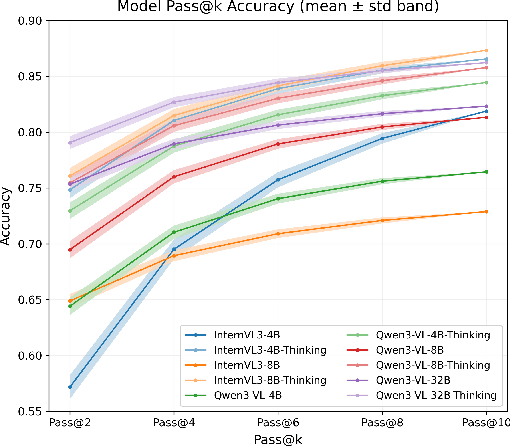

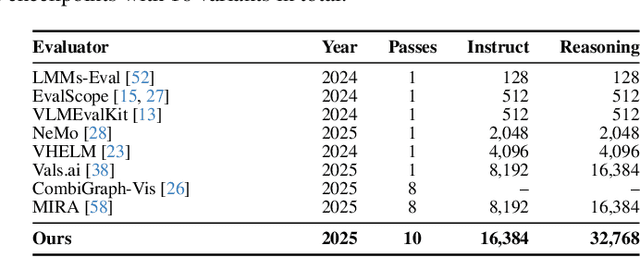
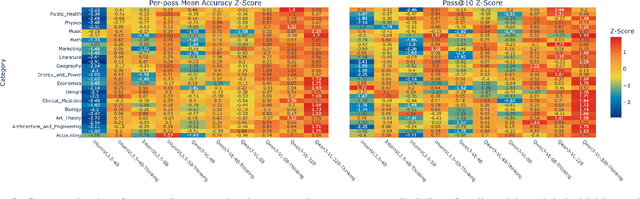
Test-time thinking (that is, generating explicit intermediate reasoning chains) is known to boost performance in large language models and has recently shown strong gains for large vision language models (LVLMs). However, despite these promising results, there is still no systematic analysis of how thinking actually affects visual reasoning. We provide the first such analysis with a large scale, controlled comparison of thinking for LVLMs, evaluating ten variants from the InternVL3.5 and Qwen3-VL families on MMMU-val under generous token budgets and multi pass decoding. We show that more thinking is not always better; long chains often yield long wrong trajectories that ignore the image and underperform the same models run in standard instruct mode. A deeper analysis reveals that certain short lookback phrases, which explicitly refer back to the image, are strongly enriched in successful trajectories and correlate with better visual grounding. Building on this insight, we propose uncertainty guided lookback, a training free decoding strategy that combines an uncertainty signal with adaptive lookback prompts and breadth search. Our method improves overall MMMU performance, delivers the largest gains in categories where standard thinking is weak, and outperforms several strong decoding baselines, setting a new state of the art under fixed model families and token budgets. We further show that this decoding strategy generalizes, yielding consistent improvements on five additional benchmarks, including two broad multimodal suites and math focused visual reasoning datasets.
VITRO: Vocabulary Inversion for Time-series Representation Optimization
Dec 23, 2024Although LLMs have demonstrated remarkable capabilities in processing and generating textual data, their pre-trained vocabularies are ill-suited for capturing the nuanced temporal dynamics and patterns inherent in time series. The discrete, symbolic nature of natural language tokens, which these vocabularies are designed to represent, does not align well with the continuous, numerical nature of time series data. To address this fundamental limitation, we propose VITRO. Our method adapts textual inversion optimization from the vision-language domain in order to learn a new time series per-dataset vocabulary that bridges the gap between the discrete, semantic nature of natural language and the continuous, numerical nature of time series data. We show that learnable time series-specific pseudo-word embeddings represent time series data better than existing general language model vocabularies, with VITRO-enhanced methods achieving state-of-the-art performance in long-term forecasting across most datasets.