 Add to Chrome
 Add to Firefox
 Add to Edge
Neuro-Inspired Visual Pattern Recognition via Biological Reservoir Computing
Feb 05, 2026
In this paper, we present a neuro-inspired approach to reservoir computing (RC) in which a network of in vitro cultured cortical neurons serves as the physical reservoir. Rather than relying on artificial recurrent models to approximate neural dynamics, our biological reservoir computing (BRC) system leverages the spontaneous and stimulus-evoked activity of living neural circuits as its computational substrate. A high-density multi-electrode array (HD-MEA) provides simultaneous stimulation and readout across hundreds of channels: input patterns are delivered through selected electrodes, while the remaining ones capture the resulting high-dimensional neural responses, yielding a biologically grounded feature representation. A linear readout layer (single-layer perceptron) is then trained to classify these reservoir states, enabling the living neural network to perform static visual pattern-recognition tasks within a computer-vision framework. We evaluate the system across a sequence of tasks of increasing difficulty, ranging from pointwise stimuli to oriented bars, clock-digit-like shapes, and handwritten digits from the MNIST dataset. Despite the inherent variability of biological neural responses-arising from noise, spontaneous activity, and inter-session differences-the system consistently generates high-dimensional representations that support accurate classification. These results demonstrate that in vitro cortical networks can function as effective reservoirs for static visual pattern recognition, opening new avenues for integrating living neural substrates into neuromorphic computing frameworks. More broadly, this work contributes to the effort to incorporate biological principles into machine learning and supports the goals of neuro-inspired vision by illustrating how living neural systems can inform the design of efficient and biologically grounded computational models.

From Neurons to Computation: Biological Reservoir Computing for Pattern Recognition
May 06, 2025In this paper, we introduce a novel paradigm for reservoir computing (RC) that leverages a pool of cultured biological neurons as the reservoir substrate, creating a biological reservoir computing (BRC). This system operates similarly to an echo state network (ESN), with the key distinction that the neural activity is generated by a network of cultured neurons, rather than being modeled by traditional artificial computational units. The neuronal activity is recorded using a multi-electrode array (MEA), which enables high-throughput recording of neural signals. In our approach, inputs are introduced into the network through a subset of the MEA electrodes, while the remaining electrodes capture the resulting neural activity. This generates a nonlinear mapping of the input data to a high-dimensional biological feature space, where distinguishing between data becomes more efficient and straightforward, allowing a simple linear classifier to perform pattern recognition tasks effectively. To evaluate the performance of our proposed system, we present an experimental study that includes various input patterns, such as positional codes, bars with different orientations, and a digit recognition task. The results demonstrate the feasibility of using biological neural networks to perform tasks traditionally handled by artificial neural networks, paving the way for further exploration of biologically-inspired computing systems, with potential applications in neuromorphic engineering and bio-hybrid computing.
Assessing Pattern Recognition Performance of Neuronal Cultures through Accurate Simulation
Jan 22, 2021
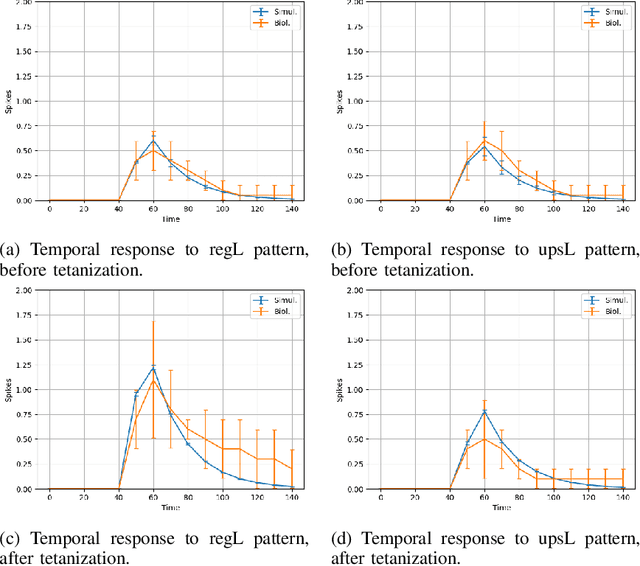
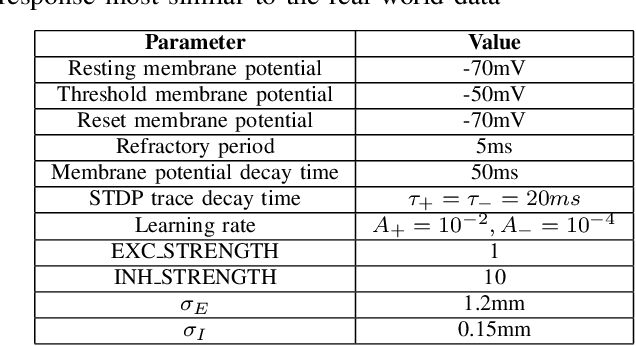
Previous work has shown that it is possible to train neuronal cultures on Multi-Electrode Arrays (MEAs), to recognize very simple patterns. However, this work was mainly focused to demonstrate that it is possible to induce plasticity in cultures, rather than performing a rigorous assessment of their pattern recognition performance. In this paper, we address this gap by developing a methodology that allows us to assess the performance of neuronal cultures on a learning task. Specifically, we propose a digital model of the real cultured neuronal networks; we identify biologically plausible simulation parameters that allow us to reliably reproduce the behavior of real cultures; we use the simulated culture to perform handwritten digit recognition and rigorously evaluate its performance; we also show that it is possible to find improved simulation parameters for the specific task, which can guide the creation of real cultures.