 Add to Chrome
 Add to Firefox
 Add to Edge
A Non-Invasive 3D Gait Analysis Framework for Quantifying Psychomotor Retardation in Major Depressive Disorder
Jan 27, 2026
Predicting the status of Major Depressive Disorder (MDD) from objective, non-invasive methods is an active research field. Yet, extracting automatically objective, interpretable features for a detailed analysis of the patient state remains largely unexplored. Among MDD's symptoms, Psychomotor retardation (PMR) is a core item, yet its clinical assessment remains largely subjective. While 3D motion capture offers an objective alternative, its reliance on specialized hardware often precludes routine clinical use. In this paper, we propose a non-invasive computational framework that transforms monocular RGB video into clinically relevant 3D gait kinematics. Our pipeline uses Gravity-View Coordinates along with a novel trajectory-correction algorithm that leverages the closed-loop topology of our adapted Timed Up and Go (TUG) protocol to mitigate monocular depth errors. This novel pipeline enables the extraction of 297 explicit gait biomechanical biomarkers from a single camera capture. To address the challenges of small clinical datasets, we introduce a stability-based machine learning framework that identifies robust motor signatures while preventing overfitting. Validated on the CALYPSO dataset, our method achieves an 83.3% accuracy in detecting PMR and explains 64% of the variance in overall depression severity (R^2=0.64). Notably, our study reveals a strong link between reduced ankle propulsion and restricted pelvic mobility to the depressive motor phenotype. These results demonstrate that physical movement serves as a robust proxy for the cognitive state, offering a transparent and scalable tool for the objective monitoring of depression in standard clinical environments.

EyeTheia: A Lightweight and Accessible Eye-Tracking Toolbox
Jan 09, 2026We introduce EyeTheia, a lightweight and open deep learning pipeline for webcam-based gaze estimation, designed for browser-based experimental platforms and real-world cognitive and clinical research. EyeTheia enables real-time gaze tracking using only a standard laptop webcam, combining MediaPipe-based landmark extraction with a convolutional neural network inspired by iTracker and optional user-specific fine-tuning. We investigate two complementary strategies: adapting a model pretrained on mobile data and training the same architecture from scratch on a desktop-oriented dataset. Validation results on MPIIFaceGaze show comparable performance between both approaches prior to calibration, while lightweight user-specific fine-tuning consistently reduces gaze prediction error. We further evaluate EyeTheia in a realistic Dot-Probe task and compare it to the commercial webcam-based tracker SeeSo SDK. Results indicate strong agreement in left-right gaze allocation during stimulus presentation, despite higher temporal variability. Overall, EyeTheia provides a transparent and extensible solution for low-cost gaze tracking, suitable for scalable and reproducible experimental and clinical studies. The code, trained models, and experimental materials are publicly available.
Fusion of Physiological and Behavioural Signals on SPD Manifolds with Application to Stress and Pain Detection
Jul 17, 2022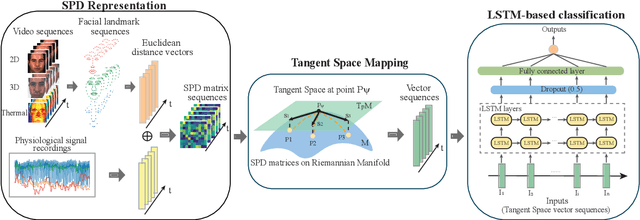
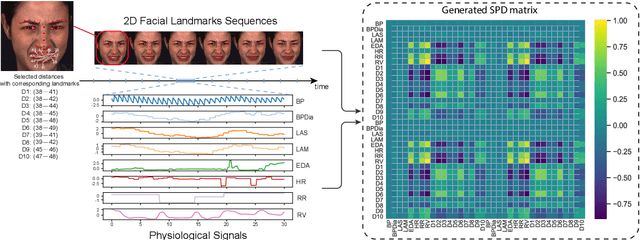

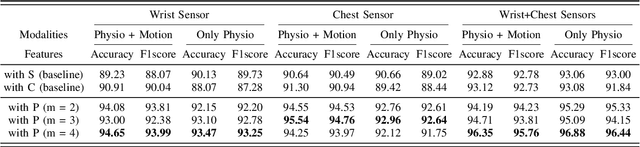
Existing multimodal stress/pain recognition approaches generally extract features from different modalities independently and thus ignore cross-modality correlations. This paper proposes a novel geometric framework for multimodal stress/pain detection utilizing Symmetric Positive Definite (SPD) matrices as a representation that incorporates the correlation relationship of physiological and behavioural signals from covariance and cross-covariance. Considering the non-linearity of the Riemannian manifold of SPD matrices, well-known machine learning techniques are not suited to classify these matrices. Therefore, a tangent space mapping method is adopted to map the derived SPD matrix sequences to the vector sequences in the tangent space where the LSTM-based network can be applied for classification. The proposed framework has been evaluated on two public multimodal datasets, achieving both the state-of-the-art results for stress and pain detection tasks.