 Add to Chrome
 Add to Firefox
 Add to Edge
From Fragmentation to Integration: Exploring the Design Space of AI Agents for Human-as-the-Unit Privacy Management
Feb 04, 2026
Managing one's digital footprint is overwhelming, as it spans multiple platforms and involves countless context-dependent decisions. Recent advances in agentic AI offer ways forward by enabling holistic, contextual privacy-enhancing solutions. Building on this potential, we adopted a ''human-as-the-unit'' perspective and investigated users' cross-context privacy challenges through 12 semi-structured interviews. Results reveal that people rely on ad hoc manual strategies while lacking comprehensive privacy controls, highlighting nine privacy-management challenges across applications, temporal contexts, and relationships. To explore solutions, we generated nine AI agent concepts and evaluated them via a speed-dating survey with 116 US participants. The three highest-ranked concepts were all post-sharing management tools with half or full agent autonomy, with users expressing greater trust in AI accuracy than in their own efforts. Our findings highlight a promising design space where users see AI agents bridging the fragments in privacy management, particularly through automated, comprehensive post-sharing remediation of users' digital footprints.

Rescriber: Smaller-LLM-Powered User-Led Data Minimization for Navigating Privacy Trade-offs in LLM-Based Conversational Agent
Oct 10, 2024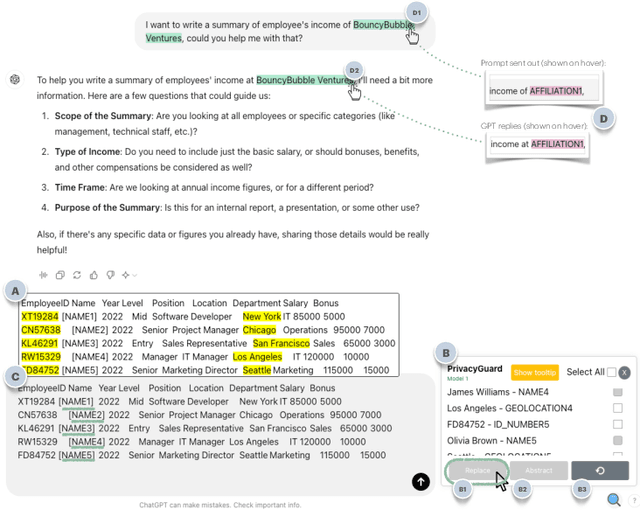
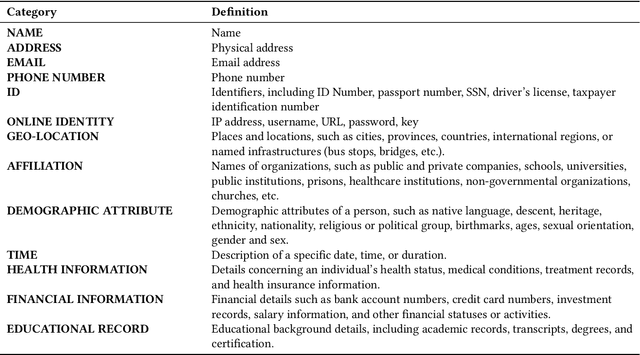
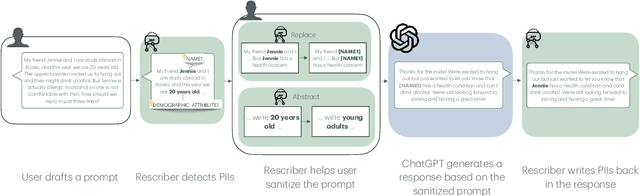

The proliferation of LLM-based conversational agents has resulted in excessive disclosure of identifiable or sensitive information. However, existing technologies fail to offer perceptible control or account for users' personal preferences about privacy-utility tradeoffs due to the lack of user involvement. To bridge this gap, we designed, built, and evaluated Rescriber, a browser extension that supports user-led data minimization in LLM-based conversational agents by helping users detect and sanitize personal information in their prompts. Our studies (N=12) showed that Rescriber helped users reduce unnecessary disclosure and addressed their privacy concerns. Users' subjective perceptions of the system powered by Llama3-8B were on par with that by GPT-4. The comprehensiveness and consistency of the detection and sanitization emerge as essential factors that affect users' trust and perceived protection. Our findings confirm the viability of smaller-LLM-powered, user-facing, on-device privacy controls, presenting a promising approach to address the privacy and trust challenges of AI.