 Add to Chrome
 Add to Firefox
 Add to Edge
Disentangled Point Diffusion for Precise Object Placement
Apr 13, 2026
Recent advances in robotic manipulation have highlighted the effectiveness of learning from demonstration. However, while end-to-end policies excel in expressivity and flexibility, they struggle both in generalizing to novel object geometries and in attaining a high degree of precision. An alternative, object-centric approach frames the task as predicting the placement pose of the target object, providing a modular decomposition of the problem. Building on this goal-prediction paradigm, we propose TAX-DPD, a hierarchical, disentangled point diffusion framework that achieves state-of-the-art performance in placement precision, multi-modal coverage, and generalization to variations in object geometries and scene configurations. We model global scene-level placements through a novel feed-forward Dense Gaussian Mixture Model (GMM) that yields a spatially dense prior over global placements; we then model the local object-level configuration through a novel disentangled point cloud diffusion module that separately diffuses the object geometry and the placement frame, enabling precise local geometric reasoning. Interestingly, we demonstrate that our point cloud diffusion achieves substantially higher accuracy than a prior approach based on SE(3)-diffusion, even in the context of rigid object placement. We validate our approach across a suite of challenging tasks in simulation and in the real-world on high-precision industrial insertion tasks. Furthermore, we present results on a cloth-hanging task in simulation, indicating that our framework can further relax assumptions on object rigidity.

Non-rigid Relative Placement through 3D Dense Diffusion
Oct 29, 2024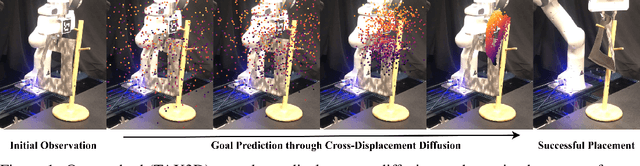
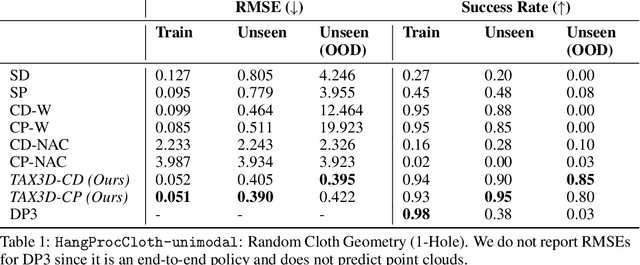
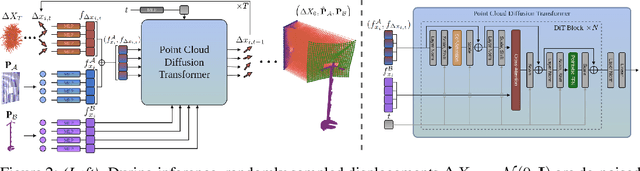
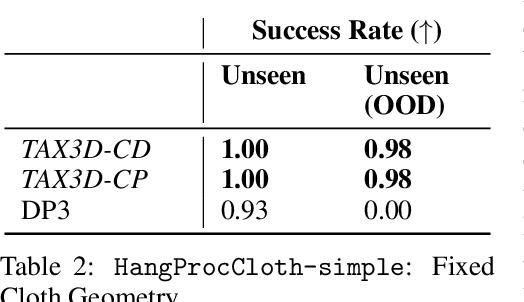
The task of "relative placement" is to predict the placement of one object in relation to another, e.g. placing a mug onto a mug rack. Through explicit object-centric geometric reasoning, recent methods for relative placement have made tremendous progress towards data-efficient learning for robot manipulation while generalizing to unseen task variations. However, they have yet to represent deformable transformations, despite the ubiquity of non-rigid bodies in real world settings. As a first step towards bridging this gap, we propose ``cross-displacement" - an extension of the principles of relative placement to geometric relationships between deformable objects - and present a novel vision-based method to learn cross-displacement through dense diffusion. To this end, we demonstrate our method's ability to generalize to unseen object instances, out-of-distribution scene configurations, and multimodal goals on multiple highly deformable tasks (both in simulation and in the real world) beyond the scope of prior works. Supplementary information and videos can be found at https://sites.google.com/view/tax3d-corl-2024 .