 Add to Chrome
 Add to Firefox
 Add to Edge
Cascaded Transfer: Learning Many Tasks under Budget Constraints
Jan 29, 2026
Many-Task Learning refers to the setting where a large number of related tasks need to be learned, the exact relationships between tasks are not known. We introduce the Cascaded Transfer Learning, a novel many-task transfer learning paradigm where information (e.g. model parameters) cascades hierarchically through tasks that are learned by individual models of the same class, while respecting given budget constraints. The cascade is organized as a rooted tree that specifies the order in which tasks are learned and refined. We design a cascaded transfer mechanism deployed over a minimum spanning tree structure that connects the tasks according to a suitable distance measure, and allocates the available training budget along its branches. Experiments on synthetic and real many-task settings show that the resulting method enables more accurate and cost effective adaptation across large task collections compared to alternative approaches.

Leveraging Graph Neural Networks to Forecast Electricity Consumption
Aug 30, 2024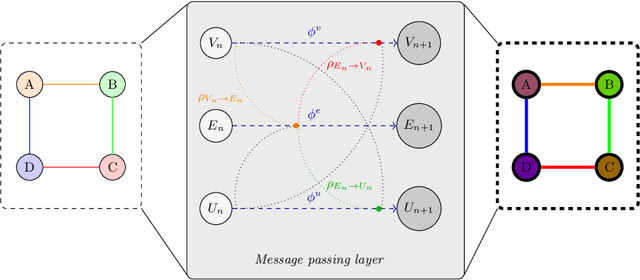
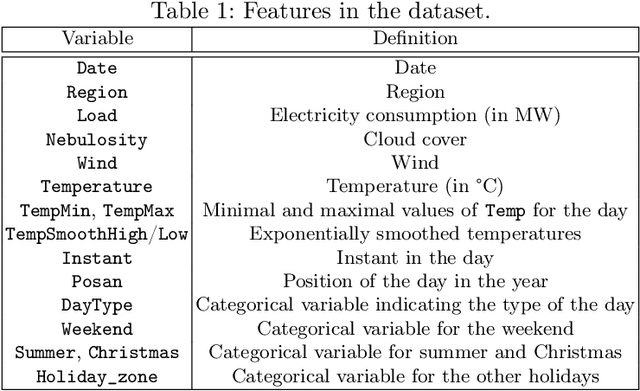
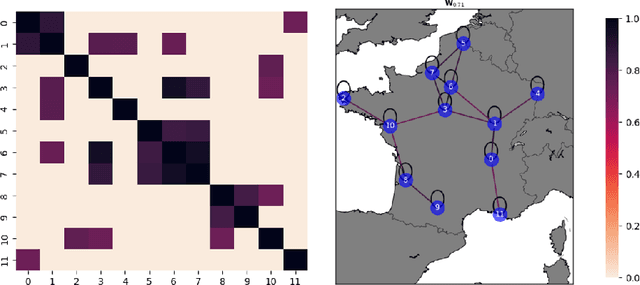
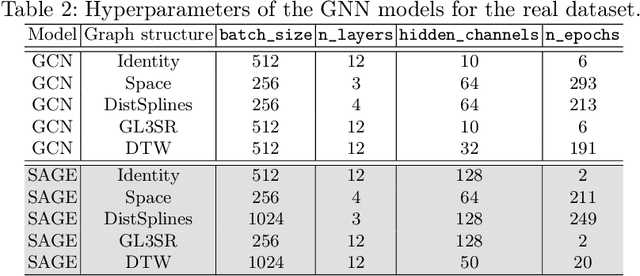
Accurate electricity demand forecasting is essential for several reasons, especially as the integration of renewable energy sources and the transition to a decentralized network paradigm introduce greater complexity and uncertainty. The proposed methodology leverages graph-based representations to effectively capture the spatial distribution and relational intricacies inherent in this decentralized network structure. This research work offers a novel approach that extends beyond the conventional Generalized Additive Model framework by considering models like Graph Convolutional Networks or Graph SAGE. These graph-based models enable the incorporation of various levels of interconnectedness and information sharing among nodes, where each node corresponds to the combined load (i.e. consumption) of a subset of consumers (e.g. the regions of a country). More specifically, we introduce a range of methods for inferring graphs tailored to consumption forecasting, along with a framework for evaluating the developed models in terms of both performance and explainability. We conduct experiments on electricity forecasting, in both a synthetic and a real framework considering the French mainland regions, and the performance and merits of our approach are discussed.