 Add to Chrome
 Add to Firefox
 Add to Edge
Test-Time Trajectory Optimization for Autonomous Driving
Jun 05, 2026
End-to-end planners for autonomous driving typically generate a set of candidate trajectories, score each one, and return the highest-scoring candidate. However, the scorer is applied only after the proposals are generated and cannot influence the set of trajectories: a weak set of candidates limits planning performance regardless of the scorer's quality. We instead treat the scorer as a learned trajectory-level reward function and search for trajectories that maximize it. Our method, TOAD, runs the Cross-Entropy Method at test time, warm-started from the planner's proposals. It requires no retraining and is plug-and-play for existing planners. Across six base planners, TOAD improves results on NAVSIM-v1 (94.7 PDMS), NAVSIM-v2 (56.3 EPDMS), and the closed-loop HUGSIM benchmark. The code will be made publicly available via the project page: https://valeoai.github.io/TOAD/.

Test-Time Conditioning with Representation-Aligned Visual Features
Feb 03, 2026While representation alignment with self-supervised models has been shown to improve diffusion model training, its potential for enhancing inference-time conditioning remains largely unexplored. We introduce Representation-Aligned Guidance (REPA-G), a framework that leverages these aligned representations, with rich semantic properties, to enable test-time conditioning from features in generation. By optimizing a similarity objective (the potential) at inference, we steer the denoising process toward a conditioned representation extracted from a pre-trained feature extractor. Our method provides versatile control at multiple scales, ranging from fine-grained texture matching via single patches to broad semantic guidance using global image feature tokens. We further extend this to multi-concept composition, allowing for the faithful combination of distinct concepts. REPA-G operates entirely at inference time, offering a flexible and precise alternative to often ambiguous text prompts or coarse class labels. We theoretically justify how this guidance enables sampling from the potential-induced tilted distribution. Quantitative results on ImageNet and COCO demonstrate that our approach achieves high-quality, diverse generations. Code is available at https://github.com/valeoai/REPA-G.
Leveraging 3D Representation Alignment and RGB Pretrained Priors for LiDAR Scene Generation
Jan 12, 2026LiDAR scene synthesis is an emerging solution to scarcity in 3D data for robotic tasks such as autonomous driving. Recent approaches employ diffusion or flow matching models to generate realistic scenes, but 3D data remains limited compared to RGB datasets with millions of samples. We introduce R3DPA, the first LiDAR scene generation method to unlock image-pretrained priors for LiDAR point clouds, and leverage self-supervised 3D representations for state-of-the-art results. Specifically, we (i) align intermediate features of our generative model with self-supervised 3D features, which substantially improves generation quality; (ii) transfer knowledge from large-scale image-pretrained generative models to LiDAR generation, mitigating limited LiDAR datasets; and (iii) enable point cloud control at inference for object inpainting and scene mixing with solely an unconditional model. On the KITTI-360 benchmark R3DPA achieves state of the art performance. Code and pretrained models are available at https://github.com/valeoai/R3DPA.
Driving on Registers
Jan 08, 2026We present DrivoR, a simple and efficient transformer-based architecture for end-to-end autonomous driving. Our approach builds on pretrained Vision Transformers (ViTs) and introduces camera-aware register tokens that compress multi-camera features into a compact scene representation, significantly reducing downstream computation without sacrificing accuracy. These tokens drive two lightweight transformer decoders that generate and then score candidate trajectories. The scoring decoder learns to mimic an oracle and predicts interpretable sub-scores representing aspects such as safety, comfort, and efficiency, enabling behavior-conditioned driving at inference. Despite its minimal design, DrivoR outperforms or matches strong contemporary baselines across NAVSIM-v1, NAVSIM-v2, and the photorealistic closed-loop HUGSIM benchmark. Our results show that a pure-transformer architecture, combined with targeted token compression, is sufficient for accurate, efficient, and adaptive end-to-end driving. Code and checkpoints will be made available via the project page.
LOGen: Toward Lidar Object Generation by Point Diffusion
Dec 10, 2024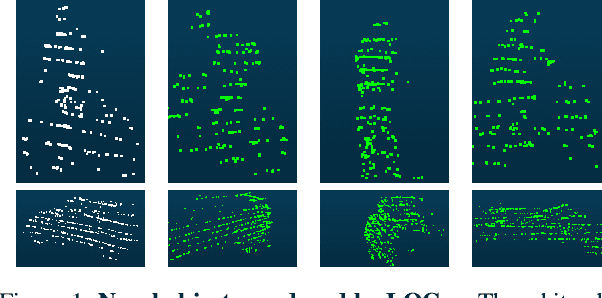
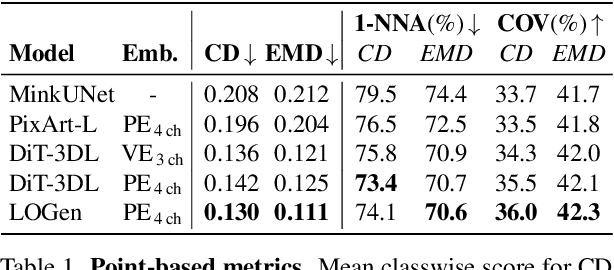
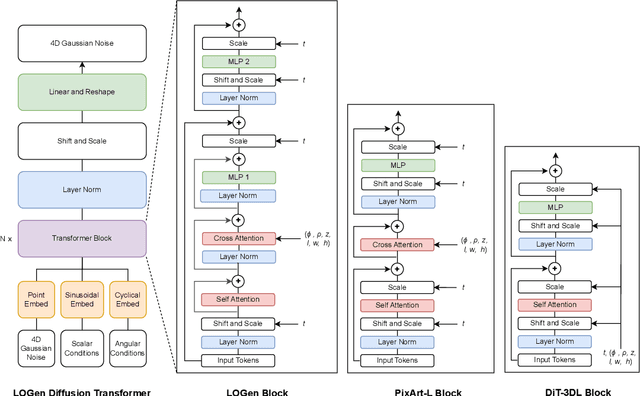
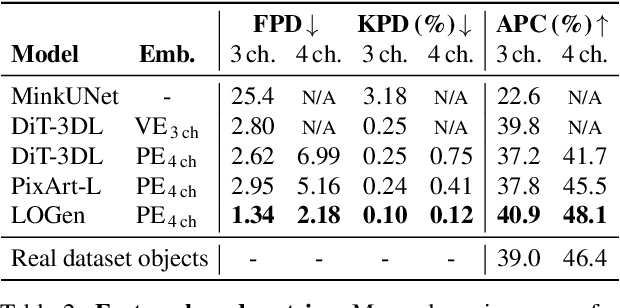
A common strategy to improve lidar segmentation results on rare semantic classes consists of pasting objects from one lidar scene into another. While this augments the quantity of instances seen at training time and varies their context, the instances fundamentally remain the same. In this work, we explore how to enhance instance diversity using a lidar object generator. We introduce a novel diffusion-based method to produce lidar point clouds of dataset objects, including reflectance, and with an extensive control of the generation via conditioning information. Our experiments on nuScenes show the quality of our object generations measured with new 3D metrics developed to suit lidar objects.