 Add to Chrome
 Add to Firefox
 Add to Edge
Neural ocean forecasting from sparse satellite-derived observations: a case-study for SSH dynamics and altimetry data
Dec 15, 2025
We present an end-to-end deep learning framework for short-term forecasting of global sea surface dynamics based on sparse satellite altimetry data. Building on two state-of-the-art architectures: U-Net and 4DVarNet, originally developed for image segmentation and spatiotemporal interpolation respectively, we adapt the models to forecast the sea level anomaly and sea surface currents over a 7-day horizon using sequences of sparse nadir altimeters observations. The model is trained on data from the GLORYS12 operational ocean reanalysis, with synthetic nadir sampling patterns applied to simulate realistic observational coverage. The forecasting task is formulated as a sequence-to-sequence mapping, with the input comprising partial sea level anomaly (SLA) snapshots and the target being the corresponding future full-field SLA maps. We evaluate model performance using (i) normalized root mean squared error (nRMSE), (ii) averaged effective resolution, (iii) percentage of correctly predicted velocities magnitudes and angles, and benchmark results against the operational Mercator Ocean forecast product. Results show that end-to-end neural forecasts outperform the baseline across all lead times, with particularly notable improvements in high variability regions. Our framework is developed within the OceanBench benchmarking initiative, promoting reproducibility and standardized evaluation in ocean machine learning. These results demonstrate the feasibility and potential of end-to-end neural forecasting models for operational oceanography, even in data-sparse conditions.

Deep learning for Lagrangian drift simulation at the sea surface
Nov 17, 2022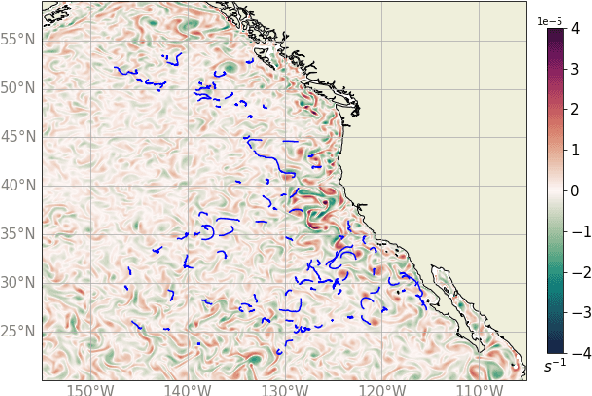
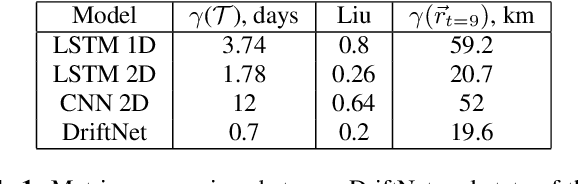
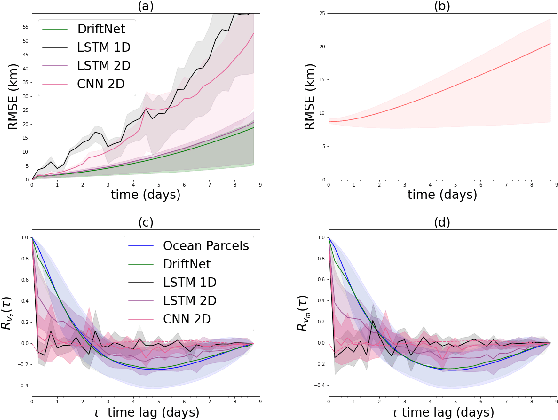
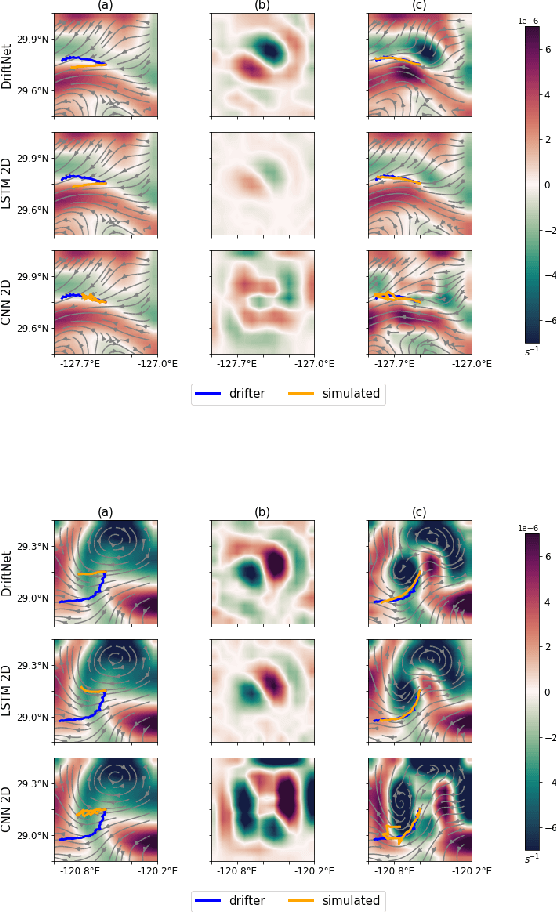
We address Lagrangian drift simulation in geophysical dynamics and explore deep learning approaches to overcome known limitations of state-of-the-art model-based and Markovian approaches in terms of computational complexity and error propagation. We introduce a novel architecture, referred to as DriftNet, inspired from the Eulerian Fokker-Planck representation of Lagrangian dynamics. Numerical experiments for Lagrangian drift simulation at the sea surface demonstrates the relevance of DriftNet w.r.t. state-of-the-art schemes. Benefiting from the fully-convolutional nature of Drift-Net, we explore through a neural inversion how to diagnose modelderived velocities w.r.t. real drifter trajectories.