 Add to Chrome
 Add to Firefox
 Add to Edge
The Llama 4 Herd: Architecture, Training, Evaluation, and Deployment Notes
Jan 15, 2026
This document consolidates publicly reported technical details about Metas Llama 4 model family. It summarizes (i) released variants (Scout and Maverick) and the broader herd context including the previewed Behemoth teacher model, (ii) architectural characteristics beyond a high-level MoE description covering routed/shared-expert structure, early-fusion multimodality, and long-context design elements reported for Scout (iRoPE and length generalization strategies), (iii) training disclosures spanning pre-training, mid-training for long-context extension, and post-training methodology (lightweight SFT, online RL, and lightweight DPO) as described in release materials, (iv) developer-reported benchmark results for both base and instruction-tuned checkpoints, and (v) practical deployment constraints observed across major serving environments, including provider-specific context limits and quantization packaging. The manuscript also summarizes licensing obligations relevant to redistribution and derivative naming, and reviews publicly described safeguards and evaluation practices. The goal is to provide a compact technical reference for researchers and practitioners who need precise, source-backed facts about Llama 4.

Olive Oil is Made of Olives, Baby Oil is Made for Babies: Interpreting Noun Compounds using Paraphrases in a Neural Model
Mar 21, 2018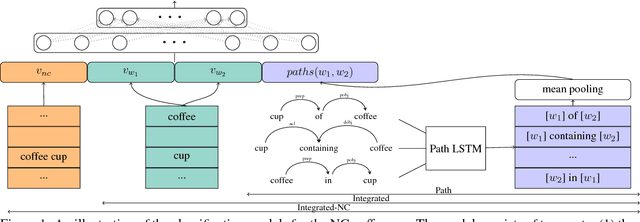
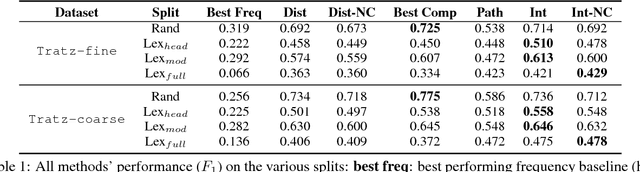
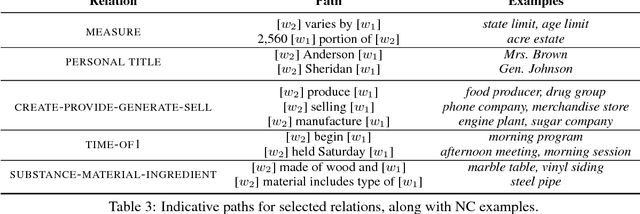
Automatic interpretation of the relation between the constituents of a noun compound, e.g. olive oil (source) and baby oil (purpose) is an important task for many NLP applications. Recent approaches are typically based on either noun-compound representations or paraphrases. While the former has initially shown promising results, recent work suggests that the success stems from memorizing single prototypical words for each relation. We explore a neural paraphrasing approach that demonstrates superior performance when such memorization is not possible.
Swivel: Improving Embeddings by Noticing What's Missing
Feb 06, 2016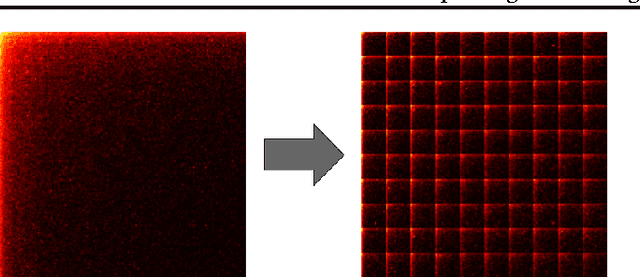
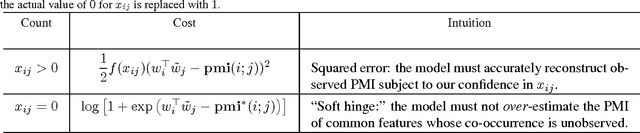
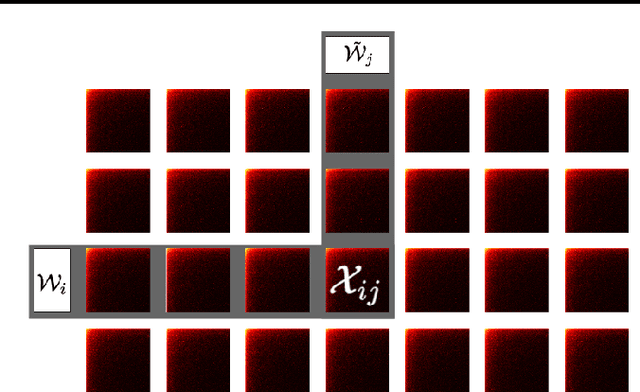

We present Submatrix-wise Vector Embedding Learner (Swivel), a method for generating low-dimensional feature embeddings from a feature co-occurrence matrix. Swivel performs approximate factorization of the point-wise mutual information matrix via stochastic gradient descent. It uses a piecewise loss with special handling for unobserved co-occurrences, and thus makes use of all the information in the matrix. While this requires computation proportional to the size of the entire matrix, we make use of vectorized multiplication to process thousands of rows and columns at once to compute millions of predicted values. Furthermore, we partition the matrix into shards in order to parallelize the computation across many nodes. This approach results in more accurate embeddings than can be achieved with methods that consider only observed co-occurrences, and can scale to much larger corpora than can be handled with sampling methods.