 Add to Chrome
 Add to Firefox
 Add to Edge
STAR: Semantic Table Representation with Header-Aware Clustering and Adaptive Weighted Fusion
Jan 22, 2026
Table retrieval is the task of retrieving the most relevant tables from large-scale corpora given natural language queries. However, structural and semantic discrepancies between unstructured text and structured tables make embedding alignment particularly challenging. Recent methods such as QGpT attempt to enrich table semantics by generating synthetic queries, yet they still rely on coarse partial-table sampling and simple fusion strategies, which limit semantic diversity and hinder effective query-table alignment. We propose STAR (Semantic Table Representation), a lightweight framework that improves semantic table representation through semantic clustering and weighted fusion. STAR first applies header-aware K-means clustering to group semantically similar rows and selects representative centroid instances to construct a diverse partial table. It then generates cluster-specific synthetic queries to comprehensively cover the table's semantic space. Finally, STAR employs weighted fusion strategies to integrate table and query embeddings, enabling fine-grained semantic alignment. This design enables STAR to capture complementary information from structured and textual sources, improving the expressiveness of table representations. Experiments on five benchmarks show that STAR achieves consistently higher Recall than QGpT on all datasets, demonstrating the effectiveness of semantic clustering and adaptive weighted fusion for robust table representation. Our code is available at https://github.com/adsl135789/STAR.

CGPT: Cluster-Guided Partial Tables with LLM-Generated Supervision for Table Retrieval
Jan 22, 2026General-purpose embedding models have demonstrated strong performance in text retrieval but remain suboptimal for table retrieval, where highly structured content leads to semantic compression and query-table mismatch. Recent LLM-based retrieval augmentation methods mitigate this issue by generating synthetic queries, yet they often rely on heuristic partial-table selection and seldom leverage these synthetic queries as supervision to improve the embedding model. We introduce CGPT, a training framework that enhances table retrieval through LLM-generated supervision. CGPT constructs semantically diverse partial tables by clustering table instances using K-means and sampling across clusters to broaden semantic coverage. An LLM then generates synthetic queries for these partial tables, which are used in hard-negative contrastive fine-tuning to refine the embedding model. Experiments across four public benchmarks (MimoTable, OTTQA, FetaQA, and E2E-WTQ) show that CGPT consistently outperforms retrieval baselines, including QGpT, with an average R@1 improvement of 16.54 percent. In a unified multi-domain corpus setting, CGPT further demonstrates strong cross-domain generalization and remains effective even when using smaller LLMs for synthetic query generation. These results indicate that semantically guided partial-table construction, combined with contrastive training from LLM-generated supervision, provides an effective and scalable paradigm for large-scale table retrieval. Our code is available at https://github.com/yumeow0122/CGPT.
Learning-From-Mistakes Prompting for Indigenous Language Translation
Jul 18, 2024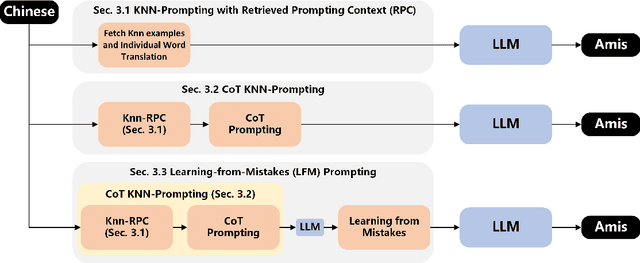
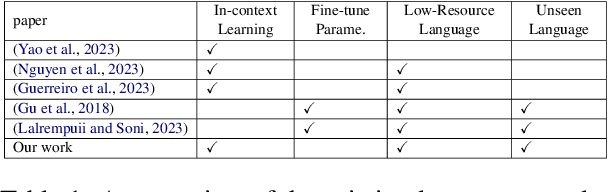
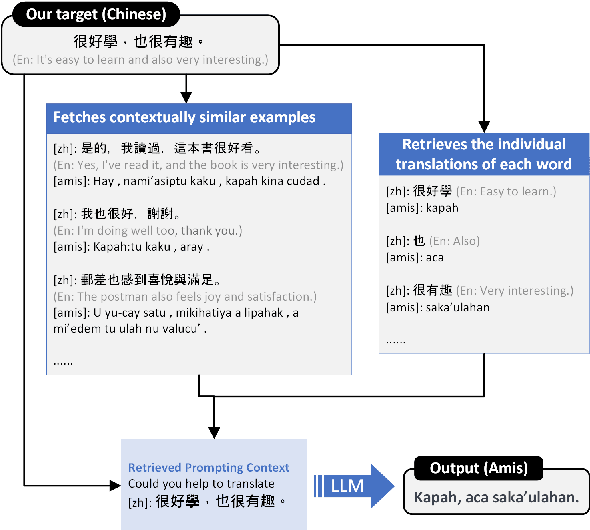
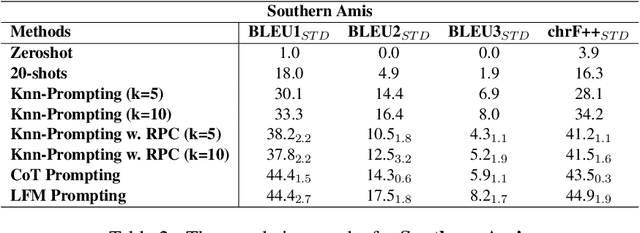
Using large language models, this paper presents techniques to improve extremely low-resourced indigenous language translations. Our approaches are grounded in the use of (1) the presence of a datastore consisting of a limited number of parallel translation examples, (2) the inherent capabilities of LLMs like GPT-3.5, and (3) a word-level translation dictionary. We harness the potential of LLMs and in-context learning techniques in such a setting for using LLMs as universal translators for extremely low-resourced languages. Our methodology hinges on utilizing LLMs as language compilers for selected language pairs, hypothesizing that they could internalize syntactic structures to facilitate accurate translation. We introduce three techniques: KNNPrompting with Retrieved Prompting Context, Chain-of-Thought Prompting and Learningfrom-Mistakes Prompting, with the last method addressing past errors. The evaluation results suggest that, even with limited corpora, LLMs can effectively translate extremely low-resource languages when paired with proper prompting.