 Add to Chrome
 Add to Firefox
 Add to Edge
Low Rank Transformer for Multivariate Time Series Anomaly Detection and Localization
Feb 09, 2026
Multivariate time series (MTS) anomaly diagnosis, which encompasses both anomaly detection and localization, is critical for the safety and reliability of complex, large-scale real-world systems. The vast majority of existing anomaly diagnosis methods offer limited theoretical insights, especially for anomaly localization, which is a vital but largely unexplored area. The aim of this contribution is to study the learning process of a Transformer when applied to MTS by revealing connections to statistical time series methods. Based on these theoretical insights, we propose the Attention Low-Rank Transformer (ALoRa-T) model, which applies low-rank regularization to self-attention, and we introduce the Attention Low-Rank score, effectively capturing the temporal characteristics of anomalies. Finally, to enable anomaly localization, we propose the ALoRa-Loc method, a novel approach that associates anomalies to specific variables by quantifying interrelationships among time series. Extensive experiments and real data analysis, show that the proposed methodology significantly outperforms state-of-the-art methods in both detection and localization tasks.

Transformer-based Multivariate Time Series Anomaly Localization
Jan 15, 2025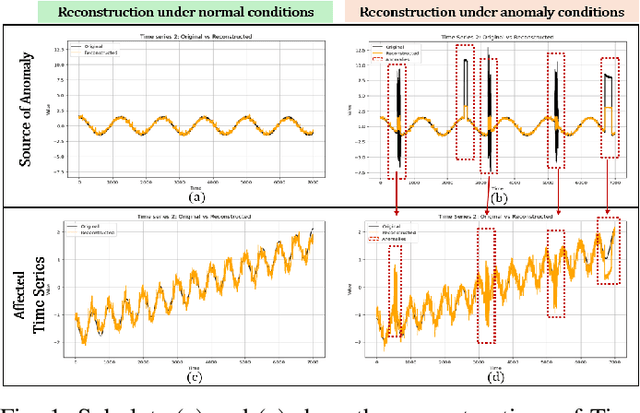
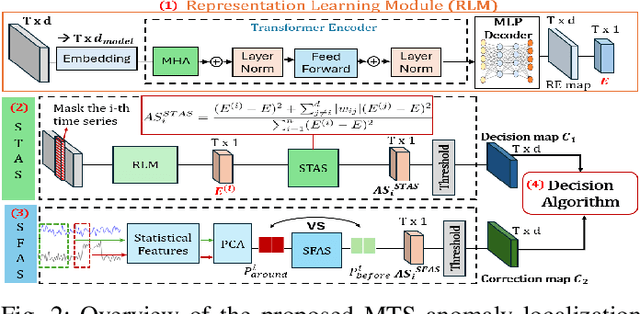
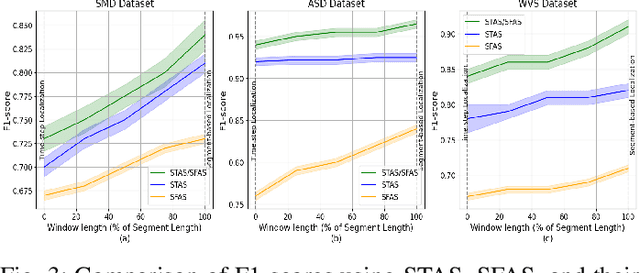
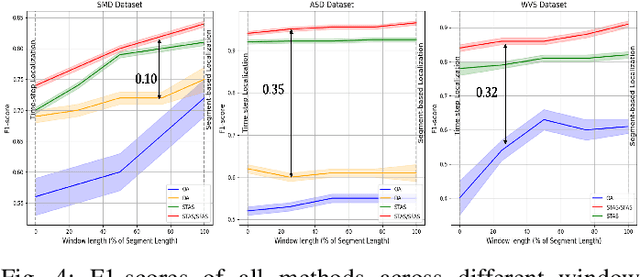
With the growing complexity of Cyber-Physical Systems (CPS) and the integration of Internet of Things (IoT), the use of sensors for online monitoring generates large volume of multivariate time series (MTS) data. Consequently, the need for robust anomaly diagnosis in MTS is paramount to maintaining system reliability and safety. While significant advancements have been made in anomaly detection, localization remains a largely underexplored area, though crucial for intelligent decision-making. This paper introduces a novel transformer-based model for unsupervised anomaly diagnosis in MTS, with a focus on improving localization performance, through an in-depth analysis of the self-attention mechanism's learning behavior under both normal and anomalous conditions. We formulate the anomaly localization problem as a three-stage process: time-step, window, and segment-based. This leads to the development of the Space-Time Anomaly Score (STAS), a new metric inspired by the connection between transformer latent representations and space-time statistical models. STAS is designed to capture individual anomaly behaviors and inter-series dependencies, delivering enhanced localization performance. Additionally, the Statistical Feature Anomaly Score (SFAS) complements STAS by analyzing statistical features around anomalies, with their combination helping to reduce false alarms. Experiments on real world and synthetic datasets illustrate the model's superiority over state-of-the-art methods in both detection and localization tasks.