 Add to Chrome
 Add to Firefox
 Add to Edge
End-to-end Differentiable Calibration and Reconstruction for Optical Particle Detectors
Feb 27, 2026
Large-scale homogeneous detectors with optical readouts are widely used in particle detection, with Cherenkov and scintillator neutrino detectors as prominent examples. Analyses in experimental physics rely on high-fidelity simulators to translate sensor-level information into physical quantities of interest. This task critically depends on accurate calibration, which aligns simulation behavior with real detector data, and on tracking, which infers particle properties from optical signals. We present the first end-to-end differentiable optical particle detector simulator, enabling simultaneous calibration and reconstruction through gradient-based optimization. Our approach unifies simulation, calibration, and tracking, which are traditionally treated as separate problems, within a single differentiable framework. We demonstrate that it achieves smooth and physically meaningful gradients across all key stages of light generation, propagation, and detection while maintaining computational efficiency. We show that gradient-based calibration and reconstruction greatly simplify existing analysis pipelines while matching or surpassing the performance of conventional non-differentiable methods in both accuracy and speed. Moreover, the framework's modularity allows straightforward adaptation to diverse detector geometries and target materials, providing a flexible foundation for experiment design and optimization. The results demonstrate the readiness of this technique for adoption in current and future optical detector experiments, establishing a new paradigm for simulation and reconstruction in particle physics.

Data-driven detector signal characterization with constrained bottleneck autoencoders
Apr 04, 2022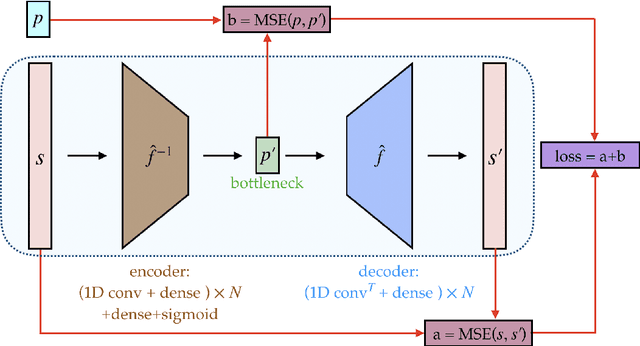
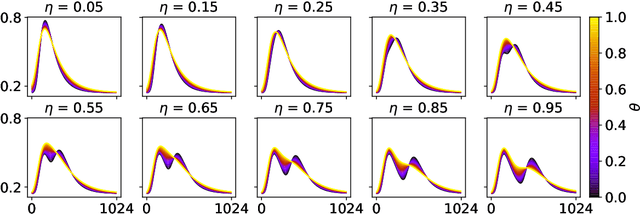
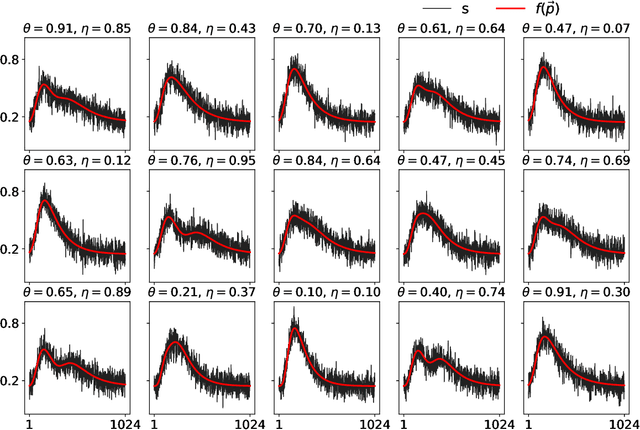
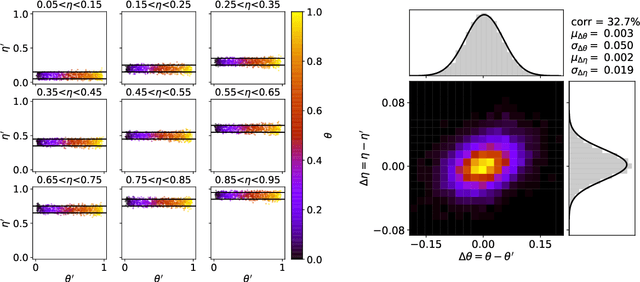
A common technique in high energy physics is to characterize the response of a detector by means of models tunned to data which build parametric maps from the physical parameters of the system to the expected signal of the detector. When the underlying model is unknown it is difficult to apply this method, and often, simplifying assumptions are made introducing modeling errors. In this article, using a waveform toy model we present how deep learning in the form of constrained bottleneck autoencoders can be used to learn the underlying unknown detector response model directly from data. The results show that excellent performance results can be achieved even when the signals are significantly affected by random noise. The trained algorithm can be used simultaneously to perform estimations on the physical parameters of the model, simulate the detector response with high fidelity and to denoise detector signals.