 Add to Chrome
 Add to Firefox
 Add to Edge
Synapse-Inspired Energy Networks: A Neuromorphic Approach to Microgrid Protection without Communication Links
Feb 25, 2026
Traditional protection systems for microgrids, which rely on high fault currents and continuous communication, struggle to keep up with the changing dynamics and cybersecurity concerns of decentralized networks. In this study, we introduce a novel biologically inspired protection system based on neuromorphic principles, where each distributed energy resource (DER) functions as a simple neuron. These neurons process local changes in voltage, current signals, and converting them into spike patterns that represent the severity of disturbances. Just as neurons communicate via synapses in biological systems, we exploit transmission cables to coordinate between DERs, enabling them to share information and respond to faults collectively. Fault detection and circuit breaker activation are driven by a First-To-Spike (FTTS) mechanism, similar to the concept of traveling wave protection, but without needing GPS synchronization or communication links. A key innovation is the ability to use the timing of spikes to locally determine the nature of a fault, offering an intelligent, adaptive response to disturbances. Performance shows tripping latency of 10-58 ms, surpassing conventional relays and even traveling-wave methods (60 ms), while maintaining detection accuracy above 98% and spatial selectivity over 97%, enabling real-time, communication-free, scalable protection for plug-and-play microgrids.

Wind ramp event prediction with parallelized Gradient Boosted Regression Trees
Oct 17, 2016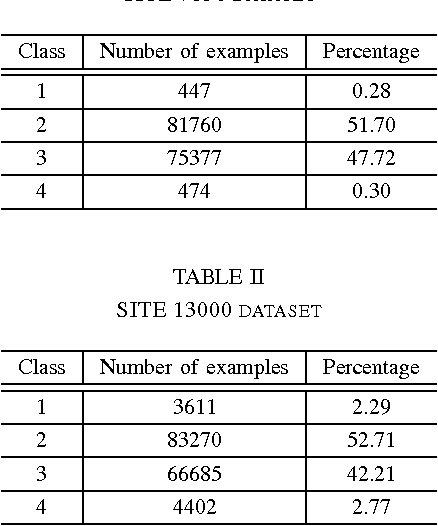
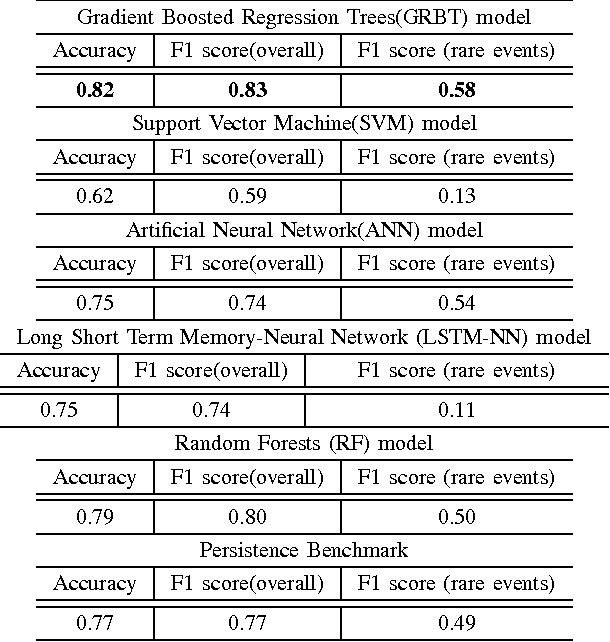
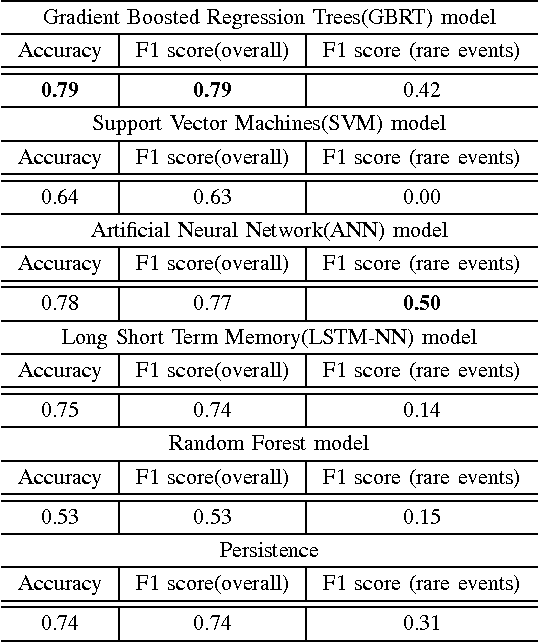
Accurate prediction of wind ramp events is critical for ensuring the reliability and stability of the power systems with high penetration of wind energy. This paper proposes a classification based approach for estimating the future class of wind ramp event based on certain thresholds. A parallelized gradient boosted regression tree based technique has been proposed to accurately classify the normal as well as rare extreme wind power ramp events. The model has been validated using wind power data obtained from the National Renewable Energy Laboratory database. Performance comparison with several benchmark techniques indicates the superiority of the proposed technique in terms of superior classification accuracy.