 Add to Chrome
 Add to Firefox
 Add to Edge
Vision Foundation Models in Agriculture: Toward Domain-Specific Adaptation for Weed Herbicide Trials Assessment
Nov 06, 2025
Herbicide field trials require accurate identification of plant species and assessment of herbicide-induced damage across diverse environments. While general-purpose vision foundation models have shown promising results in complex visual domains, their performance can be limited in agriculture, where fine-grained distinctions between species and damage types are critical. In this work, we adapt a general-purpose vision foundation model to herbicide trial characterization. Trained using a self-supervised learning approach on a large, curated agricultural dataset, the model learns rich and transferable representations optimized for herbicide trials images. Our domain-specific model significantly outperforms the best general-purpose foundation model in both species identification (F1 score improvement from 0.91 to 0.94) and damage classification (from 0.26 to 0.33). Under unseen conditions (new locations and other time), it achieves even greater gains (species identification from 0.56 to 0.66; damage classification from 0.17 to 0.27). In domain-shift scenarios, such as drone imagery, it maintains strong performance (species classification from 0.49 to 0.60). Additionally, we show that domain-specific pretraining enhances segmentation accuracy, particularly in low-annotation regimes. An annotation-efficiency analysis reveals that, under unseen conditions, the domain-specific model achieves 5.4% higher F1 score than the general-purpose model, while using 80% fewer labeled samples. These results demonstrate the generalization capabilities of domain-specific foundation models and their potential to significantly reduce manual annotation efforts, offering a scalable and automated solution for herbicide trial analysis.

AI-Assisted Colonoscopy: Polyp Detection and Segmentation using Foundation Models
Mar 31, 2025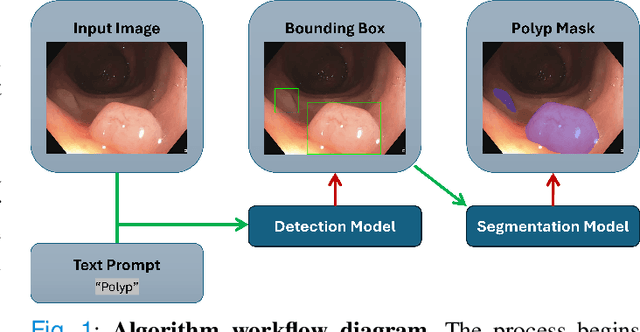
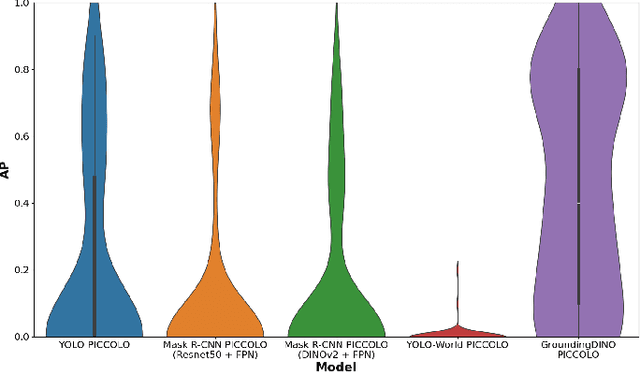
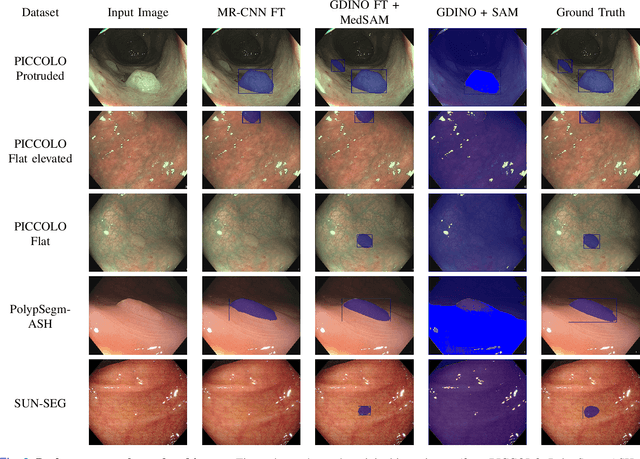
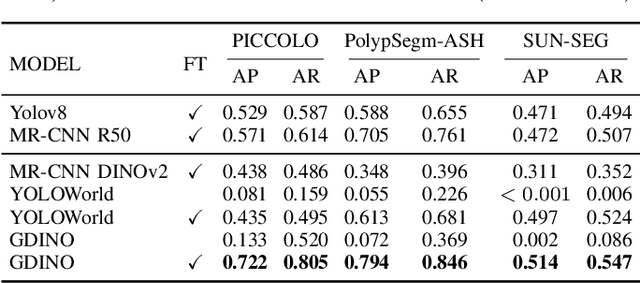
In colonoscopy, 80% of the missed polyps could be detected with the help of Deep Learning models. In the search for algorithms capable of addressing this challenge, foundation models emerge as promising candidates. Their zero-shot or few-shot learning capabilities, facilitate generalization to new data or tasks without extensive fine-tuning. A concept that is particularly advantageous in the medical imaging domain, where large annotated datasets for traditional training are scarce. In this context, a comprehensive evaluation of foundation models for polyp segmentation was conducted, assessing both detection and delimitation. For the study, three different colonoscopy datasets have been employed to compare the performance of five different foundation models, DINOv2, YOLO-World, GroundingDINO, SAM and MedSAM, against two benchmark networks, YOLOv8 and Mask R-CNN. Results show that the success of foundation models in polyp characterization is highly dependent on domain specialization. For optimal performance in medical applications, domain-specific models are essential, and generic models require fine-tuning to achieve effective results. Through this specialization, foundation models demonstrated superior performance compared to state-of-the-art detection and segmentation models, with some models even excelling in zero-shot evaluation; outperforming fine-tuned models on unseen data.