 Add to Chrome
 Add to Firefox
 Add to Edge
Context-Aware Autoencoders for Anomaly Detection in Maritime Surveillance
Jan 27, 2026
The detection of anomalies is crucial to ensuring the safety and security of maritime vessel traffic surveillance. Although autoencoders are popular for anomaly detection, their effectiveness in identifying collective and contextual anomalies is limited, especially in the maritime domain, where anomalies depend on vessel-specific contexts derived from self-reported AIS messages. To address these limitations, we propose a novel solution: the context-aware autoencoder. By integrating context-specific thresholds, our method improves detection accuracy and reduces computational cost. We compare four context-aware autoencoder variants and a conventional autoencoder using a case study focused on fishing status anomalies in maritime surveillance. Results demonstrate the significant impact of context on reconstruction loss and anomaly detection. The context-aware autoencoder outperforms others in detecting anomalies in time series data. By incorporating context-specific thresholds and recognizing the importance of context in anomaly detection, our approach offers a promising solution to improve accuracy in maritime vessel traffic surveillance systems.

DAE : Discriminatory Auto-Encoder for multivariate time-series anomaly detection in air transportation
Sep 08, 2021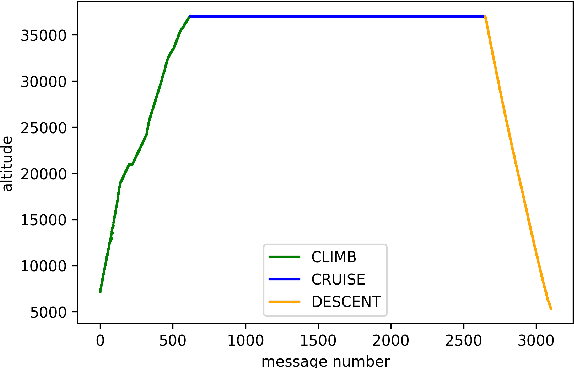
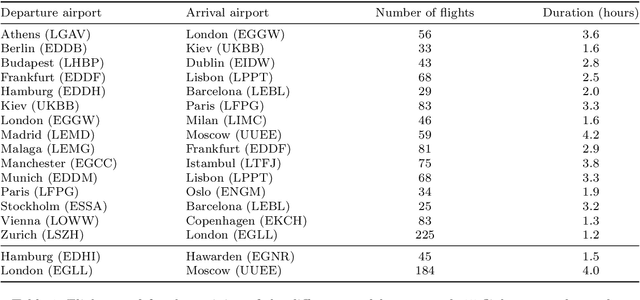
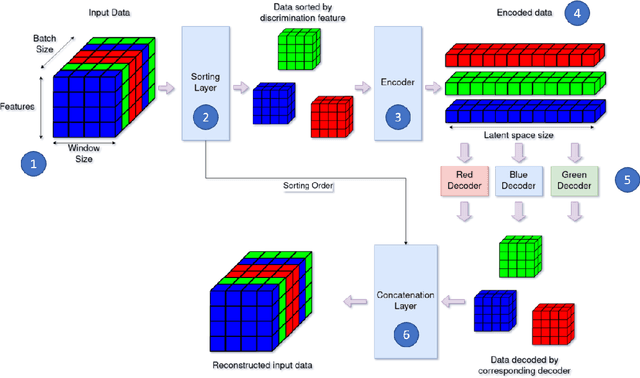

The Automatic Dependent Surveillance Broadcast protocol is one of the latest compulsory advances in air surveillance. While it supports the tracking of the ever-growing number of aircraft in the air, it also introduces cybersecurity issues that must be mitigated e.g., false data injection attacks where an attacker emits fake surveillance information. The recent data sources and tools available to obtain flight tracking records allow the researchers to create datasets and develop Machine Learning models capable of detecting such anomalies in En-Route trajectories. In this context, we propose a novel multivariate anomaly detection model called Discriminatory Auto-Encoder (DAE). It uses the baseline of a regular LSTM-based auto-encoder but with several decoders, each getting data of a specific flight phase (e.g. climbing, cruising or descending) during its training.To illustrate the DAE's efficiency, an evaluation dataset was created using real-life anomalies as well as realistically crafted ones, with which the DAE as well as three anomaly detection models from the literature were evaluated. Results show that the DAE achieves better results in both accuracy and speed of detection. The dataset, the models implementations and the evaluation results are available in an online repository, thereby enabling replicability and facilitating future experiments.