 Add to Chrome
 Add to Firefox
 Add to Edge
Cyberswarm: a novel swarm intelligence algorithm inspired by cyber community dynamics
Dec 14, 2025
Recommendation systems face challenges in dynamically adapting to evolving user preferences and interactions within complex social networks. Traditional approaches often fail to account for the intricate interactions within cyber-social systems and lack the flexibility to generalize across diverse domains, highlighting the need for more adaptive and versatile solutions. In this work, we introduce a general-purpose swarm intelligence algorithm for recommendation systems, designed to adapt seamlessly to varying applications. It was inspired by social psychology principles. The framework models user preferences and community influences within a dynamic hypergraph structure. It leverages centrality-based feature extraction and Node2Vec embeddings. Preference evolution is guided by message-passing mechanisms and hierarchical graph modeling, enabling real-time adaptation to changing behaviors. Experimental evaluations demonstrated the algorithm's superior performance in various recommendation tasks, including social networks and content discovery. Key metrics such as Hit Rate (HR), Mean Reciprocal Rank (MRR), and Normalized Discounted Cumulative Gain (NDCG) consistently outperformed baseline methods across multiple datasets. The model's adaptability to dynamic environments allowed for contextually relevant and precise recommendations. The proposed algorithm represents an advancement in recommendation systems by bridging individual preferences and community influences. Its general-purpose design enables applications in diverse domains, including social graphs, personalized learning, and medical graphs. This work highlights the potential of integrating swarm intelligence with network dynamics to address complex optimization challenges in recommendation systems.
* 49 pages, 15 figures

Monkey Optimization System with Active Membranes: A New Meta-heuristic Optimization System
Sep 30, 2019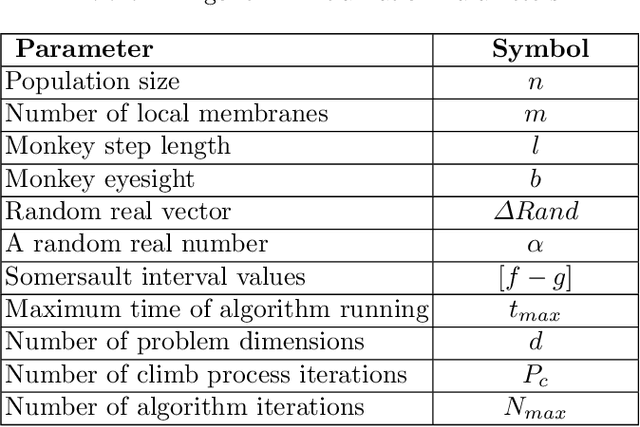
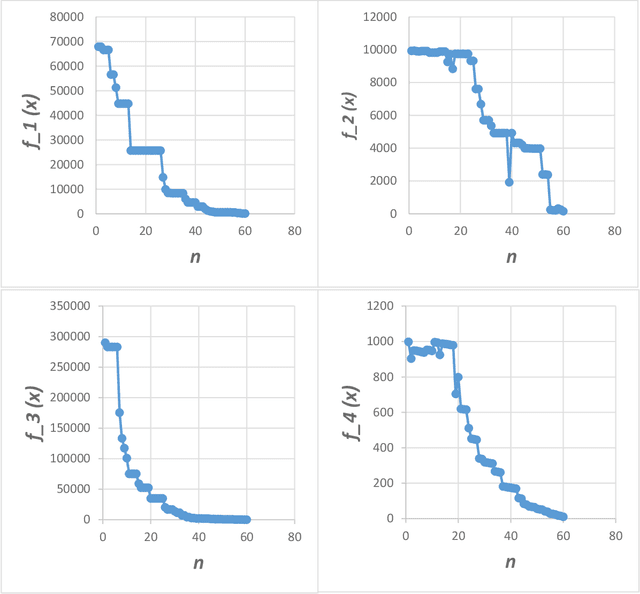
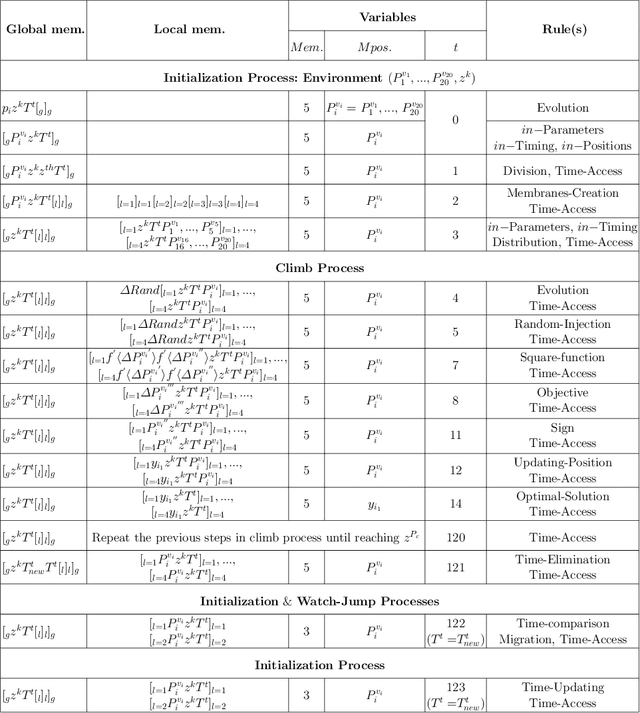
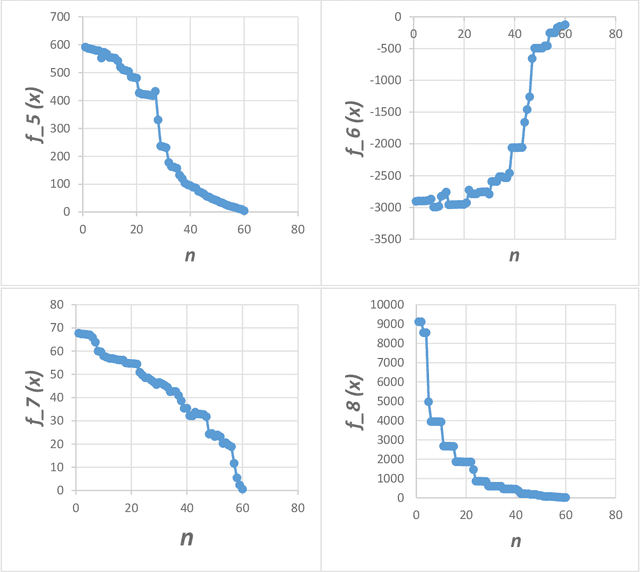
Optimization techniques, used to get the optimal solution in search spaces, have not solved the time-consuming problem. The objective of this study is to tackle the sequential processing problem in Monkey Algorithm and simulating the natural parallel behavior of monkeys. Therefore, a P system with active membranes is constructed by providing a codification for Monkey Algorithm within the context of a cell-like P system, defining accordingly the elements of the model - membrane structure, objects, rules and the behavior of it. The proposed algorithm has modeled the natural behavior of climb process using separate membranes, rather than the original algorithm. Moreover, it introduced the membrane migration process to select the best solution and the time stamp was added as an additional stopping criterion to control the timing of the algorithm. The results indicate a substantial solution for the time consumption problem, significant representation of the natural behavior of monkeys, and considerable chance to reach the best solution in the context of meta-heuristics purpose. In addition, experiments use the commonly used benchmark functions to test the performance of the algorithm as well as the expected time of the proposed P Monkey optimization algorithm and the traditional Monkey Algorithm running on population size. The unit times are calculated based on the complexity of algorithms, where P Monkey takes a time unit to fire rule(s) over a population size n; as soon as, Monkey Algorithm takes a time unit to run a step every mathematical equation over a population size.