 Add to Chrome
 Add to Firefox
 Add to Edge
The Stationarity Bias: Stratified Stress-Testing for Time-Series Imputation in Regulated Dynamical Systems
Feb 17, 2026
Time-series imputation benchmarks employ uniform random masking and shape-agnostic metrics (MSE, RMSE), implicitly weighting evaluation by regime prevalence. In systems with a dominant attractor -- homeostatic physiology, nominal industrial operation, stable network traffic -- this creates a systematic \emph{Stationarity Bias}: simple methods appear superior because the benchmark predominantly samples the easy, low-entropy regime where they trivially succeed. We formalize this bias and propose a \emph{Stratified Stress-Test} that partitions evaluation into Stationary and Transient regimes. Using Continuous Glucose Monitoring (CGM) as a testbed -- chosen for its rigorous ground-truth forcing functions (meals, insulin) that enable precise regime identification -- we establish three findings with broad implications:(i)~Stationary Efficiency: Linear interpolation achieves state-of-the-art reconstruction during stable intervals, confirming that complex architectures are computationally wasteful in low-entropy regimes.(ii)~Transient Fidelity: During critical transients (post-prandial peaks, hypoglycemic events), linear methods exhibit drastically degraded morphological fidelity (DTW), disproportionate to their RMSE -- a phenomenon we term the \emph{RMSE Mirage}, where low pointwise error masks the destruction of signal shape.(iii)~Regime-Conditional Model Selection: Deep learning models preserve both pointwise accuracy and morphological integrity during transients, making them essential for safety-critical downstream tasks. We further derive empirical missingness distributions from clinical trials and impose them on complete training data, preventing models from exploiting unrealistically clean observations and encouraging robustness under real-world missingness. This framework generalizes to any regulated system where routine stationarity dominates critical transients.

Mitigating Exposure Bias in Risk-Aware Time Series Forecasting with Soft Tokens
Dec 10, 2025Autoregressive forecasting is central to predictive control in diabetes and hemodynamic management, where different operating zones carry different clinical risks. Standard models trained with teacher forcing suffer from exposure bias, yielding unstable multi-step forecasts for closed-loop use. We introduce Soft-Token Trajectory Forecasting (SoTra), which propagates continuous probability distributions (``soft tokens'') to mitigate exposure bias and learn calibrated, uncertainty-aware trajectories. A risk-aware decoding module then minimizes expected clinical harm. In glucose forecasting, SoTra reduces average zone-based risk by 18\%; in blood-pressure forecasting, it lowers effective clinical risk by approximately 15\%. These improvements support its use in safety-critical predictive control.
Scalable Cosmic AI Inference using Cloud Serverless Computing with FMI
Jan 08, 2025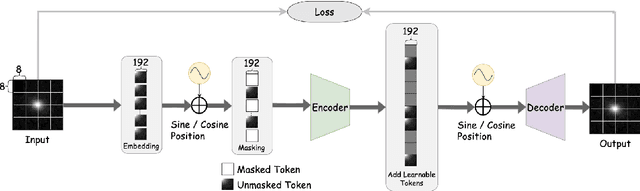
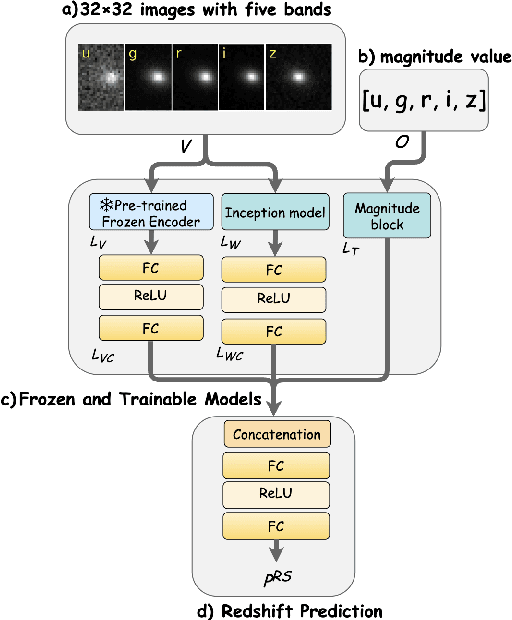
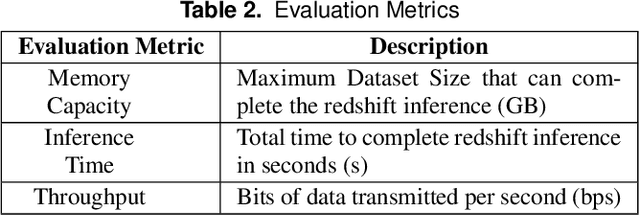
Large-scale astronomical image data processing and prediction is essential for astronomers, providing crucial insights into celestial objects, the universe's history, and its evolution. While modern deep learning models offer high predictive accuracy, they often demand substantial computational resources, making them resource-intensive and limiting accessibility. We introduce the Cloud-based Astronomy Inference (CAI) framework to address these challenges. This scalable solution integrates pre-trained foundation models with serverless cloud infrastructure through a Function-as-a-Service (FaaS) Message Interface (FMI). CAI enables efficient and scalable inference on astronomical images without extensive hardware. Using a foundation model for redshift prediction as a case study, our extensive experiments cover user devices, HPC (High-Performance Computing) servers, and Cloud. CAI's significant scalability improvement on large data sizes provides an accessible and effective tool for the astronomy community. The code is accessible at https://github.com/UVA-MLSys/AI-for-Astronomy.
AstroMAE: Redshift Prediction Using a Masked Autoencoder with a Novel Fine-Tuning Architecture
Sep 03, 2024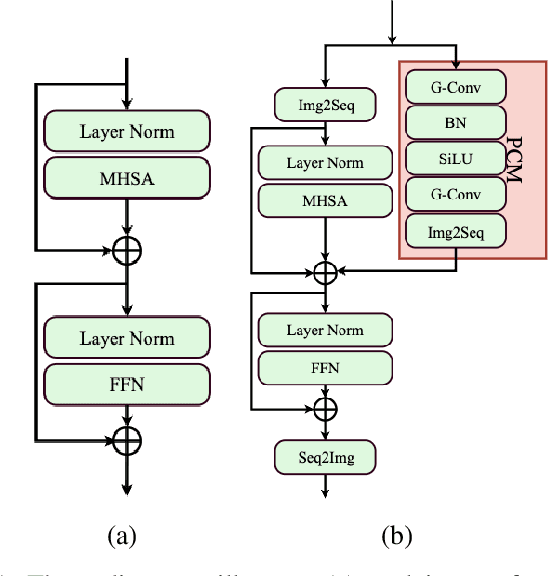
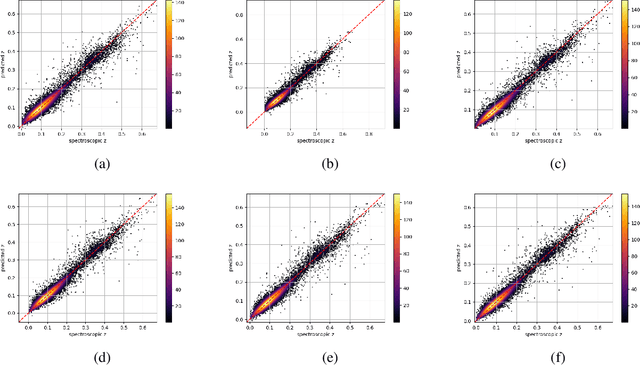
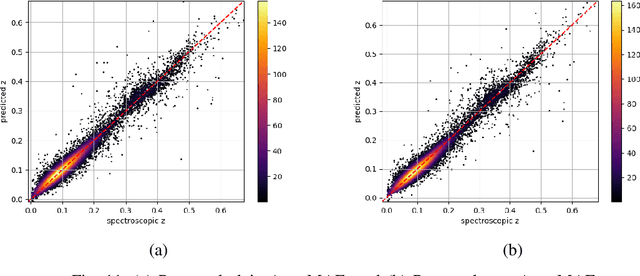
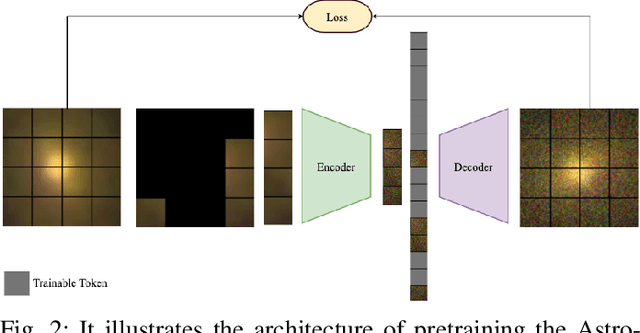
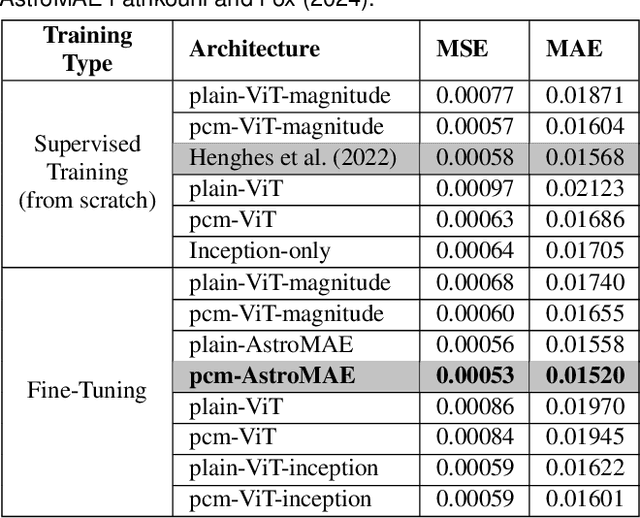
Redshift prediction is a fundamental task in astronomy, essential for understanding the expansion of the universe and determining the distances of astronomical objects. Accurate redshift prediction plays a crucial role in advancing our knowledge of the cosmos. Machine learning (ML) methods, renowned for their precision and speed, offer promising solutions for this complex task. However, traditional ML algorithms heavily depend on labeled data and task-specific feature extraction. To overcome these limitations, we introduce AstroMAE, an innovative approach that pretrains a vision transformer encoder using a masked autoencoder method on Sloan Digital Sky Survey (SDSS) images. This technique enables the encoder to capture the global patterns within the data without relying on labels. To the best of our knowledge, AstroMAE represents the first application of a masked autoencoder to astronomical data. By ignoring labels during the pretraining phase, the encoder gathers a general understanding of the data. The pretrained encoder is subsequently fine-tuned within a specialized architecture tailored for redshift prediction. We evaluate our model against various vision transformer architectures and CNN-based models, demonstrating the superior performance of AstroMAEs pretrained model and fine-tuning architecture.