 Add to Chrome
 Add to Firefox
 Add to Edge
Causal Unlearning in Collaborative Optimization: Exact and Approximate Influence Reversal under Adversarial Contributions
May 19, 2026
Federated learning systems must support data deletion requests to comply with privacy regulations, yet retraining from scratch after each deletion is computationally prohibitive. We present HF-KCU, a method that removes a client's contribution by approximating the influence function through conjugate gradient iterations in Krylov subspaces, reducing complexity from O(d^3) to O(kd) where k<<d.A causal weighting mechanism ensures that only clients holding the deleted data receive parameter updates, preventing spurious changes to unaffected clients. Our method is designed to handle bounded adversarial perturbations to the Hessian and gradient, providing graceful degradation under realistic threat models. We validate HF-KCU across convolutional (ResNet-18, SimpleCNN) and transformer (ViT-Lite) architectures on CIFAR-10, MNIST, and Fashion-MNIST. On CIFAR-10 under Dirichlet (alpha=0.5) partitioning, HF-KCU achieves 47.75 times speedup over retraining while maintaining test accuracy within 0.60% of the rational baseline(71.16 vs 71.76 %). Membership inference attacks on the forget set yield success rates of 0.499 matching the retrained model and confirming effective privacy restoration. We provide convergence guarantees showing that the Krylov approximation error decreases as O((k ^1/2-1)/(k^1/2+1)) where k is the Hessian condition number. The causal weighting mechanism ensures surgical updates, where only clients holding deleted data are modified, preserving model quality for unaffected participants and avoiding the instability of gradient-based approaches in asynchronous federated settings. This design provides interpretability as each update is directly traceable to the influence of the deleted data. The method's efficiency and precision make it suitable for production federated systems where deletion requests arrive asynchronously and computational budgets are constrained.

TinyGuard:A lightweight Byzantine Defense for Resource-Constrained Federated Learning via Statistical Update Fingerprints
Feb 02, 2026Existing Byzantine robust aggregation mechanisms typically rely on fulldimensional gradi ent comparisons or pairwise distance computations, resulting in computational overhead that limits applicability in large scale and resource constrained federated systems. This paper proposes TinyGuard, a lightweight Byzantine defense that augments the standard FedAvg algorithm via statistical update f ingerprinting. Instead of operating directly on high-dimensional gradients, TinyGuard extracts compact statistical fingerprints cap turing key behavioral properties of client updates, including norm statistics, layer-wise ratios, sparsity measures, and low-order mo ments. Byzantine clients are identified by measuring robust sta tistical deviations in this low-dimensional fingerprint space with nd complexity, without modifying the underlying optimization procedure. Extensive experiments on MNIST, Fashion-MNIST, ViT-Lite, and ViT-Small with LoRA adapters demonstrate that TinyGuard pre serves FedAvg convergence in benign settings and achieves up to 95 percent accuracy under multiple Byzantine attack scenarios, including sign-flipping, scaling, noise injection, and label poisoning. Against adaptive white-box adversaries, Pareto frontier analysis across four orders of magnitude confirms that attackers cannot simultaneously evade detection and achieve effective poisoning, features we term statistical handcuffs. Ablation studies validate stable detection precision 0.8 across varying client counts (50-150), threshold parameters and extreme data heterogeneity . The proposed framework is architecture-agnostic and well-suited for federated fine-tuning of foundation models where traditional Byzantine defenses become impractical
Investigation of inverse design of multilayer thin-films with conditional invertible Neural Networks
Oct 10, 2022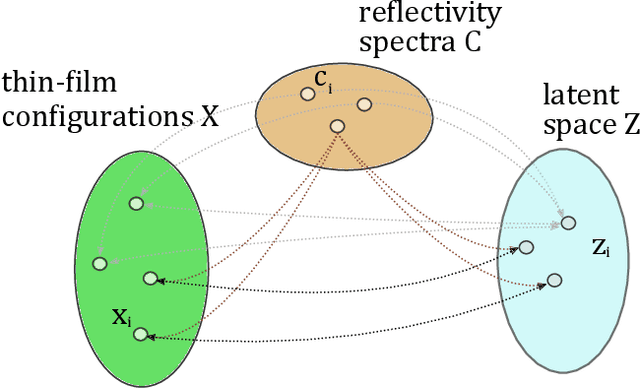
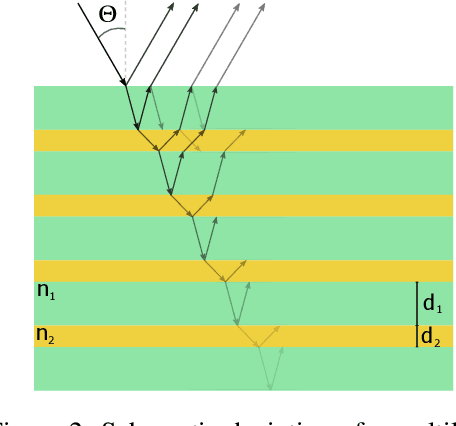
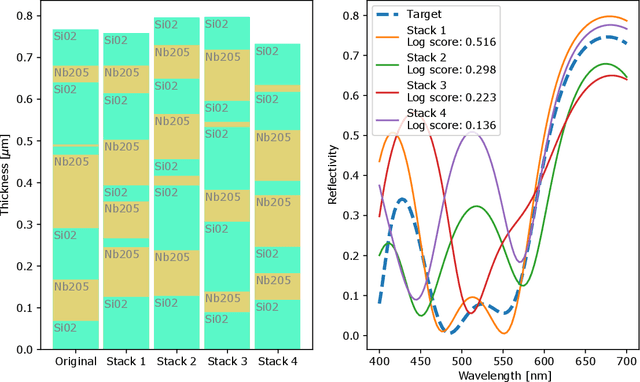
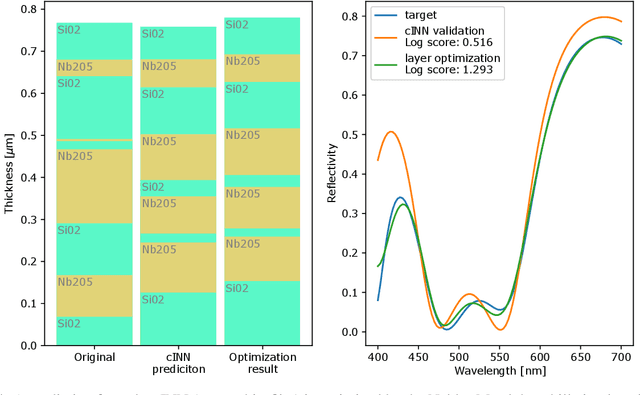
The task of designing optical multilayer thin-films regarding a given target is currently solved using gradient-based optimization in conjunction with methods that can introduce additional thin-film layers. Recently, Deep Learning and Reinforcement Learning have been been introduced to the task of designing thin-films with great success, however a trained network is usually only able to become proficient for a single target and must be retrained if the optical targets are varied. In this work, we apply conditional Invertible Neural Networks (cINN) to inversely designing multilayer thin-films given an optical target. Since the cINN learns the energy landscape of all thin-film configurations within the training dataset, we show that cINNs can generate a stochastic ensemble of proposals for thin-film configurations that that are reasonably close to the desired target depending only on random variables. By refining the proposed configurations further by a local optimization, we show that the generated thin-films reach the target with significantly greater precision than comparable state-of-the art approaches. Furthermore, we tested the generative capabilities on samples which are outside the training data distribution and found that the cINN was able to predict thin-films for out-of-distribution targets, too. The results suggest that in order to improve the generative design of thin-films, it is instructive to use established and new machine learning methods in conjunction in order to obtain the most favorable results.
TMM-Fast: A Transfer Matrix Computation Package for Multilayer Thin-Film Optimization
Nov 24, 2021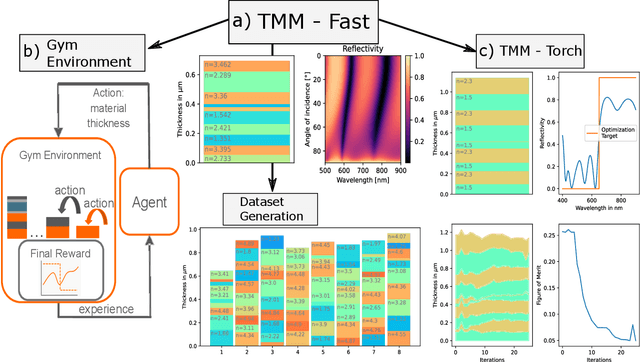
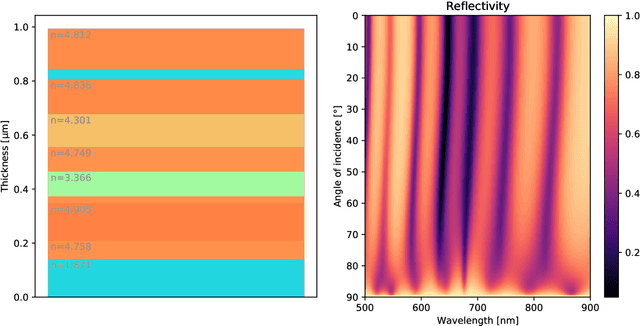
Achieving the desired optical response from a multilayer thin-film structure over a broad range of wavelengths and angles of incidence can be challenging. An advanced thin-film structure can consist of multiple materials with different thicknesses and numerous layers. Design and optimization of complex thin-film structures with multiple variables is a computationally heavy problem that is still under active research. To enable fast and easy experimentation with new optimization techniques, we propose the Python package TMM-Fast which enables parallelized computation of reflection and transmission of light at different angles of incidence and wavelengths through the multilayer thin-film. By decreasing computational time, generating datasets for machine learning becomes feasible and evolutionary optimization can be used effectively. Additionally, the sub-package TMM-Torch allows to directly compute analytical gradients for local optimization by using PyTorch Autograd functionality. Finally, an OpenAi Gym environment is presented which allows the user to train reinforcement learning agents on the problem of finding multilayer thin-film configurations.
Parameterized Reinforcement Learning for Optical System Optimization
Oct 09, 2020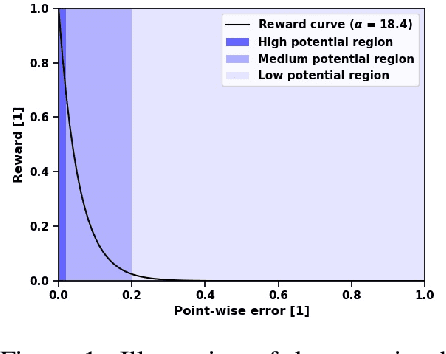

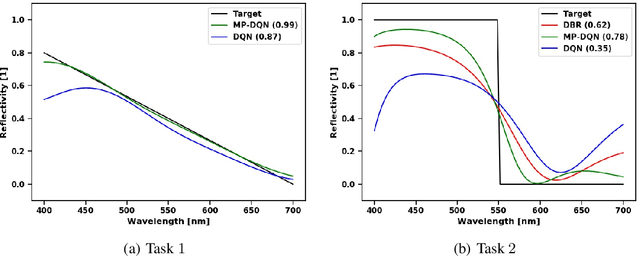
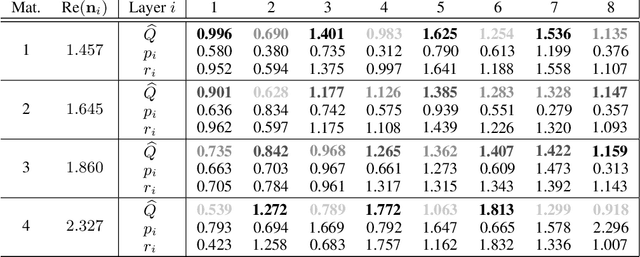
Designing a multi-layer optical system with designated optical characteristics is an inverse design problem in which the resulting design is determined by several discrete and continuous parameters. In particular, we consider three design parameters to describe a multi-layer stack: Each layer's dielectric material and thickness as well as the total number of layers. Such a combination of both, discrete and continuous parameters is a challenging optimization problem that often requires a computationally expensive search for an optimal system design. Hence, most methods merely determine the optimal thicknesses of the system's layers. To incorporate layer material and the total number of layers as well, we propose a method that considers the stacking of consecutive layers as parameterized actions in a Markov decision process. We propose an exponentially transformed reward signal that eases policy optimization and adapt a recent variant of Q-learning for inverse design optimization. We demonstrate that our method outperforms human experts and a naive reinforcement learning algorithm concerning the achieved optical characteristics. Moreover, the learned Q-values contain information about the optical properties of multi-layer optical systems, thereby allowing physical interpretation or what-if analysis.