 Add to Chrome
 Add to Firefox
 Add to Edge
LLMs Explain't: A Post-Mortem on Semantic Interpretability in Transformer Models
Jan 30, 2026
Large Language Models (LLMs) are becoming increasingly popular in pervasive computing due to their versatility and strong performance. However, despite their ubiquitous use, the exact mechanisms underlying their outstanding performance remain unclear. Different methods for LLM explainability exist, and many are, as a method, not fully understood themselves. We started with the question of how linguistic abstraction emerges in LLMs, aiming to detect it across different LLM modules (attention heads and input embeddings). For this, we used methods well-established in the literature: (1) probing for token-level relational structures, and (2) feature-mapping using embeddings as carriers of human-interpretable properties. Both attempts failed for different methodological reasons: Attention-based explanations collapsed once we tested the core assumption that later-layer representations still correspond to tokens. Property-inference methods applied to embeddings also failed because their high predictive scores were driven by methodological artifacts and dataset structure rather than meaningful semantic knowledge. These failures matter because both techniques are widely treated as evidence for what LLMs supposedly understand, yet our results show such conclusions are unwarranted. These limitations are particularly relevant in pervasive and distributed computing settings where LLMs are deployed as system components and interpretability methods are relied upon for debugging, compression, and explaining models.

Automating Violence Detection and Categorization from Ancient Texts
Mar 11, 2025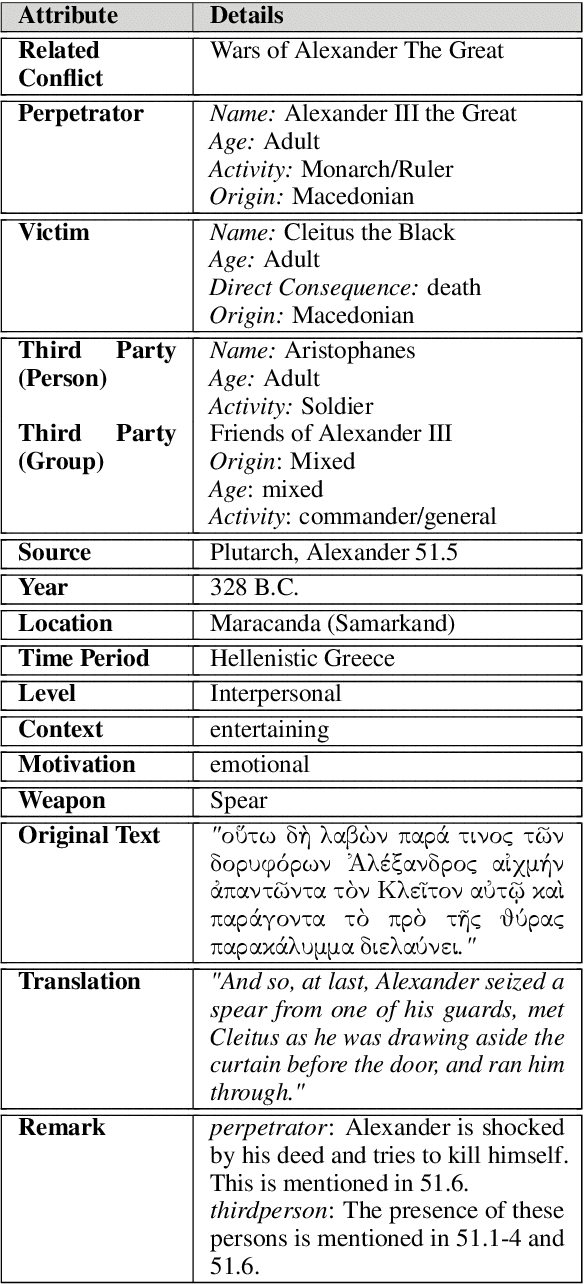
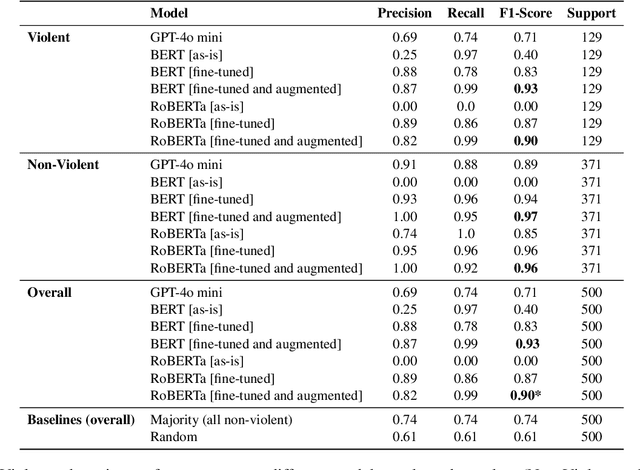
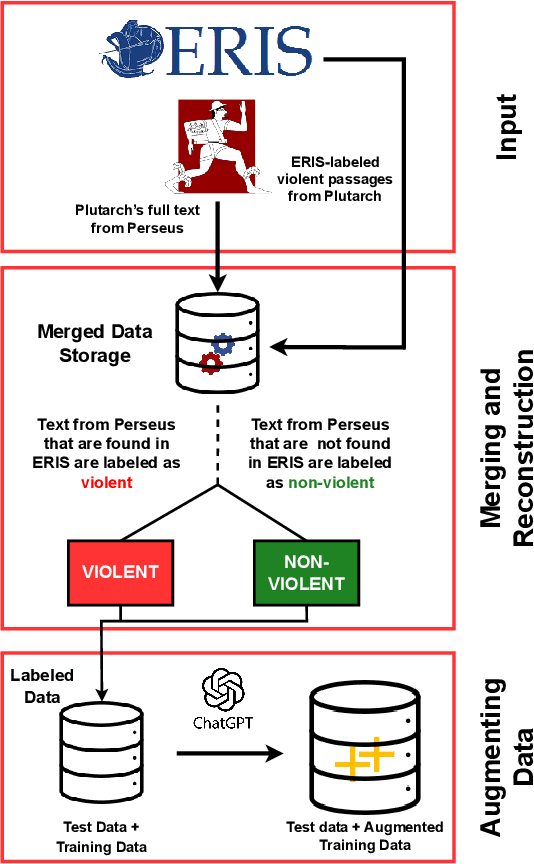

Violence descriptions in literature offer valuable insights for a wide range of research in the humanities. For historians, depictions of violence are of special interest for analyzing the societal dynamics surrounding large wars and individual conflicts of influential people. Harvesting data for violence research manually is laborious and time-consuming. This study is the first one to evaluate the effectiveness of large language models (LLMs) in identifying violence in ancient texts and categorizing it across multiple dimensions. Our experiments identify LLMs as a valuable tool to scale up the accurate analysis of historical texts and show the effect of fine-tuning and data augmentation, yielding an F1-score of up to 0.93 for violence detection and 0.86 for fine-grained violence categorization.
Detecting Conceptual Abstraction in LLMs
Apr 25, 2024We present a novel approach to detecting noun abstraction within a large language model (LLM). Starting from a psychologically motivated set of noun pairs in taxonomic relationships, we instantiate surface patterns indicating hypernymy and analyze the attention matrices produced by BERT. We compare the results to two sets of counterfactuals and show that we can detect hypernymy in the abstraction mechanism, which cannot solely be related to the distributional similarity of noun pairs. Our findings are a first step towards the explainability of conceptual abstraction in LLMs.