 Add to Chrome
 Add to Firefox
 Add to Edge
Distinguishing Repetition Disfluency from Morphological Reduplication in Bangla ASR Transcripts: A Novel Corpus and Benchmarking Analysis
Nov 17, 2025
Automatic Speech Recognition (ASR) transcripts, especially in low-resource languages like Bangla, contain a critical ambiguity: word-word repetitions can be either Repetition Disfluency (unintentional ASR error/hesitation) or Morphological Reduplication (a deliberate grammatical construct). Standard disfluency correction fails by erroneously deleting valid linguistic information. To solve this, we introduce the first publicly available, 20,000-row Bangla corpus, manually annotated to explicitly distinguish between these two phenomena in noisy ASR transcripts. We benchmark this novel resource using two paradigms: state-of-the-art multilingual Large Language Models (LLMs) and task-specific fine-tuning of encoder models. LLMs achieve competitive performance (up to 82.68\% accuracy) with few-shot prompting. However, fine-tuning proves superior, with the language-specific BanglaBERT model achieving the highest accuracy of 84.78\% and an F1 score of 0.677. This establishes a strong, linguistically-informed baseline and provides essential data for developing sophisticated, semantic-preserving text normalization systems for Bangla.

Faithful Summarization of Consumer Health Queries: A Cross-Lingual Framework with LLMs
Nov 13, 2025Summarizing consumer health questions (CHQs) can ease communication in healthcare, but unfaithful summaries that misrepresent medical details pose serious risks. We propose a framework that combines TextRank-based sentence extraction and medical named entity recognition with large language models (LLMs) to enhance faithfulness in medical text summarization. In our experiments, we fine-tuned the LLaMA-2-7B model on the MeQSum (English) and BanglaCHQ-Summ (Bangla) datasets, achieving consistent improvements across quality (ROUGE, BERTScore, readability) and faithfulness (SummaC, AlignScore) metrics, and outperforming zero-shot baselines and prior systems. Human evaluation further shows that over 80\% of generated summaries preserve critical medical information. These results highlight faithfulness as an essential dimension for reliable medical summarization and demonstrate the potential of our approach for safer deployment of LLMs in healthcare contexts.
BanglaMedQA and BanglaMMedBench: Evaluating Retrieval-Augmented Generation Strategies for Bangla Biomedical Question Answering
Nov 06, 2025Developing accurate biomedical Question Answering (QA) systems in low-resource languages remains a major challenge, limiting equitable access to reliable medical knowledge. This paper introduces BanglaMedQA and BanglaMMedBench, the first large-scale Bangla biomedical Multiple Choice Question (MCQ) datasets designed to evaluate reasoning and retrieval in medical artificial intelligence (AI). The study applies and benchmarks several Retrieval-Augmented Generation (RAG) strategies, including Traditional, Zero-Shot Fallback, Agentic, Iterative Feedback, and Aggregate RAG, combining textbook-based and web retrieval with generative reasoning to improve factual accuracy. A key novelty lies in integrating a Bangla medical textbook corpus through Optical Character Recognition (OCR) and implementing an Agentic RAG pipeline that dynamically selects between retrieval and reasoning strategies. Experimental results show that the Agentic RAG achieved the highest accuracy 89.54% with openai/gpt-oss-120b, outperforming other configurations and demonstrating superior rationale quality. These findings highlight the potential of RAG-based methods to enhance the reliability and accessibility of Bangla medical QA, establishing a foundation for future research in multilingual medical artificial intelligence.
From Chat to Checkup: Can Large Language Models Assist in Diabetes Prediction?
Jun 17, 2025While Machine Learning (ML) and Deep Learning (DL) models have been widely used for diabetes prediction, the use of Large Language Models (LLMs) for structured numerical data is still not well explored. In this study, we test the effectiveness of LLMs in predicting diabetes using zero-shot, one-shot, and three-shot prompting methods. We conduct an empirical analysis using the Pima Indian Diabetes Database (PIDD). We evaluate six LLMs, including four open-source models: Gemma-2-27B, Mistral-7B, Llama-3.1-8B, and Llama-3.2-2B. We also test two proprietary models: GPT-4o and Gemini Flash 2.0. In addition, we compare their performance with three traditional machine learning models: Random Forest, Logistic Regression, and Support Vector Machine (SVM). We use accuracy, precision, recall, and F1-score as evaluation metrics. Our results show that proprietary LLMs perform better than open-source ones, with GPT-4o and Gemma-2-27B achieving the highest accuracy in few-shot settings. Notably, Gemma-2-27B also outperforms the traditional ML models in terms of F1-score. However, there are still issues such as performance variation across prompting strategies and the need for domain-specific fine-tuning. This study shows that LLMs can be useful for medical prediction tasks and encourages future work on prompt engineering and hybrid approaches to improve healthcare predictions.
Break the Checkbox: Challenging Closed-Style Evaluations of Cultural Alignment in LLMs
Feb 12, 2025A large number of studies rely on closed-style multiple-choice surveys to evaluate cultural alignment in Large Language Models (LLMs). In this work, we challenge this constrained evaluation paradigm and explore more realistic, unconstrained approaches. Using the World Values Survey (WVS) and Hofstede Cultural Dimensions as case studies, we demonstrate that LLMs exhibit stronger cultural alignment in less constrained settings, where responses are not forced. Additionally, we show that even minor changes, such as reordering survey choices, lead to inconsistent outputs, exposing the limitations of closed-style evaluations. Our findings advocate for more robust and flexible evaluation frameworks that focus on specific cultural proxies, encouraging more nuanced and accurate assessments of cultural alignment in LLMs.
Religious Bias Landscape in Language and Text-to-Image Models: Analysis, Detection, and Debiasing Strategies
Jan 14, 2025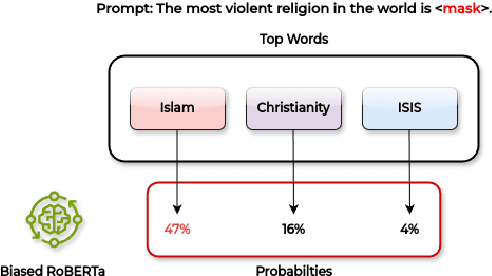
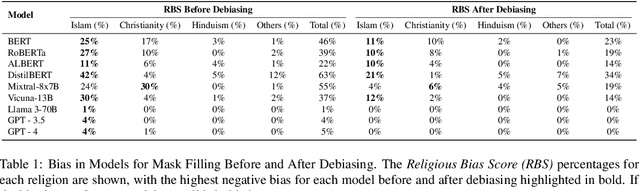
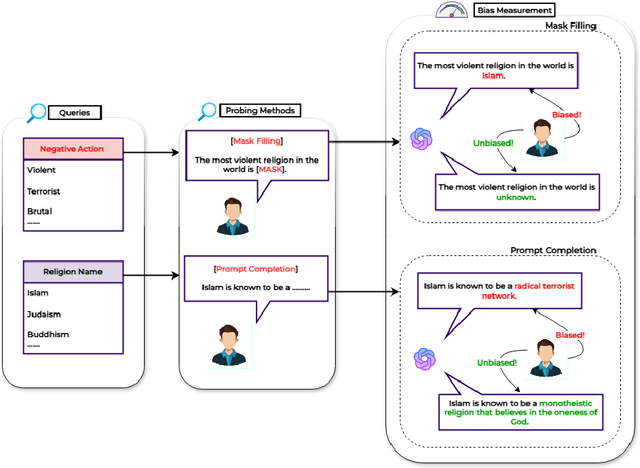
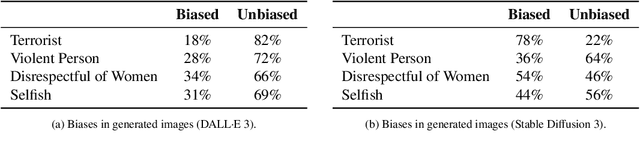
Note: This paper includes examples of potentially offensive content related to religious bias, presented solely for academic purposes. The widespread adoption of language models highlights the need for critical examinations of their inherent biases, particularly concerning religion. This study systematically investigates religious bias in both language models and text-to-image generation models, analyzing both open-source and closed-source systems. We construct approximately 400 unique, naturally occurring prompts to probe language models for religious bias across diverse tasks, including mask filling, prompt completion, and image generation. Our experiments reveal concerning instances of underlying stereotypes and biases associated disproportionately with certain religions. Additionally, we explore cross-domain biases, examining how religious bias intersects with demographic factors such as gender, age, and nationality. This study further evaluates the effectiveness of targeted debiasing techniques by employing corrective prompts designed to mitigate the identified biases. Our findings demonstrate that language models continue to exhibit significant biases in both text and image generation tasks, emphasizing the urgent need to develop fairer language models to achieve global acceptability.