 Add to Chrome
 Add to Firefox
 Add to Edge
Language Models as Artificial Learners: Investigating Crosslinguistic Influence
Jan 29, 2026
Despite the centrality of crosslinguistic influence (CLI) to bilingualism research, human studies often yield conflicting results due to inherent experimental variance. We address these inconsistencies by using language models (LMs) as controlled statistical learners to systematically simulate CLI and isolate its underlying drivers. Specifically, we study the effect of varying the L1 language dominance and the L2 language proficiency, which we manipulate by controlling the L2 age of exposure -- defined as the training step at which the L2 is introduced. Furthermore, we investigate the impact of pretraining on L1 languages with varying syntactic distance from the L2. Using cross-linguistic priming, we analyze how activating L1 structures impacts L2 processing. Our results align with evidence from psycholinguistic studies, confirming that language dominance and proficiency are strong predictors of CLI. We further find that while priming of grammatical structures is bidirectional, the priming of ungrammatical structures is sensitive to language dominance. Finally, we provide mechanistic evidence of CLI in LMs, demonstrating that the L1 is co-activated during L2 processing and directly influences the neural circuitry recruited for the L2. More broadly, our work demonstrates that LMs can serve as a computational framework to inform theories of human CLI.

A Representation Level Analysis of NMT Model Robustness to Grammatical Errors
May 27, 2025Understanding robustness is essential for building reliable NLP systems. Unfortunately, in the context of machine translation, previous work mainly focused on documenting robustness failures or improving robustness. In contrast, we study robustness from a model representation perspective by looking at internal model representations of ungrammatical inputs and how they evolve through model layers. For this purpose, we perform Grammatical Error Detection (GED) probing and representational similarity analysis. Our findings indicate that the encoder first detects the grammatical error, then corrects it by moving its representation toward the correct form. To understand what contributes to this process, we turn to the attention mechanism where we identify what we term Robustness Heads. We find that Robustness Heads attend to interpretable linguistic units when responding to grammatical errors, and that when we fine-tune models for robustness, they tend to rely more on Robustness Heads for updating the ungrammatical word representation.
Fixed and Adaptive Simultaneous Machine Translation Strategies Using Adapters
Jul 18, 2024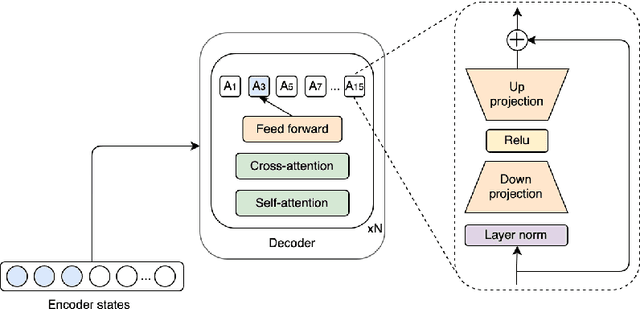
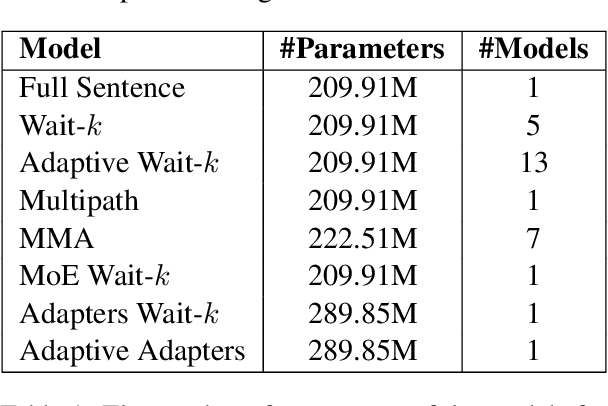
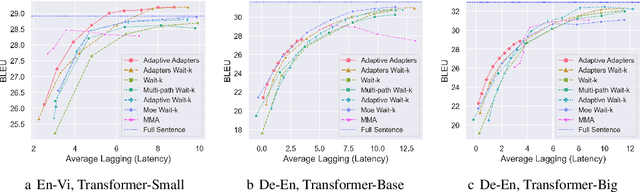
Simultaneous machine translation aims at solving the task of real-time translation by starting to translate before consuming the full input, which poses challenges in terms of balancing quality and latency of the translation. The wait-$k$ policy offers a solution by starting to translate after consuming $k$ words, where the choice of the number $k$ directly affects the latency and quality. In applications where we seek to keep the choice over latency and quality at inference, the wait-$k$ policy obliges us to train more than one model. In this paper, we address the challenge of building one model that can fulfil multiple latency levels and we achieve this by introducing lightweight adapter modules into the decoder. The adapters are trained to be specialized for different wait-$k$ values and compared to other techniques they offer more flexibility to allow for reaping the benefits of parameter sharing and minimizing interference. Additionally, we show that by combining with an adaptive strategy, we can further improve the results. Experiments on two language directions show that our method outperforms or competes with other strong baselines on most latency values.