 Add to Chrome
 Add to Firefox
 Add to Edge
MANAR: Memory-augmented Attention with Navigational Abstract Conceptual Representation
Mar 19, 2026
MANAR (Memory-augmented Attention with Navigational Abstract Conceptual Representation), contextualization layer generalizes standard multi-head attention (MHA) by instantiating the principles of Global Workspace Theory (GWT). While MHA enables unconstrained all-to-all communication, it lacks the functional bottleneck and global integration mechanisms hypothesized in cognitive models of consciousness. MANAR addresses this by implementing a central workspace through a trainable memory of abstract concepts and an Abstract Conceptual Representation (ACR). The architecture follows a two-stage logic that maps directly to GWT mechanics: (i) an integration phase, where retrieved memory concepts converge to form a collective "mental image" (the ACR) based on input stimuli; and (ii) a broadcasting phase, where this global state navigates and informs the contextualization of individual local tokens. We demonstrate that efficient linear-time scaling is a fundamental architectural byproduct of instantiating GWT functional bottleneck, as routing global information through a constant-sized ACR resolves the quadratic complexity inherent in standard attention. MANAR is a compatible re-parameterization of MHA with identical semantic roles for its projections, enabling knowledge transfer from pretrained transformers via weight-copy and thus overcoming the adoption barriers of structurally incompatible linear-time alternatives. MANAR enables non-convex contextualization, synthesizing representations that provably lie outside the convex hull of input tokens - a mathematical reflection of the creative synthesis described in GWT. Empirical evaluations confirm that MANAR matches or exceeds strong baselines across language (GLUE score of 85.1), vision (83.9% ImageNet-1K), and speech (2.7% WER on LibriSpeech), positioning it as an efficient and expressive alternative to quadratic attention.

CoViT: Real-time phylogenetics for the SARS-CoV-2 pandemic using Vision Transformers
Aug 09, 2022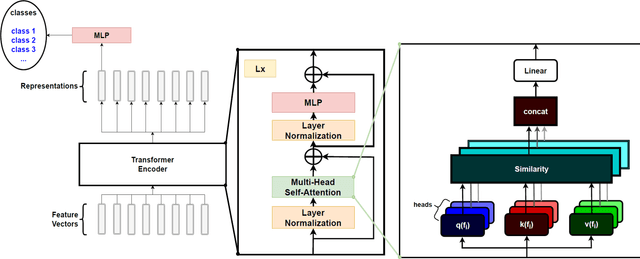

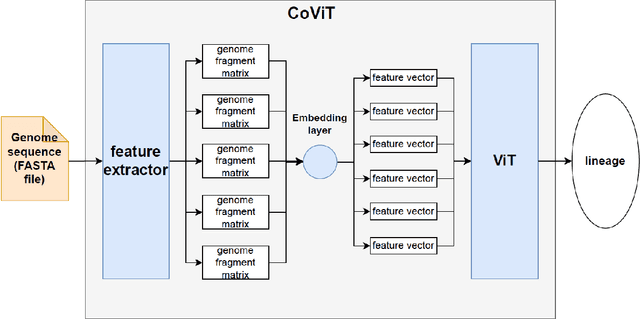
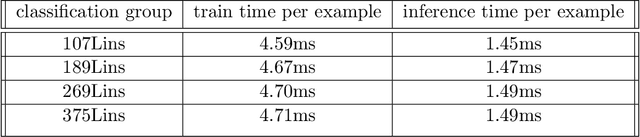
Real-time viral genome detection, taxonomic classification and phylogenetic analysis are critical for efficient tracking and control of viral pandemics such as Covid-19. However, the unprecedented and still growing amounts of viral genome data create a computational bottleneck, which effectively prevents the real-time pandemic tracking. We are attempting to alleviate this bottleneck by modifying and applying Vision Transformer, a recently developed neural network model for image recognition, to taxonomic classification and placement of viral genomes, such as SARS-CoV-2. Our solution, CoViT, places newly acquired samples onto the tree of SARS-CoV-2 lineages. One of the two potential placements returned by CoVit is the true one with the probability of 99.0%. The probability of the correct placement to be found among five potential placements generated by CoViT is 99.8%. The placement time is 1.45ms per individual genome running on NVIDIAs GeForce RTX 2080 Ti GPU. We make CoViT available to research community through GitHub: https://github.com/zuherJahshan/covit.