 Add to Chrome
 Add to Firefox
 Add to Edge
Synthetic Data Augmentation for Multi-Task Chinese Porcelain Classification: A Stable Diffusion Approach
Jan 21, 2026
The scarcity of training data presents a fundamental challenge in applying deep learning to archaeological artifact classification, particularly for the rare types of Chinese porcelain. This study investigates whether synthetic images generated through Stable Diffusion with Low-Rank Adaptation (LoRA) can effectively augment limited real datasets for multi-task CNN-based porcelain classification. Using MobileNetV3 with transfer learning, we conducted controlled experiments comparing models trained on pure real data against those trained on mixed real-synthetic datasets (95:5 and 90:10 ratios) across four classification tasks: dynasty, glaze, kiln and type identification. Results demonstrate task-specific benefits: type classification showed the most substantial improvement (5.5\% F1-macro increase with 90:10 ratio), while dynasty and kiln tasks exhibited modest gains (3-4\%), suggesting that synthetic augmentation effectiveness depends on the alignment between generated features and task-relevant visual signatures. Our work contributes practical guidelines for deploying generative AI in archaeological research, demonstrating both the potential and limitations of synthetic data when archaeological authenticity must be balanced with data diversity.

Multi-task Learning for Identification of Porcelain in Song and Yuan Dynasties
Mar 18, 2025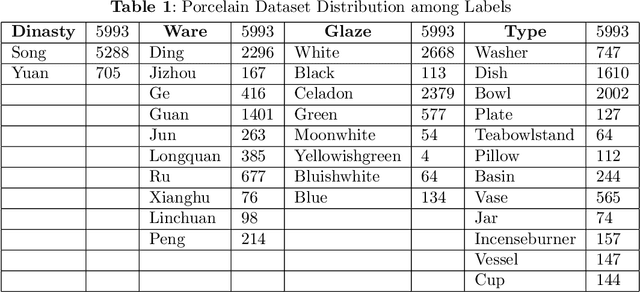
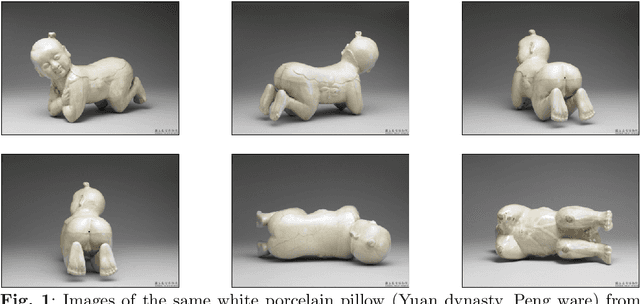
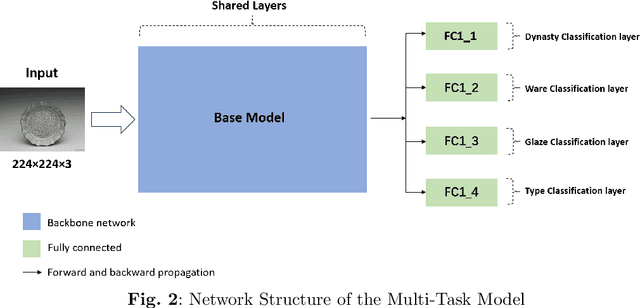
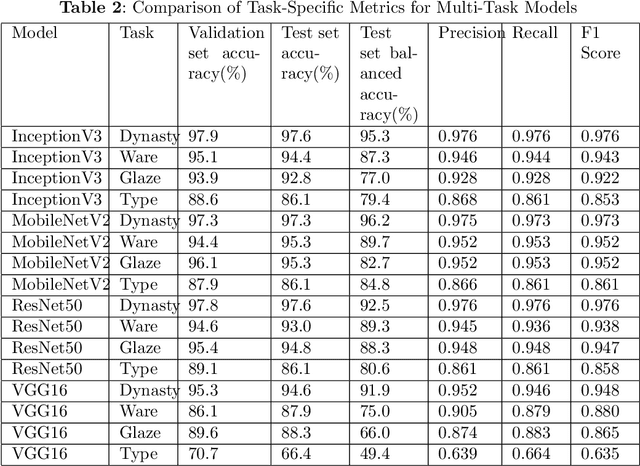
Chinese porcelain holds immense historical and cultural value, making its accurate classification essential for archaeological research and cultural heritage preservation. Traditional classification methods rely heavily on expert analysis, which is time-consuming, subjective, and difficult to scale. This paper explores the application of DL and transfer learning techniques to automate the classification of porcelain artifacts across four key attributes: dynasty, glaze, ware, and type. We evaluate four Convolutional Neural Networks (CNNs) - ResNet50, MobileNetV2, VGG16, and InceptionV3 - comparing their performance with and without pre-trained weights. Our results demonstrate that transfer learning significantly enhances classification accuracy, particularly for complex tasks like type classification, where models trained from scratch exhibit lower performance. MobileNetV2 and ResNet50 consistently achieve high accuracy and robustness across all tasks, while VGG16 struggles with more diverse classifications. We further discuss the impact of dataset limitations and propose future directions, including domain-specific pre-training, integration of attention mechanisms, explainable AI methods, and generalization to other cultural artifacts.