 Add to Chrome
 Add to Firefox
 Add to Edge
Study of Class-Incremental Radio Frequency Fingerprint Recognition Without Storing Exemplars
Jan 06, 2026
The rapid proliferation of wireless devices makes robust identity authentication essential. Radio Frequency Fingerprinting (RFF) exploits device-specific, hard-to-forge physical-layer impairments for identification, and is promising for IoT and unmanned systems. In practice, however, new devices continuously join deployed systems while per-class training data are limited. Conventional static training and naive replay of stored exemplars are impractical due to growing class cardinality, storage cost, and privacy concerns. We propose an exemplar-free class-incremental learning framework tailored to RFF recognition. Starting from a pretrained feature extractor, we freeze the backbone during incremental stages and train only a classifier together with lightweight Adapter modules that perform small task-specific feature adjustments. For each class we fit a diagonal Gaussian Mixture Model (GMM) to the backbone features and sample pseudo-features from these fitted distributions to rehearse past classes without storing raw signals. To improve robustness under few-shot conditions we introduce a time-domain random-masking augmentation and adopt a multi-teacher distillation scheme to compress stage-wise Adapters into a single inference Adapter, trading off accuracy and runtime efficiency. We evaluate the method on large, self-collected ADS-B datasets: the backbone is pretrained on 2,175 classes and incremental experiments are run on a disjoint set of 669 classes with multiple rounds and step sizes. Against several representative baselines, our approach consistently yields higher average accuracy and lower forgetting, while using substantially less storage and avoiding raw-data retention. The proposed pipeline is reproducible and provides a practical, low-storage solution for RFF deployment in resource- and privacy-constrained environments.

GlacierNet2: A Hybrid Multi-Model Learning Architecture for Alpine Glacier Mapping
Apr 06, 2022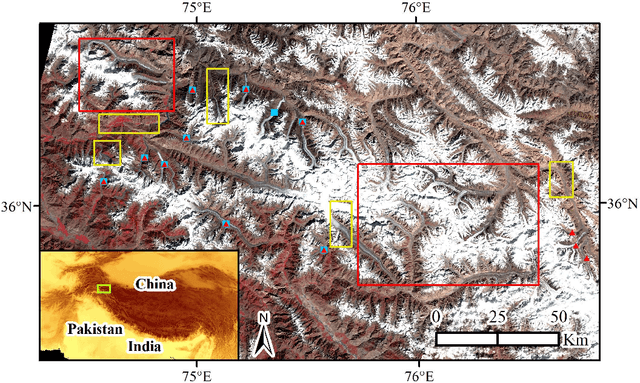
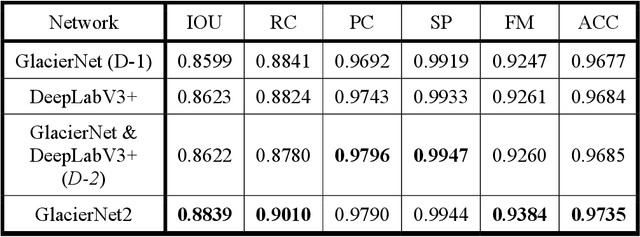
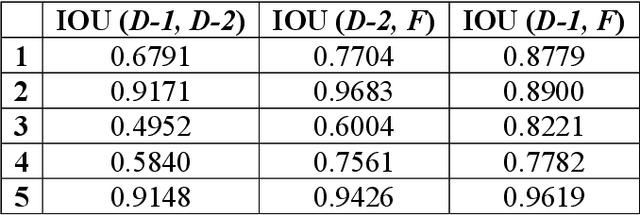
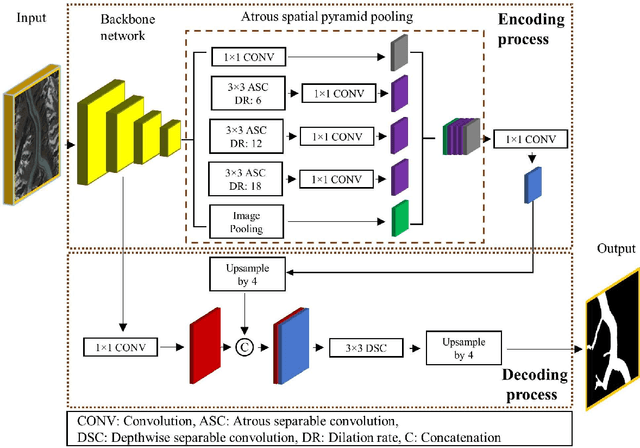
In recent decades, climate change has significantly affected glacier dynamics, resulting in mass loss and an increased risk of glacier-related hazards including supraglacial and proglacial lake development, as well as catastrophic outburst flooding. Rapidly changing conditions dictate the need for continuous and detailed observations and analysis of climate-glacier dynamics. Thematic and quantitative information regarding glacier geometry is fundamental for understanding climate forcing and the sensitivity of glaciers to climate change, however, accurately mapping debris-cover glaciers (DCGs) is notoriously difficult based upon the use of spectral information and conventional machine-learning techniques. The objective of this research is to improve upon an earlier proposed deep-learning-based approach, GlacierNet, which was developed to exploit a convolutional neural-network segmentation model to accurately outline regional DCG ablation zones. Specifically, we developed an enhanced GlacierNet2 architecture thatincorporates multiple models, automatic post-processing, and basin-level hydrological flow techniques to improve the mapping of DCGs such that it includes both the ablation and accumulation zones. Experimental evaluations demonstrate that GlacierNet2 improves the estimation of the ablation zone and allows a high level of intersection over union (IOU: 0.8839) score. The proposed architecture provides complete glacier (both accumulation and ablation zone) outlines at regional scales, with an overall IOU score of 0.8619. This is a crucial first step in automating complete glacier mapping that can be used for accurate glacier modeling or mass-balance analysis.