 Add to Chrome
 Add to Firefox
 Add to Edge
Prism: Towards Lowering User Cognitive Load in LLMs via Complex Intent Understanding
Jan 13, 2026
Large Language Models are rapidly emerging as web-native interfaces to social platforms. On the social web, users frequently have ambiguous and dynamic goals, making complex intent understanding-rather than single-turn execution-the cornerstone of effective human-LLM collaboration. Existing approaches attempt to clarify user intents through sequential or parallel questioning, yet they fall short of addressing the core challenge: modeling the logical dependencies among clarification questions. Inspired by the Cognitive Load Theory, we propose Prism, a novel framework for complex intent understanding that enables logically coherent and efficient intent clarification. Prism comprises four tailored modules: a complex intent decomposition module, which decomposes user intents into smaller, well-structured elements and identifies logical dependencies among them; a logical clarification generation module, which organizes clarification questions based on these dependencies to ensure coherent, low-friction interactions; an intent-aware reward module, which evaluates the quality of clarification trajectories via an intent-aware reward function and leverages Monte Carlo Sample to simulate user-LLM interactions for large-scale,high-quality training data generation; and a self-evolved intent tuning module, which iteratively refines the LLM's logical clarification capability through data-driven feedback and optimization. Prism consistently outperforms existing approaches across clarification interactions, intent execution, and cognitive load benchmarks. It achieves stateof-the-art logical consistency, reduces logical conflicts to 11.5%, increases user satisfaction by 14.4%, and decreases task completion time by 34.8%. All data and code are released.

PSSD: Making Large Language Models Self-denial via Human Psyche Structure
Feb 03, 2025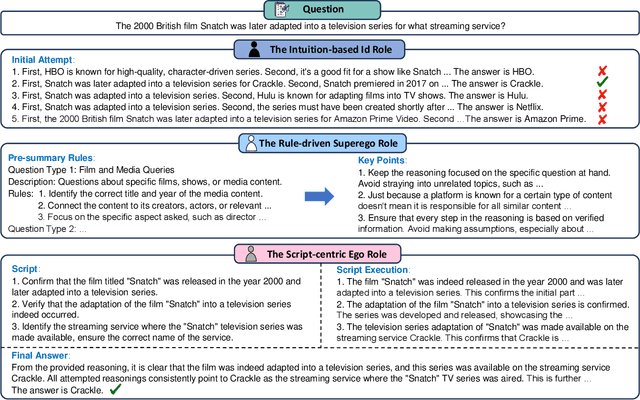
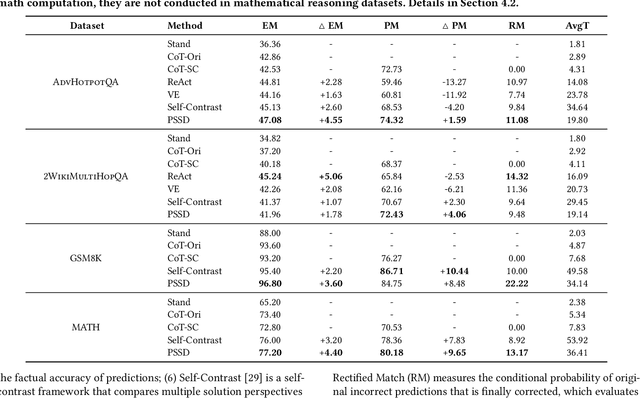
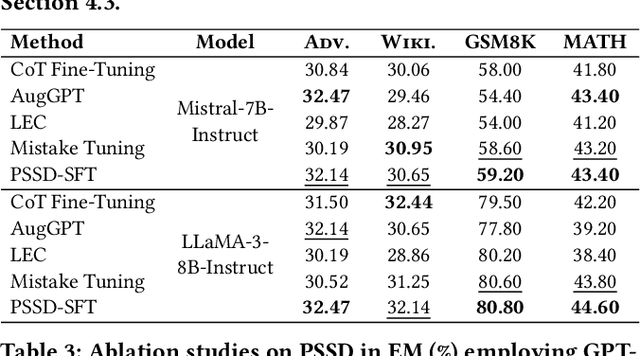
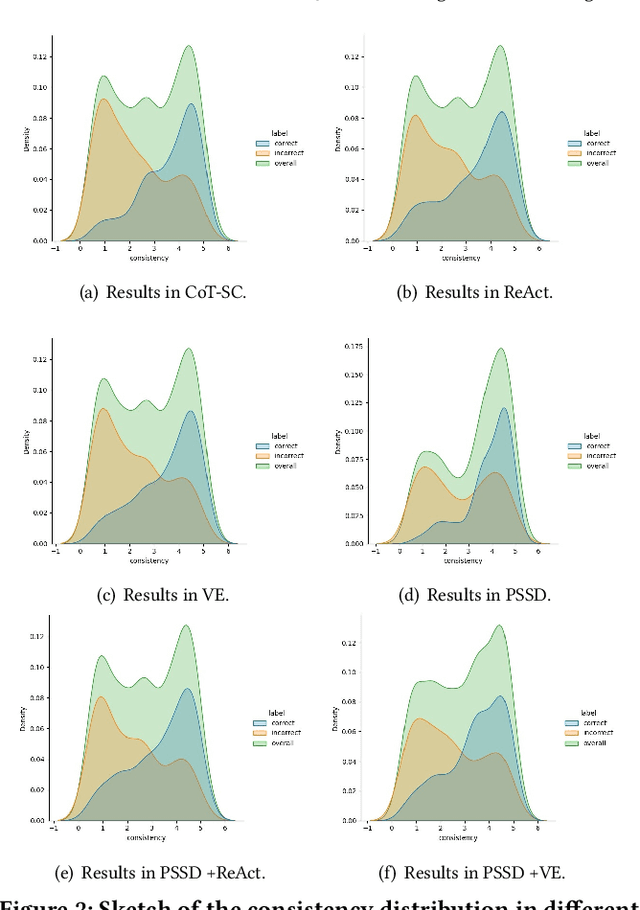
The enhance of accuracy in reasoning results of LLMs arouses the community's interests, wherein pioneering studies investigate post-hoc strategies to rectify potential mistakes. Despite extensive efforts, they are all stuck in a state of resource competition demanding significant time and computing expenses. The cause of the situation lies in the failure of identifying the fundamental feature of the solutions in this line, coined as the self-denial of LLMs. In other words, LLMs should confidently determine the potential existence of mistakes and carefully execute the targeted correction. As the whole procedure conducts within LLMs, supporting and persuasive references are hard to acquire, while the absence of specific steps towards refining hidden mistakes persists even when errors are acknowledged. In response to the challenges, we present PSSD, which refers to and implements the human psyche structure such that three distinct and interconnected roles contribute to human reasoning. Specifically, PSSD leverages the recent multi-agent paradigm, and is further enhanced with three innovatively conceived roles: (1) the intuition-based id role that provides initial attempts based on benign LLMs; (2) the rule-driven superego role that summarizes rules to regulate the above attempts, and returns specific key points as guidance; and (3) the script-centric ego role that absorbs all procedural information to generate executable script for the final answer prediction. Extensive experiments demonstrate that the proposed design not only better enhance reasoning capabilities, but also seamlessly integrate with current models, leading to superior performance.