 Add to Chrome
 Add to Firefox
 Add to Edge
Merging Methods for Multilingual Knowledge Editing for Large Language Models: An Empirical Odyssey
May 13, 2026
Multilingual knowledge editing (MKE) remains challenging because language-specific edits interfere with one another, even when locate-then-edit methods work well in monolingual settings. This paper focuses on three issues: the effectiveness of vector merging methods for MKE, the extent to which Task Singular Vectors for Merging (TSVM) can reduce multilingual interference, and the influence of the weight scaling factor and rank compression ratio on performance. We evaluate six merging variants with two popular backbone large language models, two base knowledge editing methods, and 12 languages on the MzsRE benchmark under a large-scale batch-editing setting. Our results show that vector summation with shared covariance is the most reliable overall strategy, whereas simple summation without shared covariance performs poorly. TSVM improves performance in some settings, but its ability to mitigate multilingual interference is limited. We also find that performance is sensitive to both weight scale and rank ratio, with larger-than-default scaling and relatively low rank often yielding better results. These findings clarify the practical strengths and limits of current vector merging methods for MKE and provide guidance for future multilingual knowledge editing research.

Maestro-EVC: Controllable Emotional Voice Conversion Guided by References and Explicit Prosody
Aug 09, 2025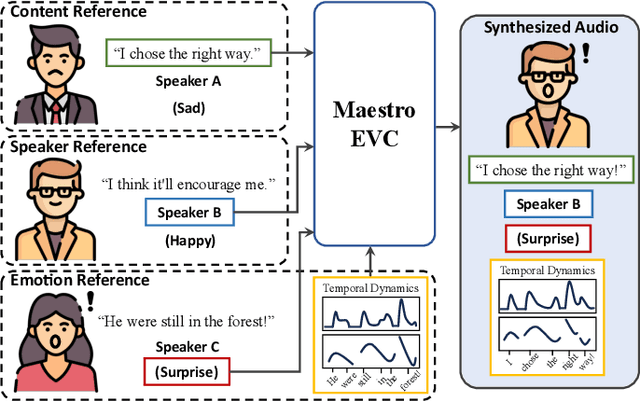
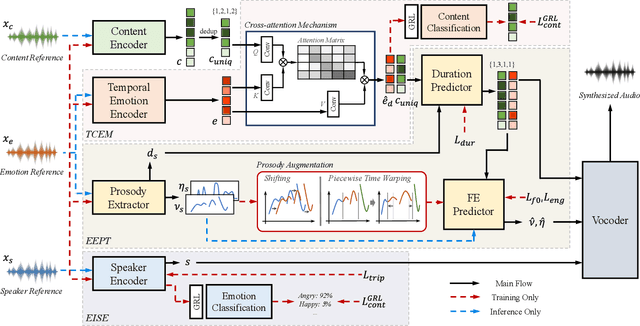
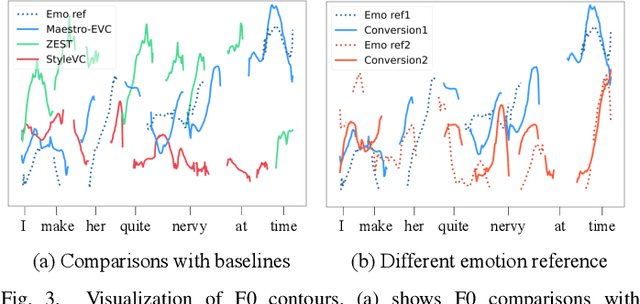
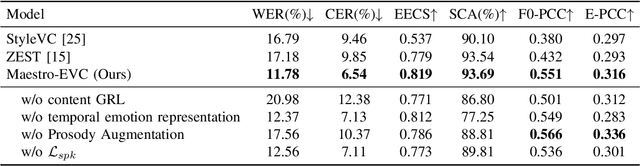
Emotional voice conversion (EVC) aims to modify the emotional style of speech while preserving its linguistic content. In practical EVC, controllability, the ability to independently control speaker identity and emotional style using distinct references, is crucial. However, existing methods often struggle to fully disentangle these attributes and lack the ability to model fine-grained emotional expressions such as temporal dynamics. We propose Maestro-EVC, a controllable EVC framework that enables independent control of content, speaker identity, and emotion by effectively disentangling each attribute from separate references. We further introduce a temporal emotion representation and an explicit prosody modeling with prosody augmentation to robustly capture and transfer the temporal dynamics of the target emotion, even under prosody-mismatched conditions. Experimental results confirm that Maestro-EVC achieves high-quality, controllable, and emotionally expressive speech synthesis.
SKQVC: One-Shot Voice Conversion by K-Means Quantization with Self-Supervised Speech Representations
Nov 25, 2024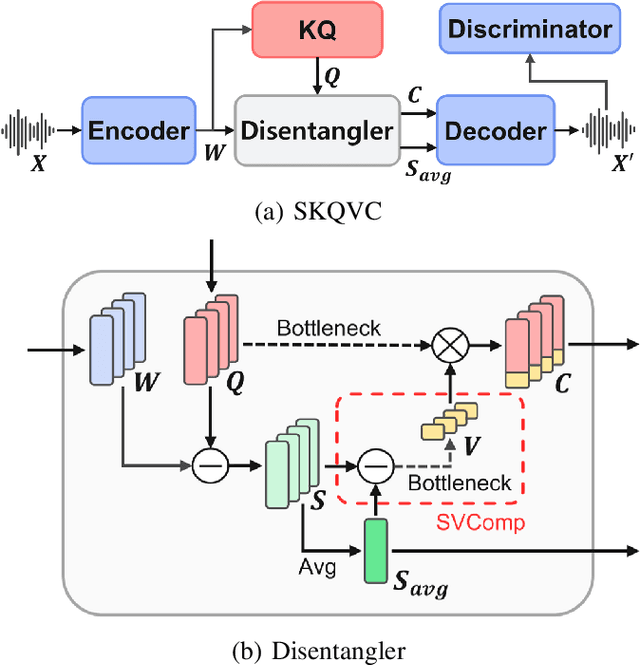
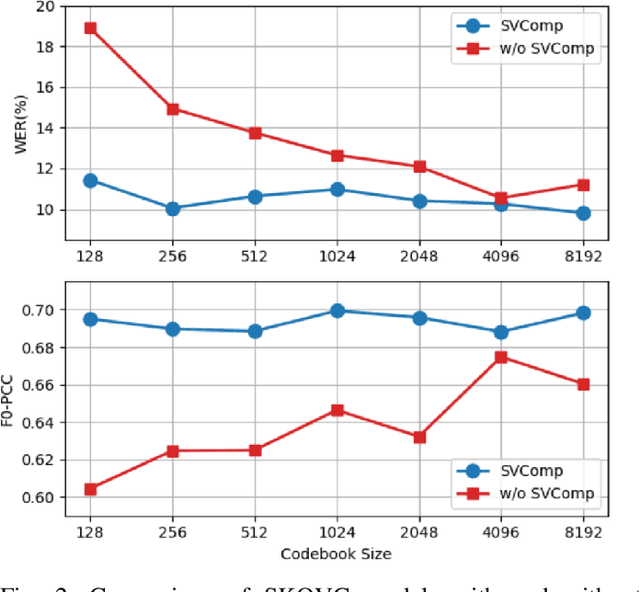
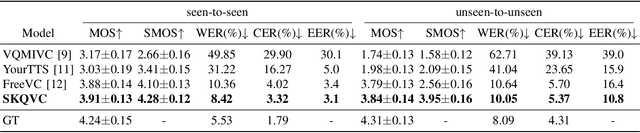
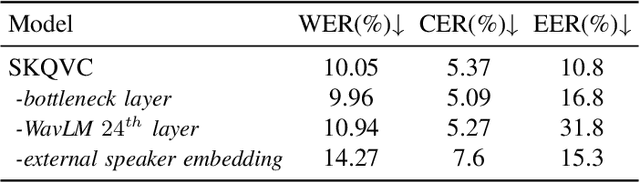
One-shot voice conversion (VC) is a method that enables the transformation between any two speakers using only a single target speaker utterance. Existing methods often rely on complex architectures and pre-trained speaker verification (SV) models to improve the fidelity of converted speech. Recent works utilizing K-means quantization (KQ) with self-supervised learning (SSL) features have proven capable of capturing content information from speech. However, they often struggle to preserve speaking variation, such as prosodic detail and phonetic variation, particularly with smaller codebooks. In this work, we propose a simple yet effective one-shot VC model that utilizes the characteristics of SSL features and speech attributes. Our approach addresses the issue of losing speaking variation, enabling high-fidelity voice conversion trained with only reconstruction losses, without requiring external speaker embeddings. We demonstrate the performance of our model across 6 evaluation metrics, with results highlighting the benefits of the speaking variation compensation method.
AutoCycle-VC: Towards Bottleneck-Independent Zero-Shot Cross-Lingual Voice Conversion
Oct 10, 2023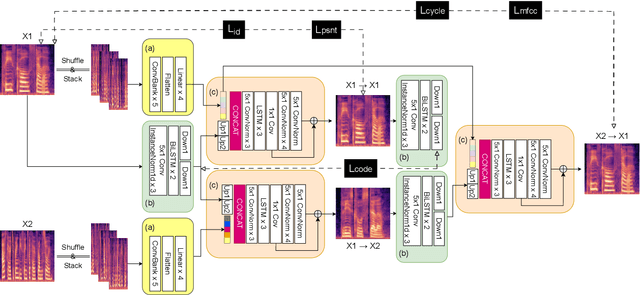
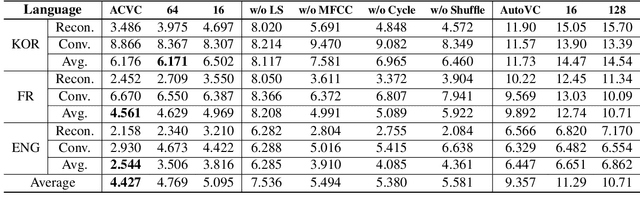
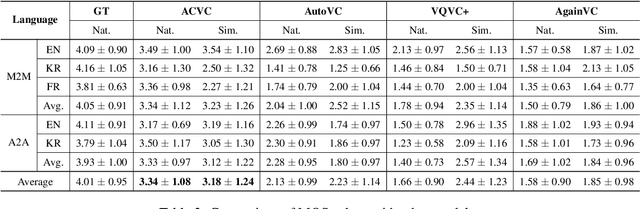

This paper proposes a simple and robust zero-shot voice conversion system with a cycle structure and mel-spectrogram pre-processing. Previous works suffer from information loss and poor synthesis quality due to their reliance on a carefully designed bottleneck structure. Moreover, models relying solely on self-reconstruction loss struggled with reproducing different speakers' voices. To address these issues, we suggested a cycle-consistency loss that considers conversion back and forth between target and source speakers. Additionally, stacked random-shuffled mel-spectrograms and a label smoothing method are utilized during speaker encoder training to extract a time-independent global speaker representation from speech, which is the key to a zero-shot conversion. Our model outperforms existing state-of-the-art results in both subjective and objective evaluations. Furthermore, it facilitates cross-lingual voice conversions and enhances the quality of synthesized speech.