 Add to Chrome
 Add to Firefox
 Add to Edge
CorGi: Contribution-Guided Block-Wise Interval Caching for Training-Free Acceleration of Diffusion Transformers
Dec 30, 2025
Diffusion transformer (DiT) achieves remarkable performance in visual generation, but its iterative denoising process combined with larger capacity leads to a high inference cost. Recent works have demonstrated that the iterative denoising process of DiT models involves substantial redundant computation across steps. To effectively reduce the redundant computation in DiT, we propose CorGi (Contribution-Guided Block-Wise Interval Caching), training-free DiT inference acceleration framework that selectively reuses the outputs of transformer blocks in DiT across denoising steps. CorGi caches low-contribution blocks and reuses them in later steps within each interval to reduce redundant computation while preserving generation quality. For text-to-image tasks, we further propose CorGi+, which leverages per-block cross-attention maps to identify salient tokens and applies partial attention updates to protect important object details. Evaluation on the state-of-the-art DiT models demonstrates that CorGi and CorGi+ achieve up to 2.0x speedup on average, while preserving high generation quality.

Not All Adapters Matter: Selective Adapter Freezing for Memory-Efficient Fine-Tuning of Language Models
Nov 26, 2024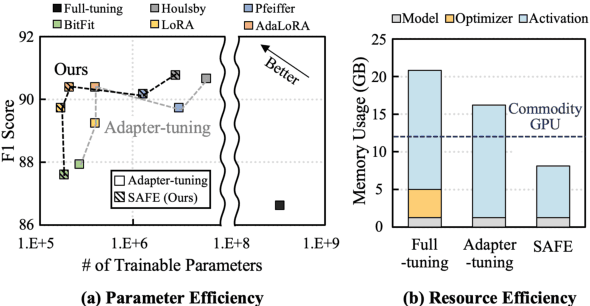

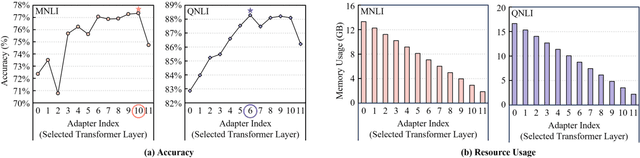
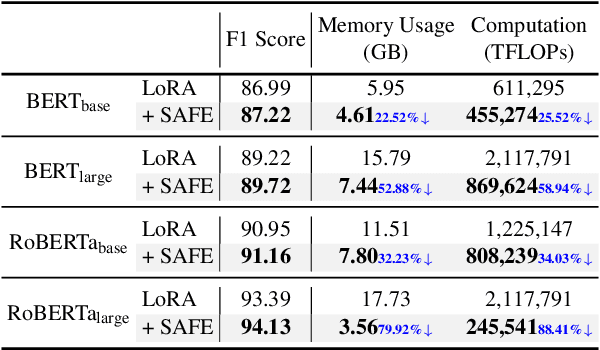
Transformer-based large-scale pre-trained models achieve great success, and fine-tuning, which tunes a pre-trained model on a task-specific dataset, is the standard practice to utilize these models for downstream tasks. Recent work has developed adapter-tuning, but these approaches either still require a relatively high resource usage. Through our investigation, we show that each adapter in adapter-tuning does not have the same impact on task performance and resource usage. Based on our findings, we propose SAFE, which gradually freezes less-important adapters that do not contribute to adaptation during the early training steps. In our experiments, SAFE reduces memory usage, computation amount, and training time by 42.85\%, 34.59\%, and 11.82\%, respectively, while achieving comparable or better performance compared to the baseline. We also demonstrate that SAFE induces regularization effect, thereby smoothing the loss landscape.