 Add to Chrome
 Add to Firefox
 Add to Edge
RelightAnyone: A Generalized Relightable 3D Gaussian Head Model
Jan 06, 2026
3D Gaussian Splatting (3DGS) has become a standard approach to reconstruct and render photorealistic 3D head avatars. A major challenge is to relight the avatars to match any scene illumination. For high quality relighting, existing methods require subjects to be captured under complex time-multiplexed illumination, such as one-light-at-a-time (OLAT). We propose a new generalized relightable 3D Gaussian head model that can relight any subject observed in a single- or multi-view images without requiring OLAT data for that subject. Our core idea is to learn a mapping from flat-lit 3DGS avatars to corresponding relightable Gaussian parameters for that avatar. Our model consists of two stages: a first stage that models flat-lit 3DGS avatars without OLAT lighting, and a second stage that learns the mapping to physically-based reflectance parameters for high-quality relighting. This two-stage design allows us to train the first stage across diverse existing multi-view datasets without OLAT lighting ensuring cross-subject generalization, where we learn a dataset-specific lighting code for self-supervised lighting alignment. Subsequently, the second stage can be trained on a significantly smaller dataset of subjects captured under OLAT illumination. Together, this allows our method to generalize well and relight any subject from the first stage as if we had captured them under OLAT lighting. Furthermore, we can fit our model to unseen subjects from as little as a single image, allowing several applications in novel view synthesis and relighting for digital avatars.

Monocular Facial Appearance Capture in the Wild
Dec 17, 2024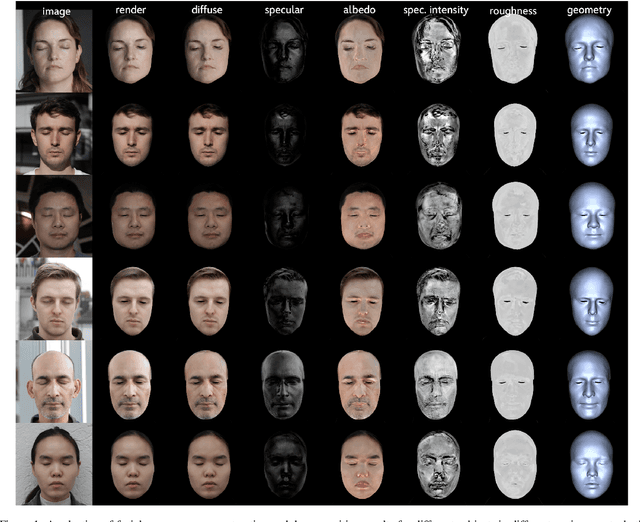
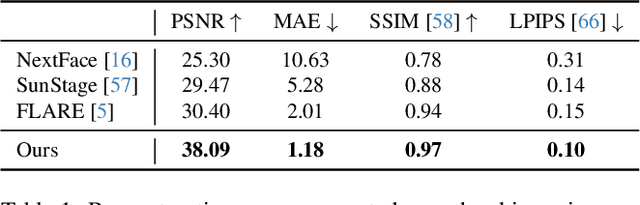
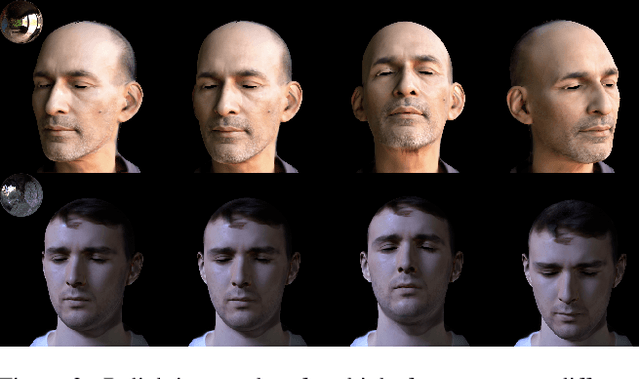
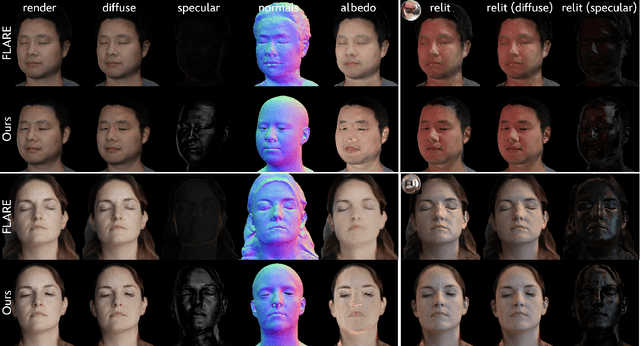
We present a new method for reconstructing the appearance properties of human faces from a lightweight capture procedure in an unconstrained environment. Our method recovers the surface geometry, diffuse albedo, specular intensity and specular roughness from a monocular video containing a simple head rotation in-the-wild. Notably, we make no simplifying assumptions on the environment lighting, and we explicitly take visibility and occlusions into account. As a result, our method can produce facial appearance maps that approach the fidelity of studio-based multi-view captures, but with a far easier and cheaper procedure.
Artist-Friendly Relightable and Animatable Neural Heads
Dec 06, 2023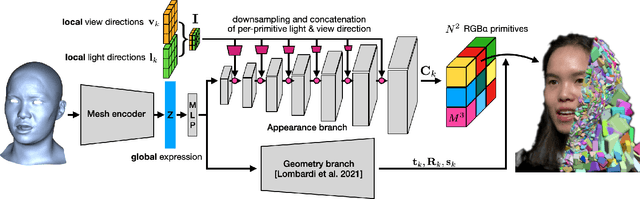
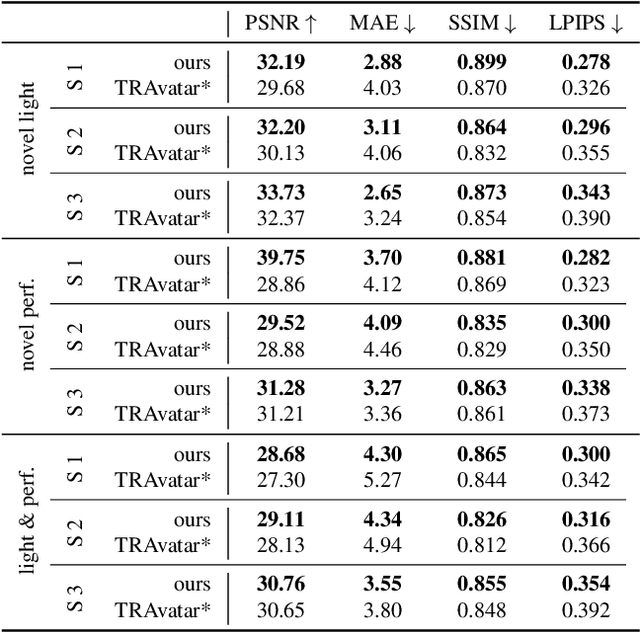
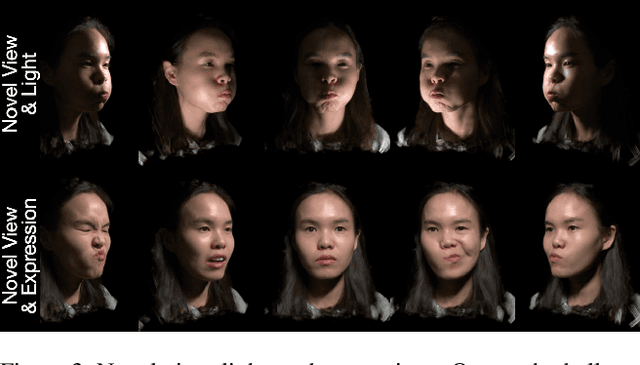
An increasingly common approach for creating photo-realistic digital avatars is through the use of volumetric neural fields. The original neural radiance field (NeRF) allowed for impressive novel view synthesis of static heads when trained on a set of multi-view images, and follow up methods showed that these neural representations can be extended to dynamic avatars. Recently, new variants also surpassed the usual drawback of baked-in illumination in neural representations, showing that static neural avatars can be relit in any environment. In this work we simultaneously tackle both the motion and illumination problem, proposing a new method for relightable and animatable neural heads. Our method builds on a proven dynamic avatar approach based on a mixture of volumetric primitives, combined with a recently-proposed lightweight hardware setup for relightable neural fields, and includes a novel architecture that allows relighting dynamic neural avatars performing unseen expressions in any environment, even with nearfield illumination and viewpoints.