 Add to Chrome
 Add to Firefox
 Add to Edge
Enhancing Knowledge Tracing through Leakage-Free and Recency-Aware Embeddings
Aug 23, 2025
Knowledge Tracing (KT) aims to predict a student's future performance based on their sequence of interactions with learning content. Many KT models rely on knowledge concepts (KCs), which represent the skills required for each item. However, some of these models are vulnerable to label leakage, in which input data inadvertently reveal the correct answer, particularly in datasets with multiple KCs per question. We propose a straightforward yet effective solution to prevent label leakage by masking ground-truth labels during input embedding construction in cases susceptible to leakage. To accomplish this, we introduce a dedicated MASK label, inspired by masked language modeling (e.g., BERT), to replace ground-truth labels. In addition, we introduce Recency Encoding, which encodes the step-wise distance between the current item and its most recent previous occurrence. This distance is important for modeling learning dynamics such as forgetting, which is a fundamental aspect of human learning, yet it is often overlooked in existing models. Recency Encoding demonstrates improved performance over traditional positional encodings on multiple KT benchmarks. We show that incorporating our embeddings into KT models like DKT, DKT+, AKT, and SAKT consistently improves prediction accuracy across multiple benchmarks. The approach is both efficient and widely applicable.

KTbench: A Novel Data Leakage-Free Framework for Knowledge Tracing
Apr 11, 2024
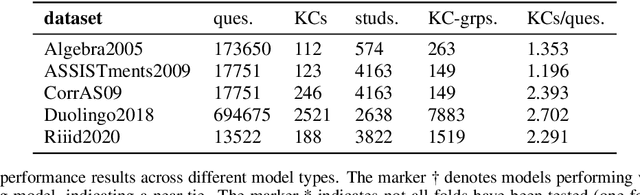
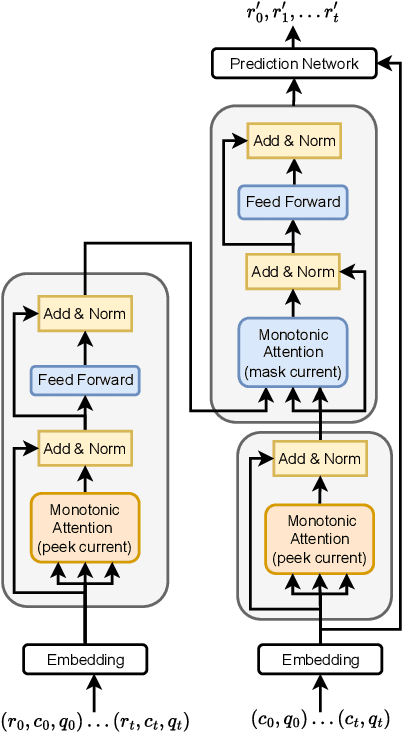
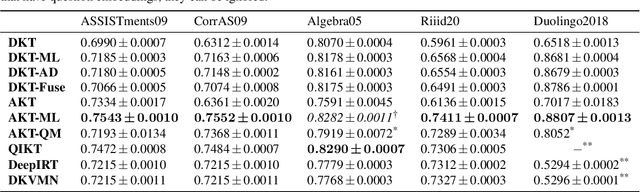
Knowledge Tracing (KT) is concerned with predicting students' future performance on learning items in intelligent tutoring systems. Learning items are tagged with skill labels called knowledge concepts (KCs). Many KT models expand the sequence of item-student interactions into KC-student interactions by replacing learning items with their constituting KCs. This often results in a longer sequence length. This approach addresses the issue of sparse item-student interactions and minimises model parameters. However, two problems have been identified with such models. The first problem is the model's ability to learn correlations between KCs belonging to the same item, which can result in the leakage of ground truth labels and hinder performance. This problem can lead to a significant decrease in performance on datasets with a higher number of KCs per item. The second problem is that the available benchmark implementations ignore accounting for changes in sequence length when expanding KCs, leading to different models being tested with varying sequence lengths but still compared against the same benchmark. To address these problems, we introduce a general masking framework that mitigates the first problem and enhances the performance of such KT models while preserving the original model architecture without significant alterations. Additionally, we introduce KTbench, an open-source benchmark library designed to ensure the reproducibility of this work while mitigating the second problem.