 Add to Chrome
 Add to Firefox
 Add to Edge
Advancing Wood Identification in the Philippines: Utilizing the Xylorix Platform for Efficient AI Model Development and Deployment for Five Key Species
Jun 09, 2026
Illegal logging and timber trade continue to pose significant challenges in the Philippines, where accurate wood species identification is essential for enforcement but limited by the need for specialised equipment and expertise. This study aims to evaluate whether AI models for macroscopic wood identification can be developed and deployed by wood scientists without programming expertise using the Xylorix platform, focusing on five Philippine hardwood species: Mangium (Acacia mangium Willd.), Rain Tree [Samanea saman (Jacq.) Merr.], Banuyo (Wallaceodendron celebicum Koord.), Tindalo [Afzelia rhomboidea (Blanco) Vidal], and Ipil [Intsia bijuga (Colebr.) O. Kuntze]. Binary classifiers were trained on 10,663 verified cross-section images from 260 specimens and evaluated using specimen-level mean scoring to mirror operational field conditions. Area Under the ROC Curve (AUC) values ranged from 0.969 (Ipil) to 1.000 (Mangium), and Average Precision (AP) values ranged from 0.589 (Samanea) to 1.000 (Mangium). Four of five species achieved AA grade (AUC and AP both \geq 0.90); Rain Tree received AE (AUC \geq 0.90, AP < 0.60) due to AP compression from its small positive test set (3 specimens). All five classifiers rank their target specimens above non-target specimens with near-perfect fidelity. Specimen-level error analysis revealed 9 false negatives from Ipil, primarily stemming from localized image artifacts and 3 false positives for Rain Tree and 1 false positive for Tindalo caused by shared tribal-level anatomical traits. These findings demonstrate that Xylorix non-programmers can leverage the Xylorix platform to construct operationally reliable wood identification models suitable for field deployment at supply chain checkpoints.

Rapid and Robust Automated Macroscopic Wood Identification System using Smartphone with Macro-lens
Sep 24, 2017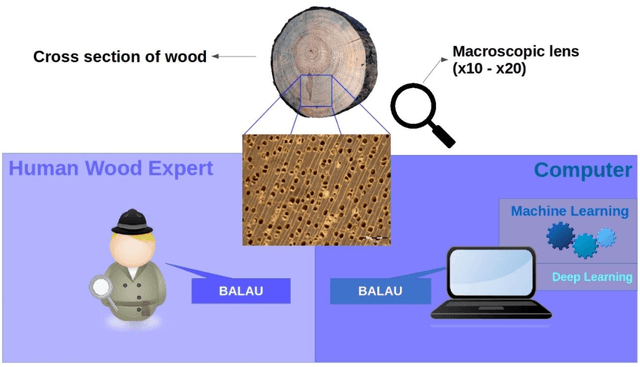

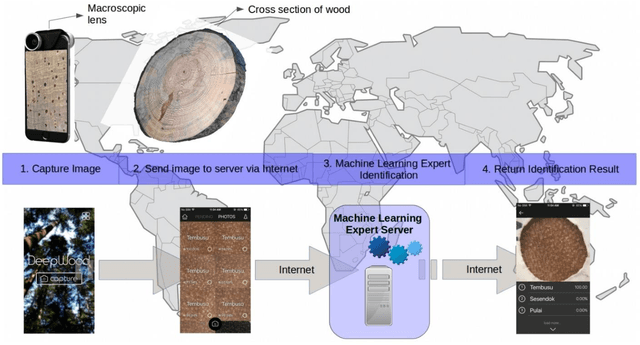
Wood Identification has never been more important to serve the purpose of global forest species protection and timber regulation. Macroscopic level wood identification practiced by wood anatomists can identify wood up to genus level. This is sufficient to serve as a frontline identification to fight against illegal wood logging and timber trade for law enforcement authority. However, frontline enforcement official may lack of the accuracy and confidence of a well trained wood anatomist. Hence, computer assisted method such as machine vision methods are developed to do rapid field identification for law enforcement official. In this paper, we proposed a rapid and robust macroscopic wood identification system using machine vision method with off-the-shelf smartphone and retrofitted macro-lens. Our system is cost effective, easily accessible, fast and scalable at the same time provides human-level accuracy on identification. Camera-enabled smartphone with Internet connectivity coupled with a macro-lens provides a simple and effective digital acquisition of macroscopic wood images which are essential for macroscopic wood identification. The images are immediately streamed to a cloud server via Internet connection for identification which are done within seconds.