 Add to Chrome
 Add to Firefox
 Add to Edge
Neural network methods for two-dimensional finite-source reflector design
Apr 02, 2026
We address the inverse problem of designing two-dimensional reflectors that transform light from a finite, extended source into a prescribed far-field distribution. We propose a neural network parameterization of the reflector height and develop two differentiable objective functions: (i) a direct change-of-variables loss that pushes the source distribution through the learned inverse mapping, and (ii) a mesh-based loss that maps a target-space grid back to the source, integrates over intersections, and remains continuous even when the source is discontinuous. Gradients are obtained via automatic differentiation and optimized with a robust quasi-Newton method. As a comparison, we formulate a deconvolution baseline built on a simplified finite-source approximation: a 1D monotone mapping is recovered from flux balance, yielding an ordinary differential equation solved in integrating-factor form; this solver is embedded in a modified Van Cittert iteration with nonnegativity clipping and a ray-traced forward operator. Across four benchmarks -- continuous and discontinuous sources, and with/without minimum-height constraints -- we evaluate accuracy by ray-traced normalized mean absolute error (NMAE). Our neural network approach converges faster and achieves consistently lower NMAE than the deconvolution method, and handles height constraints naturally. We discuss how the method may be extended to rotationally symmetric and full three-dimensional settings via iterative correction schemes.

A neural network approach for solving the Monge-Ampère equation with transport boundary condition
Oct 25, 2024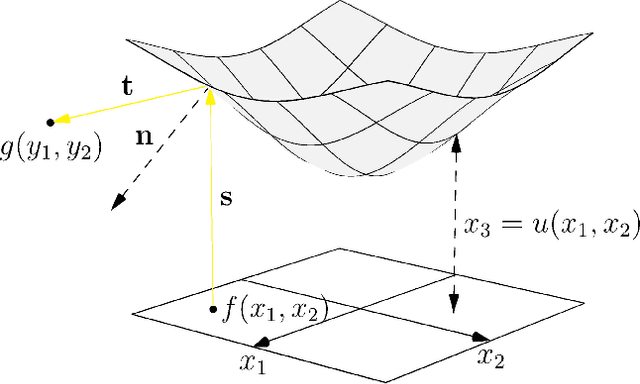
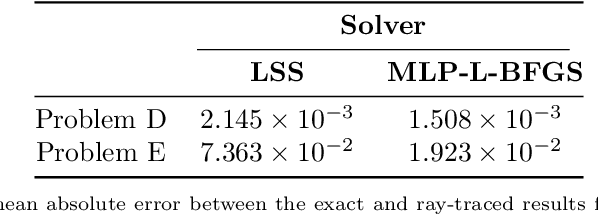
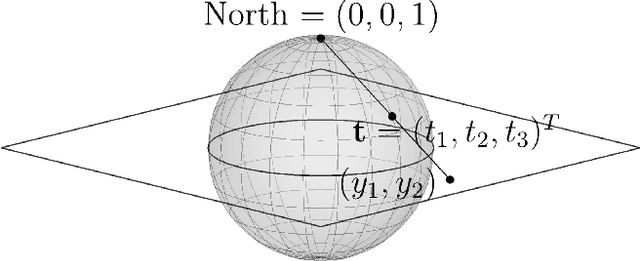
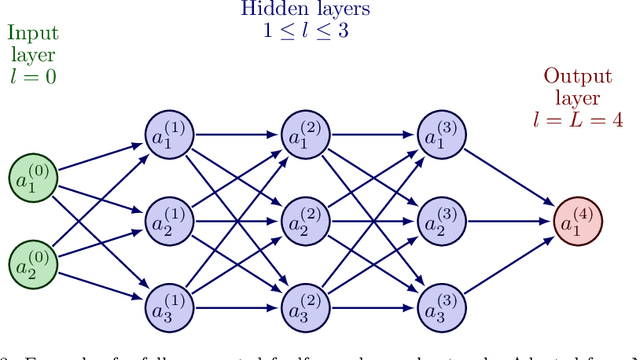
This paper introduces a novel neural network-based approach to solving the Monge-Amp\`ere equation with the transport boundary condition, specifically targeted towards optical design applications. We leverage multilayer perceptron networks to learn approximate solutions by minimizing a loss function that encompasses the equation's residual, boundary conditions, and convexity constraints. Our main results demonstrate the efficacy of this method, optimized using L-BFGS, through a series of test cases encompassing symmetric and asymmetric circle-to-circle, square-to-circle, and circle-to-flower reflector mapping problems. Comparative analysis with a conventional least-squares finite-difference solver reveals the competitive, and often superior, performance of our neural network approach on the test cases examined here. A comprehensive hyperparameter study further illuminates the impact of factors such as sampling density, network architecture, and optimization algorithm. While promising, further investigation is needed to verify the method's robustness for more complicated problems and to ensure consistent convergence. Nonetheless, the simplicity and adaptability of this neural network-based approach position it as a compelling alternative to specialized partial differential equation solvers.